

Listen to this podcast in the app for free: Download for free in the App Store
radio.net
Sleep timer
Save favorites
214 episodes
We Automated Support and Lost Our Escalation Instinct
07/24/2026 | 14 mins."Did someone drop the ball?" is the wrong question when an escalation slips through the cracks. The right question: "Did we design a system where the ball could be seen at all?" @StacieBairdHX on how automating the routine tickets erodes the instinct to spot the non-routine ones — HX Podcast Episode 2 out now.
Key data points:
Klarna cut "hundreds" of support roles for AI, saw quality decline, began rehiring1 CEO admitted "prioritizing cost over experience"1
Salesforce cut support from ~9,000 to ~5,0002 CEO said AI handles about half of cases, meaning humans still do the other half2
Gartner projects 50% of companies that cut support for AI will rehire by 20273
Visier analysis of 2.4M workers: highest boomerang rate since 2018 (Visier, 2026)4
Footnotes
Orgvue Survey, 2025 ↩ ↩2 ↩3 ↩4
Forrester Research, Predictions 2026: The Future of Work ↩ ↩2 ↩3
Robert Half Survey, 2026 (via CNBC) ↩ ↩2
Careerminds Survey of 600 HR Professionals, 2026 ↩ ↩2
Harvard Business Review, Executive Survey, 2025 ↩
Challenger, Gray & Christmas, Inc. AI-Attributed Layoffs, 2026 ↩
Stacie
For more episodes, visit StacieBaird.com.The Layoff That Looked Right on Paper
07/17/2026 | 13 mins.When "the AI can do 80% of the work" turns into "why are decisions taking longer six months later," you're caught in The AI Headcount Trap. @StacieBairdHX unpacks the 55% regret rate, the 101,000 layoffs, and the question every CEO needs to be asking on HX Podcast Episode 1.
Key data points:
39% of business leaders made employees redundant due to AI (Orgvue, 2025)1 Of that group, 55% later said the decision was wrong (Orgvue, 2025)1
55% of employers regret AI-driven layoffs (Forrester Research, 2026)2
32% of US hiring managers cut roles for AI, then rehired for the same position (Robert Half, 2026)3
52% of companies that cut for AI were rehiring within 6 months (Careerminds, 2026)4
600+ executives admitted most AI-driven layoffs were for future capability, not current performance (Harvard Business Review, 2025)5
101,743 layoffs attributed to AI, Jan-Jun 2026 (Challenger, Gray & Christmas, 2026)6
Footnotes
Orgvue Survey, 2025 ↩ ↩2 ↩3 ↩4
Forrester Research, Predictions 2026: The Future of Work ↩ ↩2 ↩3
Robert Half Survey, 2026 (via CNBC) ↩ ↩2
Careerminds Survey of 600 HR Professionals, 2026 ↩ ↩2
Harvard Business Review, Executive Survey, 2025 ↩
Challenger, Gray & Christmas, Inc. AI-Attributed Layoffs, 2026 ↩
Stacie
For more episodes, visit StacieBaird.com.The CHRO Paradox — Part 3: Building the Bench Together
07/10/2026 | 20 mins.The best leadership benches aren't bought — they're built, and they're built together.
In the finale of The CHRO Paradox series, Stacie makes the data-led case that developing the next generation of leaders is the most rewarding work a CEO and CHRO ever share.
From the "founder returns" headlines to the 54% financial-performance edge of companies that develop leaders at every level, this episode reframes succession from a risk to manage into a partnership to build.
Stacie
For more episodes, visit StacieBaird.com.Respecting the Universe: Navigating the CHRO Paradox with Marc Robertz-Schwartz
07/03/2026 | 54 mins.We are diving back into one of my favorite topics—values—but from a perspective that is as refreshing as it is necessary for the current state of our industry. I'm thrilled to welcome Marc Robertz-Schwartz, founder of Red Apples Media and author of The Red Apples Way, for a deep dive into the foundational DNA of leadership. We explore the "CHRO paradox," addressing the critical gap between the stated values on a company's wall and the lived reality of the people in the seats. Marc shares his powerful "Red Apples" framework, starting with the unexpected anchor of "respecting the universe," and explains why surrender is often a leader's most effective tool.
This conversation is a must-listen for anyone navigating the high-stakes intersection of technology and human systems. We break down Marc's five-step diagnostic for organizational health and discuss the "black flags" that signal when a company's culture is out of alignment. Whether you are leading a massive restructuring or trying to supercharge your team's engagement, Marc's insights on authenticity, accountability, and the "human behind the automation" offer a clear roadmap for building an organization that doesn't just survive, but truly thrives.
Stacie
For more episodes, visit StacieBaird.com.The CHRO Paradox — Part 2: Power, Authority & the C-Suite Gap
06/26/2026 | 24 mins.CHROs have more responsibility than ever but less structural power than the role requires. In Part 2 of The CHRO Paradox series, Stacie explores the "C-suite gap"—the disconnect between where the CHRO sits and where real decisions are made. Drawing on data from The Conference Board, the Harvard Law School Forum on Corporate Governance, Protiviti, and the Josh Bersin Company, this episode maps the four derailers keeping the authority gap open, illustrates what success looks like when organizations close it, and provides five concrete moves for HR leaders operating inside the gap right now.
Stacie
For more episodes, visit StacieBaird.com.
More Business podcasts
 REAL AF with Andy FrisellaBusiness, Entrepreneurship, Marketing
 The Ramsey ShowBusiness, Education, Investing, Self-Improvement
 Digital Social HourBusiness, Careers, Daily News, Education, Entrepreneurship, News, Self-Improvement, Society & Culture, Sports
 Unblinded with Sean CallagyBusiness, Education, News, Sports, Sports News
 Bred To Lead | With Dr. Jake Tayler JacobsBusiness, Education, Self-Improvement
 Money Rehab with Nicole LapinBusiness, Education, Self-Improvement
 The Diary Of A CEO with Steven BartlettBusiness, Education, Society & Culture
 Coffeez with Joe ShalabyBusiness, Careers, Entrepreneurship
 The Learning Leader Show With Ryan HawkBusiness, Careers, Management
 Founder's StoryBusiness, Entrepreneurship
Trending Business podcasts
 Money Stuff: The PodcastBusiness, News, Society & Culture
 Moonshots with Peter DiamandisBusiness
 Thoughtful Money with Adam TaggartBusiness, Investing
 Closing BellBusiness, News
 Voices of LibertyBusiness, Government, Non-Profit
 The GaryVee Audio ExperienceBusiness, Marketing
 The Stacking Benjamins ShowBusiness, Education, Investing, Self-Improvement
 Suze Orman's Women & Money (And Everyone Smart Enough To Listen)Business, Investing
 White Coat Investor PodcastBusiness, Health & Wellness, Investing, Medicine
 The Twenty Minute VC (20VC): Venture Capital | Startup Funding | The PitchBusiness, Investing, News, Tech News, Technology
 Motley Fool Hidden Gems InvestingBusiness, Investing
 The Carey Nieuwhof Leadership PodcastBusiness, Management
 The Ramsey Show HighlightsBusiness, Education, Investing, Self-Improvement
 The Brad Weisman ShowBusiness, Entrepreneurship, Relationships, Society & Culture
 The Psychology of Money with Morgan HouselBusiness
 Marketplace All-in-OneBusiness, News
 Money Moves with Jill SchlesingerBusiness, Business News, Education, Investing, News, Self-Improvement
 BiggerPockets Money PodcastBusiness, Education, Investing
 Stay Wealthy Retirement PodcastBusiness, Investing
 Startups DecodedBusiness, Entrepreneurship, Investing, Management
 CNBC's "Fast Money"Business, Investing, News
 Growth Triggers: Content Marketing & AIBusiness, Education, Entrepreneurship, Marketing, Self-Improvement, Tutorials
 Halftime ReportBusiness, Business News, Investing, News
 The Koerner Office - Business Ideas and Deep Dives with Chris KoernerBusiness, Entrepreneurship, Investing, Marketing
 Networth and Chill with Your Rich BFFBusiness, Business News, Entrepreneurship, News
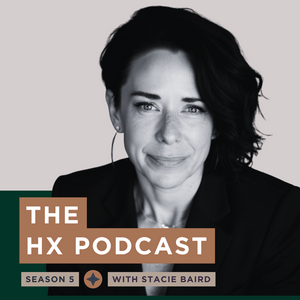
About The HX Podcast with Stacie Baird
A weekly podcast focused on stories that demonstrate how defining our own human experience (HX) leads to elevating the same across teams, organizations, families and communities. Each week
Podcast websiteListen to The HX Podcast with Stacie Baird, REAL AF with Andy Frisella and many other podcasts from around the world with the radio.net app
Get the free radio.net app
- Stations and podcasts to bookmark
- Stream via Wi-Fi or Bluetooth
- Supports Carplay & Android Auto
- Many other app features
Get the free radio.net app
- Stations and podcasts to bookmark
- Stream via Wi-Fi or Bluetooth
- Supports Carplay & Android Auto
- Many other app features

The HX Podcast with Stacie Baird
Scan code,
download the app,
start listening.
download the app,
start listening.
 USA
USA