
Listen to this podcast in the app for free: Download for free in the App Store
radio.net
Sleep timer
Save favorites
153 episodes
Dr. David Eagle: The Hospital Squeeze
09/30/2026 | 39 mins.DC EKG with Joe Grogan
DC EKG Ep 140 | Joe Grogan & Dr. David Eagle: The Hospital Squeeze
Guest: Dr. David Eagle, President, American Independent Medical Practice Association
Episode Description
Joe Grogan sits down with Dr. David Eagle, President of the American Independent Medical Practice Association and board-certified hematologist oncologist from New York Cancer and Blood Specialists, to discuss the collapse of independent oncology practices in America. Dr. Eagle explains how hospital consolidation through aggressive acquisition strategies, combined with punitive reimbursement policies and the 340B drug pricing program, has devastated independent community oncology practices. He details how independent practices declined from 85% of cancer care in 2000 to roughly 45% today, the "uneven playing field" created by 340B, and how policy changes under the Inflation Reduction Act are accelerating the crisis. The conversation covers Medicare payment systems, facility fee exploitation, reimbursement pressures, and the future of cancer care delivery when independent practices disappear. Dr. Eagle also discusses promising advances in cancer treatment including CAR T cell therapy, personalized vaccines, and precision medicine—innovations that may be lost if the healthcare system cannot maintain community-based oncology practices.
Key Timestamps
0:54 Joe Grogan welcomes Dr. David Eagle from New York Cancer and Blood Specialists
1:44 Why independent medical practice is important for oncology and the healthcare system
3:38 Current state of independent oncology practices in America
3:42 In 2000, community practices were 85% of cancer care; now roughly 45%
5:04 How hospitals create artificial competition by setting up practices nearby
6:02 The transition when Dr. Eagle's practice was acquired by a hospital system
6:08 How hospitals exploit facility fees while patients pay higher copays
7:11 Medicare Modernization Act 2003: The ASP system shift that squeezed independent doctors
10:18 IRA drug pricing: How add-on payments shrink as negotiated drug prices fall
10:51 2025 physician fee schedule: The grim economic reality for independent practices
12:29 Why independent community oncologists aren't valued by policymakers
15:51 Jeff Faserka: CEO of New York Cancer and Blood, previously in FDA commissioner contention
26:18 340B playbook: How hospitals have spent 15 years acquiring independent practices
32:52 Cancer treatment breakthrough: From leukemia to solid tumors, we're in a new frontier
36:40 Personalized medicine: The future requires maintaining community-based delivery systems
Key Topics
Hospital consolidation, independent oncology practices, 340B drug pricing program, reimbursement crisis, Inflation Reduction Act, Medicare payment systems, facility fees, CAR T cell therapy, personalized medicine, physician economics, healthcare policy, community medicine
Podcast: DC EKG with Joe Grogan | Episode: 140 | Host: Joe Grogan | Guest: Dr. David Eagle, President, American Independent Medical Practice Association
Sponsor: Survivors for Solutions - https://survivorsforsolutions.org
Executive Producer: John "CZ" Czwartacki, DC EKG Podcast
Producer: Stay on Course Studios - https://www.stayoncourse.studioJohn Desser: Health Savings Accounts and Market-Based Healthcare Solutions
09/28/2026 | 50 mins.Joe Grogan talks with John Desser, VP and Head of Government Affairs at Health Equity, about market-based healthcare and why
Health Savings Accounts (HSAs) may be its future. John's 35-year career runs from an internship in Senator John McCain's office through the Bush administration, eHealth, and now Health Equity. He recounts how the ACA's first draft nearly wiped out private online insurance marketplaces, why healthcare.gov stumbled, and how consumer control can fix healthcare's misaligned incentives. He also reflects on Ron Wyden's universal coverage plan without a mandate, Ted Kennedy's role in bipartisan reform, McCain's skinny repeal vote, and Trump's "give the money to the people" approach.
Key Timestamps
1:10 Joe welcomes John Desser of Health Equity
1:26 From foreign policy major to healthcare policy
1:46 Falling into healthcare in McCain's office, summer 1989
2:40 35 years in healthcare, thanks to Dave McIntyre
3:18 Coalition for Affordable Health Coverage and refundable tax credits
4:45 Bill Thomas: Spend as much as Democrats, but spend it our way
6:11 Updating the Archer MSA law
7:30 How Bill Thomas put HSAs in the Medicare Modernization Act
8:06 Leading health policy in the Bush administration
10:45 The uninsured project and Ron Wyden's universal coverage bill
12:03 Why dropping the mandate cost zero coverage
15:09 eHealth: Selling insurance online for a decade
17:05 Waxman's ACA draft and the 100% premium surtax
19:54 The John Dingell meeting that removed the surtax
21:14 The healthcare.gov disaster
22:55 Marketing costs: $20,000 per healthcare.gov sign-up
27:06 Trump administration launches enhanced direct enrollment
30:22 John joins Health Equity in July 2022
30:54 Why HSAs matter: Consumers, not bureaucrats, should ration care
34:18 Trump's "give the money to the people" instinct
35:35 The problem with arbitrary value-based pricing
39:21 ACA criticism: Ted Kennedy's absence and the 60-vote problem
41:51 Why bipartisan healthcare laws are more durable
44:15 "Build a new house next to the old one"
44:50 John Goodman's case for HSAs in Medicaid
45:28 Why every employer plan should include HSAs
Key Topics
HSAs, market-based healthcare, the ACA, healthcare.gov, online insurance marketplaces, Medicare Modernization Act, Medicaid reform, employer-sponsored coverage, bipartisan healthcare policy, consumer-driven healthcare
About the Guest
John Desser is VP and Head of Government Affairs at Health Equity, the nation's largest HSA provider, with 17 million total accounts. In more than 35 years in healthcare policy, he has worked for Senator John McCain, led health policy at HHS in the Bush administration, and run government affairs at eHealth during the ACA rollout. He is an expert in consumer-driven healthcare and market-based reform.
Podcast: DC EKG with Joe Grogan | Episode: 141 | Host: Joe Grogan | Guest: John Desser, Vice President and Head of Government Affairs, Health Equity
Sponsor: Survivors for Solutions – https://survivorsforsolutions.org
Executive Producer: John "CZ" Czwartacki, DC EKG Podcast | Producer: Stay on Course StudiosElizabeth Chamblee Birch on The Pain Brokers
09/28/2026 | 46 mins.Elizabeth Chamblee Birch, law professor and author of The Pain Brokers, exposes a coordinated healthcare fraud scheme targeting over 100,000 women. Stolen HIPAA-protected health records were weaponized by call centers in India and South Florida to convince women they needed emergency mesh removal surgery. Many women were left permanently incontinent after unnecessary procedures. The scheme involved call centers using stolen medical data, South Florida surgical operations, lawyers creating hidden liens, and litigation funders profiting from women's suffering. Birch introduces the villains: Vince Chabra (online pill mill founder), Blake Barber (travel concierge), and complicit doctors. She also highlights heroes: Barbara Bennis (defense attorney who uncovered the conspiracy) and J.R. Baxter (young plaintiffs lawyer who fought back). The episode reveals how electronic health record systems enabled massive data breaches, how private equity infiltrated the legal system, and what reforms are desperately needed to prevent future schemes.
Key Timestamps
0:53 Joe Grogan introduction
1:25 Joe asks Elizabeth about her background
1:37 Elizabeth's background: 21 years teaching mass torts
2:25 Elizabeth's MFA in narrative nonfiction at UGA
3:26 What is vaginal mesh used for?
5:21 Sharon gets intimate stolen medical data in phone call
6:00 Sharon didn't know she had mesh inserted
6:32 Call centers in India and South Florida
7:32 Alpha Law: Frankenstein firm through D.C. loophole
9:31 Outbound calls fueled by illegal stolen HIPAA data
10:12 Sharon's journey through the system
12:39 Sharon's financial devastation: $69-120K lien
13:24 Litigation funders threaten Sharon's house after settlement
15:00 Multi-district litigation vs class action
16:15 The perverse economics of the scheme
17:33 Economics: $15K vs $215K+ for removal
19:10 Women left permanently incontinent after unnecessary surgeries
21:15 Meet Vince Chabra and Blake Barber: the kingpins
26:11 Wolf of Wall Street moment: 14,000 claims for $40 million
27:45 Cold called over 100,000 women, signed 14,000 as clients
28:35 Barbara Bennis: defense attorney hero discovers conspiracy
30:37 Jerry Plummer and J.R. Baxter: young lawyer fighting back
34:36 Electronic health records enabled the data breach
36:07 Women receive $40K average settlement before fees
37:30 Data bias in medicine: gender gap in settlements
42:37 Solutions: anti-kickback statute reform
43:35 Private equity infiltrating law firms: the next frontier
Key Topics
Vaginal mesh litigation, healthcare fraud, HIPAA violations, stolen health records, call center fraud, litigation funding, private equity, women's health bias, legal reform, unnecessary surgery, settlement bias, data breach, electronic health records
Podcast: DC EKG with Joe Grogan | Episode: 139 | Host: Joe Grogan | Guest: Elizabeth Chamblee Birch, Law Professor, University of Georgia
Sponsor: Survivors for Solutions – https://survivorsforsolutions.org
Executive Producer: John "CZ" Czwartacki, DC EKG Podcast
Producer: Stay on Course Studios – https://www.stayoncourse.studioJohn Bertrand on FDA Approval, CMS Reimbursement, and AI Healthcare Reality
09/07/2026 | 48 mins.Guest: John Bertrand, former Digital Diagnostics
Episode Description
Joe Grogan sits down with John Bertrand, a veteran healthcare technology executive who scaled Digital Diagnostics to 75 health systems and achieved the first FDA approval and CMS reimbursement for an autonomous AI diagnostic device without a physician in the diagnostic loop. Bertrand reveals the harsh realities of bringing AI innovation to market: FDA and CMS regulatory frameworks are built for traditional medical devices and physician-driven care, not autonomous AI diagnostics. The conversation covers the shocking CMS reimbursement draft that came in 40-60% below cost of goods sold, the massive first-mover disadvantage in regulated medical device AI, and why reimbursement is the true gating factor for adoption—not clinical superiority. Bertrand explains how workflow integration and financial incentives matter far more than being clinically better. The episode explores the massive gap between what entrepreneurs think should happen with new innovations and the regulatory reality. He concludes with a sobering assessment: if building diagnostic AI again, he would choose supply chain automation instead because the regulatory and reimbursement headwinds are so significant they punish innovators. Where AI is actually making an impact today is patient-facing triage agents, administrative automation, and revenue cycle management—areas with far less friction.
KEY TIMESTAMPS
0:40 Joe introduces John Bertrand and his healthcare tech background
1:28 John clarifies he recently left Digital Diagnostics for supply chain work
2:40 John's career: 13 years at Epic Systems across multiple roles
6:10 What does Digital Diagnostics' AI device do? Automating retinal imaging
7:56 First FDA approval and first CMS reimbursement for autonomous AI diagnostic
9:02 Joe's threshold question: shouldn't better innovation be easily adopted?
9:50 Reality: workflow integration and reimbursement matter more than clinical quality
11:50 The adoption curve: all successful FDA-approved AI devices have CMS reimbursement
14:10 FDA experience: desire to help but frameworks built for old technology
15:40 FDA scrutiny on AI exceeds scrutiny on human clinicians
18:05 FDA guidance changes every 6-12 months, creating constant pivoting and delays
20:08 Shifting to CMS: the shocking draft reimbursement story
20:45 Draft came in at $10 per test, needed $30+ to be viable
22:42 Four months of negotiations with CMS to shift value argument
24:40 Process not codified: each company follows unique regulatory path
28:04 Six years at Digital Diagnostics: was it worth it?
28:44 John would not recommend diagnostic AI to new founders
33:02 Turning down multiple diagnostic AI opportunities post-Digital Diagnostics
34:19 AI hype vs reality: where are patients actually seeing life improvements?
34:19 Patient-facing triage agents are the second inning of real AI opportunity
36:25 Reimbursement for chat-based triage: who gets paid?
38:23 Autonomous vs assistive AI: the regulatory gap that exists
40:31 Could Digital Diagnostics have done physician-in-loop from the start?
41:33 Real opportunity: clinical practices deploying their own AI
42:20 State licensing nightmare: deploying AI across 50 states
44:55 The real concern: RCM automation becoming a zero-sum AI bot battle
45:20 Dead Internet Theory applied to healthcare revenue cycle
47:38 Closing: a tour de force on AI healthcare reality
Key Topics
AI in healthcare, FDA approval process, CMS reimbursement, autonomous AI diagnostics, Digital Diagnostics, diabetic retinopathy, regulatory frameworks, first-mover disadvantage, workflow integration, reimbursement strategy, patient-facing AI, healthcare innovation, regulatory friction, adoption barriers, state licensing, RCM automation, healthcare AI reality
About the Guest
John Bertrand is a veteran healthcare technology executive with over 20 years of experience. He spent 13 years at Epic Systems in analyst, product manageREFILL | Tomas Philipson on IRA, Inflation, Real Wages, and COVID Policy Tradeoffs (Originally Aired: June 2, 2023)
08/31/2026 | 54 mins.
More Government podcasts










Trending Government podcasts
























About DC EKG
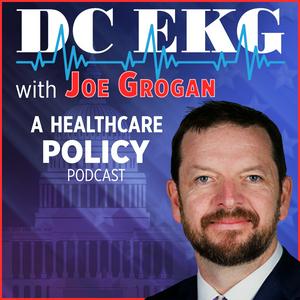
Join former White House policy expert Joe Grogan as he cuts through the complexities of healthcare legislation and its real-world implications. Each episode of DC EKG aims to demystify the policies shaping our healthcare system, uncovering how these changes impact patients, providers, and payers across the country.
Podcast websiteListen to DC EKG, Optimist Economy and many other podcasts from around the world with the radio.net app
Get the free radio.net app
- Stations and podcasts to bookmark
- Stream via Wi-Fi or Bluetooth
- Supports Carplay & Android Auto
- Many other app features
Get the free radio.net app
- Stations and podcasts to bookmark
- Stream via Wi-Fi or Bluetooth
- Supports Carplay & Android Auto
- Many other app features

DC EKG
Scan code,
download the app,
start listening.
download the app,
start listening.
 USA
USA