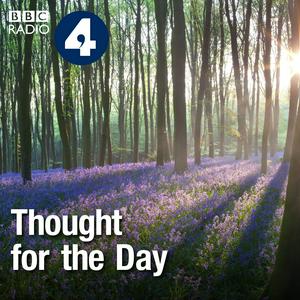
Thought for the Day

BBC Radio 4
Thought for the Day
Latest episode

228 episodes

  • Thought for the Day

    Jayne Manfredi

    1/23/2026 | 3 mins.
    “You’ve failed.”
    Words spoken to me by a man with a clipboard, in a Renault Clio back in 1997. Failing my driving test seems trivial now, from the misty vantage point of nearly thirty years distance, but at age seventeen these were devastating words to hear. The unpleasant sting of failure is a lingering memory; the embarrassment, increasing with each friend calling to say they had passed. The sense of inadequacy. The desperation and the increasing certainty that I would never, ever pass myself.
    Such is the stigma and social detriment of failure that some people will resort to nefarious means in order to pass. Cheating on driving tests has increased by nearly 50% over the past year; a dangerous form of deception which risks lives, and also severs the social contract which relies on us all following the rules in order to be safe. Failure is key both to character building and communal ethics.
    The biblical record is littered with examples of human failure, and those who tried everything to avoid it. The Trickster is a common narrative trope, which includes a disreputable collection of characters who cheat and lie in order to succeed rather than risk the disgrace of failure. Abram who persuades Sarai to pose as his sister to dupe Pharoah. Laban who uses deception to ensnare Jacob into working longer for him. Rebekah, the trickster architect of the plan to fool Isaac into blessing her younger son Jacob over his brother Esau. These cheats appear to prosper, at least momentarily, in a moral universe which allowed deception, but the biblical record shows that their ethical misdeeds often came back to haunt them. Jacob, for example, so quick to be part of his mother’s schemes, ended up being deceived himself, tricked into marrying the wrong woman.
    The book of Proverbs says that food gained by fraud tastes sweet, but one ends up with a mouth full of gravel. So it was for our biblical tricksters, whom God used to work out his divine purposes - not because God loves a cheater, but because God loves those who fail. It is in the failing and the striving and the trying again that we learn our best lessons.
    Elizabeth Day has written that “if you’ve survived it, failure has taught you something.” I finally passed my driving test, but it was in the failure to do so that I learned how to be a good driver. The taste of failure is bitter indeed, hard to swallow and takes a long time to uncomfortably digest, but it’s what feeds our character and helps us to grow, and however horrible it tastes, at least it’s not gravel.
  • Thought for the Day

    Jasvir Singh

    1/22/2026 | 2 mins.
    22 JAN 26
  • Thought for the Day

    Rev Lucy Winkett

    1/21/2026 | 3 mins.
    21 JAN 26
  • Thought for the Day

    Rev Dr Sam Wells

    1/20/2026 | 2 mins.
    20 JAN 26
  • Thought for the Day

    Bishop Philip North

    1/19/2026 | 2 mins.
    19 JAN 26

More Religion & Spirituality podcasts

About Thought for the Day

Reflections from a faith perspective on issues and people in the news.
Podcast website

Listen to Thought for the Day, The Briefing with Albert Mohler and many other podcasts from around the world with the radio.net app
Get the free radio.net app

  • Stations and podcasts to bookmark
  • Stream via Wi-Fi or Bluetooth
  • Supports Carplay & Android Auto
  • Many other app features

Thought for the Day: Podcasts in Family

Social
v8.3.0 | © 2007-2026 radio.de GmbH
Generated: 1/23/2026 - 6:32:33 PM