

Listen to this podcast in the app for free: Download for free in the App Store
radio.net
Sleep timer
Save favorites
43 episodes
Not Every Growth Phase Feels Like Growth
07/25/2026 | 47 mins.Discover your free gift from Dr. Jeffrey Rutstein at drjeffreyrutstein.com/links — a 20-minute video on nervous system states and the practices that can help you find regulation.
Want to leave a question? Call 866-357-5156
There's a voice that shows up the moment things get quiet — the one that says you're behind, or worse, that you've lost ground you already fought for in your healing journey. Old patterns creep back in, and what looks like burnout or nervous system dysregulation gets quietly relabeled as personal failure. Before you've caught your breath, you're building a case against yourself: I should be further than this by now. That voice isn't measuring your emotional healing or your progress toward nervous system regulation — it's shame, running an old script about safety, worth, and how much room you're allowed to take up while you heal.
In this episode of Wired for Well-Being, psychologist, trauma expert, and polyvagal theory specialist Dr. Jeffrey Rutstein explores why growth in trauma recovery rarely moves in a straight line. He and producer Stephen Lessard unpack the different faces growth can take for trauma survivors — and why the moments that feel most like failure often aren't.
Drawing on shame research and years of trauma-informed clinical work, Jeffrey walks through the difference between a natural plateau, a genuine setback, and the fear and shame that can masquerade as either one. He explains what's happening in the nervous system during each phase, and how trauma survivors in particular get caught confusing self-protection with self-sabotage. This episode is for anyone who's judged themselves for not growing fast enough, or for landing back in an old pattern they thought they'd already left behind.
Have a question for Jeffrey? Leave a voicemail at 866-357-5156. If you can't reach that number, record a voice memo or email hello@drjeffreyrutstein.com.
Discover your free gift from Dr. Jeffrey Rutstein. Find it at drjeffreyrutstein.com/links.
The content in this podcast is for informational purposes only and is not intended as professional mental health advice. Always consult a qualified healthcare provider for medical or mental health concerns.The Blind Spot in Our Healing Journey
07/18/2026 | 45 mins.Discover your free gift from Dr. Jeffrey Rutstein at drjeffreyrutstein.com/links — a 20-minute video on nervous system states and the practices that can help you find regulation.
Want to leave a question? Call 866-357-5156
Most of us are chasing one of two things when we talk about healing: getting back to who we were before, or building the calmest, safest version of ourselves we can. Both feel like the obvious answer. Both are quietly exhausting. You measure your healing by how calm you can stay, and the moment you're not, it feels like proof you're failing at your own trauma recovery. That chase never actually lands anywhere solid, and for a lot of trauma survivors, it starts to look a lot like burnout. It has everything to do with how your nervous system decides between protecting you and letting you connect.
In this episode of Wired for Well-Being, Dr. Jeffrey Rutstein — psychologist, trauma expert, and nervous system specialist — takes on a listener's question about what healing is actually moving toward. He reframes the goal most of us have been chasing without ever naming it.
Drawing on polyvagal theory, shame research, and years of trauma-informed clinical work, Jeffrey unpacks why neither returning to your old self nor staying permanently calm is actually possible — or the point. He walks through how trauma narrows attention, pulls people out of their bodies, and teaches nervous system dysregulation as a survival strategy. This episode is for anyone in emotional healing who's felt like they're failing at regulation, or burned out from trying to stay calm all the time.
Have a question for Jeffrey? Leave a voicemail at 866-357-5156. If you can't reach that number, record a voice memo or email hello@drjeffreyrutstein.com.
Discover your free gift from Dr. Jeffrey Rutstein. Find it at drjeffreyrutstein.com/links.
The content in this podcast is for informational purposes only and is not intended as professional mental health advice. Always consult a qualified healthcare provider for medical or mental health concerns.The Cost of Not Meeting Life As It Is
07/11/2026 | 50 mins.Discover your free gift from Dr. Jeffrey Rutstein at drjeffreyrutstein.com/links — a 20-minute video on nervous system states and the practices that can help you find regulation.
Want to leave a question? Call 866-357-5156
You fight the diagnosis. You fight the fall. You fight the friend who died too soon, the body that won't cooperate, the years slipping by faster than you can hold onto them. Every fight costs you twice — once for the thing itself, and once for how hard you worked against it. This is what nervous system dysregulation looks like from the inside: constant bracing against a reality that won't budge. Trauma survivors know this pattern especially well — a nervous system trained early to see the world as unsafe doesn't know how to stop defending against it, even decades later. Underneath every white-knuckled fight is a nervous system that has never trusted that it's safe enough to let go.
In this episode of Wired for Well-Being, licensed psychologist and trauma expert Dr. Jeffrey Rutstein answers a listener's question about learning to surrender at 83, after a series of falls and a string of losses cracked open a lifelong belief that nowhere is safe. He reframes surrender not as defeat, but as the nervous system's path out of dysregulation and into ease — a form of emotional healing that has nothing to do with giving up.
Drawing on polyvagal theory and years of trauma-informed clinical work, Jeffrey unpacks why fighting reality always adds a second layer of pain on top of the first, and how nervous system regulation begins in the body, not the mind. He walks through a simple practice for locating where resistance lives physically and softening it, plus what separates true surrender from giving up when you still have every reason to keep fighting for your life. This conversation is for anyone running on the exhausted, burnout edge of resisting what they can't change — and still afraid that letting go means losing.
Have a question for Jeffrey? Leave a voicemail at 866-357-5156. If you can't reach that number, record a voice memo or email hello@drjeffreyrutstein.com.
Discover your free gift from Dr. Jeffrey Rutstein. Find it at drjeffreyrutstein.com/links.
The content in this podcast is for informational purposes only and is not intended as professional mental health advice. Always consult a qualified healthcare provider for medical or mental health concerns.Trusting Your Gut When Trauma Taught You Not To
07/04/2026 | 48 mins.Discover your free gift from Dr. Jeffrey Rutstein at drjeffreyrutstein.com/links — a 20-minute video on nervous system states and the practices that can help you find regulation.
Want to leave a question? Call 866-357-5156
You've done the work. The therapy, the nervous system education, the healing. And still — when your gut speaks, you're not sure you can believe it. Is this my gut, or is it fear? For trauma survivors, this isn't a small question. It's the question. Because trauma doesn't just wound the nervous system — it teaches the body to go quiet, to stay out of your own way, to protect others even at the cost of your own truth. The result: a body that's still sending signals, and a nervous system that's learned not to trust them.
In this episode of Wired for Well-Being, Dr. Jeffrey Rutstein — psychologist, trauma expert, and nervous system specialist — unpacks one of the most disorienting experiences in trauma recovery: learning to tell the difference between gut knowing and nervous system activation when both feel identical from the inside.
Drawing on polyvagal theory, shame research, and decades of trauma-informed clinical work, Jeffrey and Steve explore how nervous system regulation is the prerequisite for hearing the gut clearly, why trauma survivors abandon body awareness to protect others, and how to begin distinguishing matched neuroception from the mismatched signals that keep the past alive in the present. This episode is for anyone who has done the inner work and still wonders: can I trust what I feel?
Have a question for Jeffrey? Leave a voicemail at 866-357-5156. If you can't reach that number, record a voice memo or email hello@drjeffreyrutstein.com.
Discover your free gift from Dr. Jeffrey Rutstein. Find it at drjeffreyrutstein.com/links.
The content in this podcast is for informational purposes only and is not intended as professional mental health advice. Always consult a qualified healthcare provider for medical or mental health concerns.The Crash After Connection Has a Name
06/27/2026 | 36 mins.Discover your free gift from Dr. Jeffrey Rutstein at drjeffreyrutstein.com/links — a 20-minute video on nervous system states and the practices that can help you find regulation.
Want to leave a question? Call 866-357-5156
You know this feeling. You're in — connected, engaged, fully yourself. And then something shifts. The energy drains, the walls go up, and you can't find your way back. The judgment arrives almost instantly: why do I keep doing this? What is wrong with me? But the crash isn't a character flaw. It's a signal. And the force behind it — the hidden driver underneath the cycling itself — has been running the show the whole time. Shame.
In this episode of Wired for Well-Being, Dr. Jeffrey Rutstein — psychologist, trauma expert, and nervous system specialist — responds to a listener living with multiple complex diagnoses who cycles between deep community connection and painful withdrawal, and reframes the question entirely: the cycling isn't something to fix. It's something to get curious about.
Drawing on polyvagal theory, shame research, and decades of trauma-informed clinical work, Jeffrey and Steve explore how shame quietly drives nervous system dysregulation — pushing people to abandon themselves in connection, over-function for others, and burn out until withdrawal becomes the only exit. They unpack why the judgment layer that follows a state shift makes it stickier, why curiosity is the one thing that opens movement, and what it looks like to stay present with others without leaving yourself behind. For anyone navigating trauma recovery, burnout, or the exhausting pull between connection and collapse, this episode names what's been driving the cycle.
Have a question for Jeffrey? Leave a voicemail at 866-357-5156. If you can't reach that number, record a voice memo or email hello@drjeffreyrutstein.com.
Discover your free gift from Dr. Jeffrey Rutstein. Find it at drjeffreyrutstein.com/links.
The content in this podcast is for informational purposes only and is not intended as professional mental health advice. Always consult a qualified healthcare provider for medical or mental health concerns.
More Education podcasts
 Mick UnpluggedBusiness, Education, Entrepreneurship, Management, Self-Improvement
 Makes Sense - with Dr. JC DoornickEducation, Self-Improvement
 The Mel Robbins PodcastEducation, Health & Wellness, Mental Health, Relationships, Self-Improvement, Society & Culture
 Digital Social HourBusiness, Careers, Daily News, Education, Entrepreneurship, News, Self-Improvement, Society & Culture, Sports
 The Jamie Kern Lima ShowBusiness, Education, Entrepreneurship, Health & Wellness, Mental Health, Self-Improvement
 Living Your LegacyBusiness, Education, Entrepreneurship, Film Interviews, Self-Improvement, TV & Film
 Finding Peak with Ryan HanleyBusiness, Education, Entrepreneurship, Management, Self-Improvement
 How to Be a Better HumanEducation, Self-Improvement
 The Daily StoicBusiness, Education, Self-Improvement, Society & Culture
 IMO with Michelle Obama and Craig RobinsonEducation, Self-Improvement, Society & Culture
Trending Education podcasts
 New DiscoursesEducation
 Am I the Genius?Education, Self-Improvement
 صلح درونEducation, Self-Improvement
 Planet Money Summer SchoolEducation
 The Saad Truth with Dr. SaadEducation, Science, Society & Culture
 Before BreakfastEducation, Self-Improvement
 Platypus Economics with Justin WolfersBusiness, Courses, Education, Science, Social Sciences
 Organize 365 PodcastBusiness, Education, Entrepreneurship, Self-Improvement
 Paring Down: Realistic minimalism, decluttering, & intentional livingEducation, Home & Garden, Leisure, Self-Improvement
 The Other Side NDE (Near Death Experiences)Education, Religion & Spirituality
 Martha DebayleEducation, Self-Improvement
 Pulling The Thread with Elise LoehnenEducation, Religion & Spirituality, Self-Improvement
 رادیو راه با مجتبی شکوریEducation
 Grounded Wellness by Primally PureAlternative Health, Education, Health & Wellness, Self-Improvement
 10 MINUTES TO LESS SUFFERINGEducation, Health & Wellness, Mental Health, Religion & Spirituality, Self-Improvement, Spirituality
 The Scriptures Are RealCourses, Education, Religion & Spirituality
 Weekly Motivation by Ben Lionel ScottEducation, Self-Improvement
 Better Than HappyChristianity, Education, Religion & Spirituality, Self-Improvement
 This Naked Mind PodcastEducation, Self-Improvement
 Habits of A GoddessEducation, Self-Improvement
 BPLUS بیپلاس پادکست فارسی خلاصه کتابEducation, Kids & Family, Self-Improvement
 MODERN STOICISMEducation, Self-Improvement
 The PreambleEducation, Government, History
 جافکری | JafekriEducation, Self-Improvement
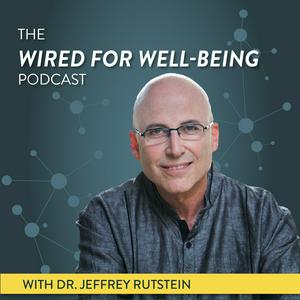
About The Wired for Well-Being Podcast
Wired for Well-Being is a podcast devoted to viewing our lives through a nervous system perspective—so we can better understand what’s really happening inside us and how to shift it.
Hosted by Dr. Jeffrey Rutstein, a clinical psychologist with over 40 years of experience treating trauma, dissociation, chronic pain, and chronic illness, the podcast takes you beyond theory and into real-life application. Each episode includes listener questions about the struggles we all face—relationships, healing journeys, fear, overwhelm, or anger—and offers fresh insights from the science of the nervous system.
With warmth and clarity, Jeffrey unpacks what’s going on beneath the surface: why certain situations trigger us, how old patterns linger in the body, and what it actually takes to move toward healing and connection.
Joined by producer and friend Steve Lessard, Jeffrey brings compassion, practical tools, and decades of clinical wisdom to every conversation. The goal is simple but profound: to help you stop seeing yourself as broken, and instead discover how you are inherently wired for well-being, resilience, and deeper connection.
Podcast websiteListen to The Wired for Well-Being Podcast, Mick Unplugged and many other podcasts from around the world with the radio.net app
Get the free radio.net app
- Stations and podcasts to bookmark
- Stream via Wi-Fi or Bluetooth
- Supports Carplay & Android Auto
- Many other app features
Get the free radio.net app
- Stations and podcasts to bookmark
- Stream via Wi-Fi or Bluetooth
- Supports Carplay & Android Auto
- Many other app features
The Wired for Well-Being Podcast
Scan code,
download the app,
start listening.
download the app,
start listening.
The Wired for Well-Being Podcast: Podcasts in Family
 USA
USA