

Listen to this podcast in the app for free: Download for free in the App Store
radio.net
Sleep timer
Save favorites
49 episodes
Glitched
07/21/2026 | 34 mins.Have you ever stepped into an unfamiliar room, only to be struck by the chilling, unshakable certainty that you have stood in that exact spot before?
For generations, humanity has blamed this unsettling phenomenon on previous lives, ancestral memory, or a literal glitch in our simulated reality. But what is even stranger than the feeling itself is its secondary symptom: the sudden, overwhelming conviction that you can predict the immediate future. Whether your mind is playing a brilliant spatial trick on itself, or you are briefly tuning into a parallel self vibrating across the cosmos, the reality is far stranger than we think.
Settle in, get comfortable, and let’s explore the spaces where psychology meets the edge of the unknown.
Join the Circle:
Deepen the Study: Join our community and subscribe to the paid tier on Substack for exclusive deep-dive show notes, bibliography, and bonus essays.
Share Your Story: Have you ever had a déjà vu experience where you could have sworn you saw the future? Leave a comment on our Substack or reach out to us on socials @PsychStrangePod
Support the Show: If you love our mix of science and the strange, please leave a five-star review on Apple Podcasts or Spotify. It helps our dark academia library grow!
Hosted on Acast. See acast.com/privacy for more information.The Blood Goddess of Yerba Buena
07/14/2026 | 31 mins.In 1963, deep in the isolated mountains of Tamaulipas, Mexico, a routine police investigation uncovered a nightmare: a remote mining village transformed into an apocalyptic cult of ritual sacrifice, ruled by a twenty-six-year-old woman claiming to be the ancient Aztec goddess Coatlicue. Her name was Magdalena Solís, historically remembered as "The High Priestess of Blood."
But the true horror of Yerba Buena isn’t just the crimes committed in that torch-lit cave. It’s how they began. Magdalena wasn't a born cult leader; she was a destitute young woman hired by two petty con men to play a part in a financial scam.
In this episode, we step away from standard true-crime sensationalism to examine the terrifying fluidness of the human psyche. How does a conscious grift mutate into genuine, dangerous megalomania? How do ordinary, peaceful people become complicit in atrocities within a matter of weeks? We trace the story of Magdalena Solís through the lens of social psychology, exploring folie à plusieurs (shared psychosis), deindividuation, and the dark architecture of total isolation.
Deepen Your Research on Substack
Want to go beyond the audio? Read our companion essay for this episode over on the Substack
Go Ad-Free: Paid Substack subscribers get exclusive access to academic deep-dives, source bibliographies, and completely ad-free listening for every single episode. Join the community at: psychologyofthestrange.substack.com
Further Reading
Cultish: The Language of Fanaticism — Amanda Montell
Not every cult needs a cave and a chalice. Montell breaks down the actual mechanism, the language, that turns a group into something closer to a cult than anyone inside it wants to admit. If this episode had you thinking about how belief gets built one word at a time, start here.
Connect with the Show:
Substack: psychologyofthestrange.substack.com
TikTok / Reels: @PsychStrangePod
Hosted on Acast. See acast.com/privacy for more information.Akashic Library and Near Death Experiences
07/07/2026 | 34 mins.Have you ever wondered what happens in those final milliseconds when the lights go out? Pop culture loves to promise that clinical death is a peaceful journey toward a warm light, but the data tells a much more complicated, occasionally terrifying story.
This week, we are pulling on two deeply intertwined, thoroughly bizarre threads of human consciousness. First, we explore the esoteric concept of the Akashic Records. The infinite, celestial library that hundreds of modern NDE (Near-Death Experience) survivors claim to have visited to view the pre-birth blueprints of their mortal lives.
Then, we pivot into the dark underbelly of resuscitation science: Distressing NDEs. Statistics show that a significant portion of the population doesn't get a cosmic hug when they flatline; instead, their minds serve up a custom horror film. We break down the neurobiology of a dying brain, Jung’s collective unconscious, and the three distinct archetypes of hellish experiences. Finally, we look at why cutting-edge cognitive models like 4E Cognition might mean these realms are far more than mere hallucinations.
Go Deeper on Substack:
Want to pull on these threads even further? Join our inner circle on Substack! Paid subscribers get completely ad-free listening for every single episode so your atmosphere remains uninterrupted. Plus, this week I’m dropping an exclusive subscriber-only companion essay that dives deep into the clinical case studies of hellish NDEs, the exact mechanics of veridical perception, and the messy philosophy behind 4E cognition theory. Subscribe at https://psychstrangepod.substack.com/?r=4ajm1n&utm_campaign=profile&utm_medium=profile-page
References & Recommended Reading:
Greyson, B., & Bush, N. E. (1992). Distressing Near-Death Experiences. Psychiatry: Interpersonal and Biological Processes. (The foundational study establishing the 11-22% statistic on dark NDEs).
Jung, C. G. The Archetypes and the Collective Unconscious. Princeton University Press.
Gallagher, S. (2017). Enactivist Interventions: Rethinking the Mind. Oxford University Press. (An excellent foundational text for understanding 4E cognition).
Pasricha, S. (1993). A systematic survey of near-death experiences as reported by inpatient populations in India. Journal of Scientific Exploration. (For the cross-cultural administrative and Yamadoota data).
Connect With the Show:
Host: Tara Perreault
Instagram/Twitter: @PsychStrangePod
Listen & Review: If this episode gave you a healthy dose of intellectual existential dread, please leave us a 5-star review on Apple Podcasts or Spotify, it directly helps our independent library grow!
Hosted on Acast. See acast.com/privacy for more information.The Old Ursuline Convent & the Casket Girls
06/30/2026 | 31 mins.If you walk down Chartres Street in the French Quarter of New Orleans late at night, your eyes will naturally drift upward to the third floor of the Old Ursuline Convent. There, behind the heavy brickwork, sit rows of dark wooden shutters. They are always closed. Always sealed.
Local folklore says that inside that attic rests a collection of hundreds of small, wooden trunks—trunks shaped suspiciously like coffins. Legend claims that in 1728, a fleet of ships arrived carrying young, pale women who clutched these boxes like lifelines: the Filles à la Cassette, or Casket Girls. And the rumor that keeps tourists up at night? They smuggled the first vampires into America, forcing the nuns to seal the windows with 800 Pope-blessed silver nails and threatening anyone who enters with automatic excommunication.
But what if the real horror story isn't what flew out of that attic, but why the townspeople needed a monster to be there?
In this episode of Psychology of the Strange, we dissect the Old Ursuline Convent not as a haunted house, but as a laboratory of human behavior. Pulling back the gothic romance, we explore how a primitive, isolated society weaponized psychological projection, linguistic drift, and institutional secrecy to turn traumatized young women into the ultimate dark triad predators. Finally, we look at the thin line between scientific parsimony and the primal elegance of the monster—and why our minds have an evolved appetite for the thrill of recreational fear.
Support the Show on Substack!
Want to go deeper into the psychology behind the lore? Upgrade to a paid subscription at Substack to unlock:
Premium Companion Essays: This week, dive into the data behind Morality-as-Cooperation Theory and a deeper look at how Dark Triad traits manifest in high-stress ecosystems.
Ad-Free Listening: Immerse yourself in the dark without interruption.
Exclusive Community: Join discussion threads and vote on upcoming episode topics.
Check Out the Reading List on Amazon!
Hosted on Acast. See acast.com/privacy for more information.The Inverse Curse of the Modern Potion
06/23/2026 | 34 mins.What happens when a medication designed to heal the physical body accidentally alters more than was prescribed?
On June 17, 2026, researchers at Rutgers University dropped a scientific bombshell in the journal Criminology, revealing a startling psychiatric byproduct of GLP-1 medications like Ozempic and Wegovy: a massive, unprecedented drop in impulsive, violent behavior and substance abuse.
While the rest of the media treats these synthetic hormones as a story about physical weight loss, we are pulling the conversation deep into the uncanny valley of human consciousness. In this episode, we step into the biological engine room of human behavior to connect this cutting-edge neuroscience to the body horror of Stephen King’s Thinner, ancient European folklore of the Changeling, and the modern internet paranoia surrounding celebrity clones.
If a weekly injection into the thigh can turn down human rage by over 60%, virtue ceases to be a moral achievement. It becomes a metabolic variable. Are we actually the independent captains of our own minds, or are we just passengers at the mercy of our digestive chemistry?
The Hard Science: Key Metrics From the Study
The pipeline connecting high baseline impulsivity to physical violence was found to be 62% weaker in current GLP-1 users.
The well-established link between alcohol abuse and violent outbursts was slashed by 52%.
Neurological data suggests the medication functions as a form of "chemical CBT". Densely peppered GLP-1 receptors in the brain's ventral tegmental area cap the maximum voltage of dopamine pathways, physically widening the critical gap between a dark impulse and the physical action.
Inside the Episode
Stephen King's Thinner and the primal horror of biological rebellion.
How GLP-1 drugs quiet the "food noise," "rage noise," and the neuroscience of the mesolimbic dopamine pathway.
Connecting the rapid physical and behavioral transformations of Hollywood to medieval fae superstitions and algorithmic "clone" conspiracy theories.
Why a synthetic molecule designed to enforce the rules of polite society directly onto our neurotransmitters is weirder than any gothic hex.
The Schopenhauer Paradox, if we can buy restraint at a pharmacy, does free will exist?
A rational cushion on the sci-fi nightmare, where treatment ends, and the slippery slope of chemical compliance begins.
Referenced Works & Deep Dives
The Study: Semenza, D., & Thomas, C. (June 17, 2026). Criminology. "GLP-1 Receptor Agonists and the Mitigation of Impulsive and Violent Behavior."
Literature: Thinner by Stephen King (writing as Richard Bachman), 1984.
Philosophy: Arthur Schopenhauer, Essays on the Freedom of the Will.
Support the Strange
If you want to wander deeper into the shadows of psychological research with me, join our community of intellectual anomalies:
Substack: Subscribe to our paid tier for completely ad-free listening and access to this week's companion essay, where I pull out my full research notebook, explore the history of behavioral optimization, and dissect the psychology of the uncanny valley.
Buymeacoffee: If you enjoyed the episode and what to send a special thanks, Buy me a coffee to fuel the research that goes into each episode
Social Media: Follow the journey and join the conversation on Instagram, X, and TikTok @psychstrangepod.
Listener Note: “Man can do what he wills, but he cannot will what he wills.” What do you think? Is our morality a grand cathedral of the soul, or just a temporary tent pitched on the volatile swamp of our baseline metabolism? Slide into socials and let me know.
Hosted on Acast. See acast.com/privacy for more information.
More History podcasts
 Everything Everywhere Daily: History, Science, Geography & MoreEducation, History
 Stuff You Missed in History ClassHistory, Society & Culture
 After Dark: Myths, Misdeeds & the ParanormalHistory, Society & Culture, True Crime
 Dan Snow's History HitHistory
 The AncientsHistory
 The Team HouseDocumentary, Government, History, Society & Culture
 History That Doesn't SuckEducation, History, Society & Culture
 The Rest Is HistoryHistory
 ThroughlineDocumentary, History, Society & Culture
 American History TellersEducation for Kids, History, Kids & Family, Society & Culture
Trending History podcasts
 راوکست | RavcastArts, Books, History, Society & Culture, True Crime
 Mobituaries with Mo RoccaHistory, Society & Culture
 Ask Haviv AnythingHistory
 The History of the Twentieth CenturyHistory
 Past Present FutureHistory, News, Philosophy, Politics, Society & Culture
 Master PlanHistory, News, Politics
 Trashy DivorcesComedy, History
 Cocaine & Rhinestones: The History of Country MusicHistory
 Useless Information PodcastComedy, History, Society & Culture
 The Ancient WorldHistory
 The History of EnglandHistory
 HistoryExtra podcastHistory
 History For Sleep with the Drowsy HistorianHistory
 The History HourHistory, Personal Journals, Society & Culture
 Catholic SaintsHistory
 The Days of NoahHistory
 Ben Franklin's WorldArts, Books, History, Society & Culture
 Echoes of HistoryHistory, Leisure, Society & Culture, Video Games
 Decoding The UnknownHistory
 Whatʻs the Connection?History
 True Weird StuffDocumentary, History, Science, Society & Culture
 Irish History PodcastHistory
 D-Day: The Tide TurnsHistory
 The History of English PodcastHistory
 The Art of CrimeArts, History
 WW2: Both Sides of The WireHistory
About Psychology of the Strange
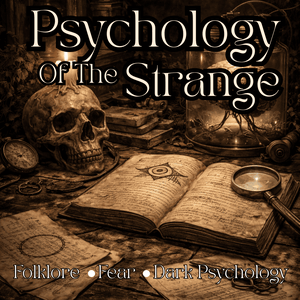
Folklore. Fear. Dark Psychology.Psychology of the Strange is a narrative psychology podcast that explores the eerie, the uncanny, and the deeply human. Every episode begins with an original atmospheric story rooted in dark folklore, superstition, or real events and then shifts into a psychological analysis that unpacks why these tales grip the human mind. From winter-born omens and skeletal visitors to fearlessness, moral ambiguity, and the monsters we create to explain uncertainty, this show lives in the spaces where folklore and psychology overlap.If you like stories that linger… and explanations that cut deeper… you’re in the right place.ABOUT THE HOSTHosted by Tara Perreault, a doctoral student in psychology at the University of South Florida. Her research focuses on the darker edges of human nature: fearlessness, Dark Triad traits, moral ambiguity, recreational fear, and the meanings people draw from the strange and the supernatural. Tara blends academic insight with myth, atmosphere, and psychological storytelling. Her approach is part folklore study, part dark psychology, part narrative experiment. She has presented research at multiple conferences, published empirical work, and spent years studying how people make sense of fear — in haunted houses, on screen, and in the stories we pass down through generations. Psychology of the Strange is her creative extension of that work: a place where the uncanny becomes meaningful, and where every monster is really a metaphor for something we haven’t faced yet. Hosted on Acast. See acast.com/privacy for more information.
Podcast websiteListen to Psychology of the Strange, Everything Everywhere Daily: History, Science, Geography & More and many other podcasts from around the world with the radio.net app
Get the free radio.net app
- Stations and podcasts to bookmark
- Stream via Wi-Fi or Bluetooth
- Supports Carplay & Android Auto
- Many other app features
Get the free radio.net app
- Stations and podcasts to bookmark
- Stream via Wi-Fi or Bluetooth
- Supports Carplay & Android Auto
- Many other app features
Psychology of the Strange
Scan code,
download the app,
start listening.
download the app,
start listening.
 USA
USA