
Listen to this podcast in the app for free: Download for free in the App Store
radio.net
Sleep timer
Save favorites
30 episodes
How To Break the Food Supply
11/24/2026 | 35 mins.The world produces more calories per person than ever before. Will it always?
This Thanksgiving, Are We Doomed? cheeeerfully considers the vast, complex machine spinning behind modern abundance. Specialized farms suck in fertilizer, pesticide, seeds, and more to churn out the waves of grain, herds of meat, and a rainbow of fruits, vegetables, and gummy candies.
Ben Bradford investigates what happens when one hub in this machine gets knocked offline — say, due to an invasion of Ukraine. Or, when a chokepoint in the Middle East slams shut on a critical hose of fertilizer. Then, he keeps squeezing.
Thankfully, it’s not easy to break the machine. Unfortunately, it’s not impossible. More unfortunately: One of the best ways to do it may be leaving the machine as-is.
Guests:
Andrew Muhammad, agricultural economist at the University of Tennessee
Omanjana Goswami, food and environment expert at the Union of Concerned Scientists
Raj Patel, professor of food-systems at the University of Texas at Austin
Check out related episodes:
Past Dooms That Didn't Arrive (incl. Death by Baby)
How To Start a Nuclear War
Asteroids! The Doom We're Best At
Supervolcano!
Just a Minor Sun Explosion (Solar Storms)
Support Are We Doomed?, get bonus episodes, and more: https://doompod.com/support/
Watch animated episodes on Youtube! https://www.youtube.com/@arewedoomedpod
To manage podcast ad preferences, review the links below:
See pcm.adswizz.com for information about our collection and use of personal data for sponsorship and to manage your podcast sponsorship preferences.
NPR Privacy PolicyAre We Running Out of Sand?!
11/10/2026 | 36 mins.Sand is everywhere. Beaches. Rivers. Deserts full of powdery dunes. How could we possibly run out?
Journalist Vince Beiser has dug deep into the past century — and more — of human construction and found one tiny grain at its foundation: sand. In apartments and eyeglasses, in computer chips and cleaning equipment. The hunt for sand has reshaped coastlines, spawned black markets, and launched beach “heists.” And, some of them, possibly, could have been avoided, if the Romans had bothered to write down their own lost recipe for concrete.
Guest:
Vince Beiser, journalist and author of The World in a Grain: The Story of Sand and How It Transformed Civilization
Support Are We Doomed?, get bonus episodes, and more: https://doompod.com/support/
Watch animated episodes on Youtube! https://www.youtube.com/@arewedoomedpod
Also mentioned this episode:
Are We Going the Way of the Roman Empire?
To manage podcast ad preferences, review the links below:
See pcm.adswizz.com for information about our collection and use of personal data for sponsorship and to manage your podcast sponsorship preferences.
NPR Privacy PolicyIs the Microplastic In You Really Bad?
10/27/2026 | 32 mins.You have plastic in you. In your lungs, your gut, your blood, maybe your brain. That sounds bad.
But how bad?
Ben Bradford investigates whether microplastics are shaping up to be one of those hazards humanity realizes too late — like lead, asbestos, or air pollution — or whether we’re filling gaps in the science with fear.
Guests:
Tracey Woodruff, environmental health scientist and epidemiologist
Ian Mudway, toxicologist at Imperial College London
Support Are We Doomed?, get bonus episodes, and more: https://doompod.com/support/
Watch animated episodes on Youtube! https://www.youtube.com/@arewedoomedpod
To manage podcast ad preferences, review the links below:
See pcm.adswizz.com for information about our collection and use of personal data for sponsorship and to manage your podcast sponsorship preferences.
NPR Privacy PolicyHow High Can You Build a Seawall?
10/13/2026 | 32 mins.It’s a particularly watery moment, with a hurricane on the Gulf Coast and El Niño-fueled waves flooding California homes. Not helping: The seas are rising, and they’re going to keep rising. How much can we build to stop that? And if we can’t, what will happen to the places in the way of the waves?
Ben Bradford starts in New Orleans, where a flashpoint new study finds rising water will (eventually) overwhelm our best sea walls. But what about those of the Dutch, who have spent a thousand years living dry at submarine elevations?
Then, there are nations already retreating from the rising water’s path. From Lagos to Fiji, we look at the best attempts we can learn from — and the worst.
Jesse Keenan, professor of urban planning at Tulane University and author of North: The Future of Post-Climate America
Jola Ajibade, environmental sciences professor at Emory University
Support Are We Doomed?, get bonus episodes, and more: https://doompod.com/support/
Watch earlier episodes on Youtube! https://www.youtube.com/@arewedoomedpod
To manage podcast ad preferences, review the links below:
See pcm.adswizz.com for information about our collection and use of personal data for sponsorship and to manage your podcast sponsorship preferences.
NPR Privacy PolicyCan Other Planets Tell Us Our Fate?
10/06/2026 | 31 mins.The universe should be crawling with life. With hundreds of billions of stars in our galaxy and hundreds of billions of galaxies, at least someone must have gotten a few billion years’ head start on us. So where is everybody?
This is the Fermi Paradox. And the simplest solution may be that intelligent life is common, but civilizations always destroy themselves before they get very far. And so will we.
But that’s not the only answer…
With the help of some ants, and a planet named Steve, Ben Bradford takes on the mystery of an apparently empty universe.
Guests:
Seth Baum, executive director of the Global Catastrophic Risk Institute
Michael Travisano, evolutionary biologist at the University of Minnesota
Sara Seager, astrophysicist at MIT
Support Are We Doomed?, get bonus episodes, and more: https://doompod.com/support/
Watch earlier episodes on Youtube! https://www.youtube.com/@arewedoomedpod
To manage podcast ad preferences, review the links below:
See pcm.adswizz.com for information about our collection and use of personal data for sponsorship and to manage your podcast sponsorship preferences.
NPR Privacy Policy
More Science podcasts

Trending Science podcasts












About Are We Doomed?
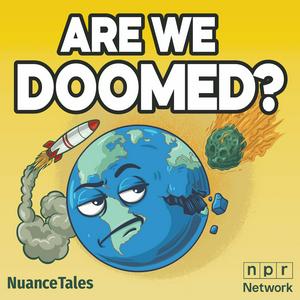
Is the world ending, or does it just feel like it? "Are We Doomed?" investigates the greatest risks facing society, the planet, and our species. What’s real? What’s hype? And how do we actually make it out alive? Nukes. Asteroids. Autocracy. Rogue AI. Climate-driven pandemics. Angry hippopotamuses. Teeth clenched, curiosity engaged, quips ready, this “slightly narrative” podcast explores everything from the existential and the unexpected to the overblown. Award-winning public radio journalist Ben Bradford brings you wild true stories, high-production sound design, and world-class experts answering the questions they never prepared for (“Why is the Earth doing this to us?”). From NuanceTales and distributed by the NPR Network, this show delves into history, science, technology, and the natural world, to help you separate legitimate world-changing risks from doomsday fantasies. Come for the supervolcano under Yellowstone National Park (real), stay to learn why the post-apocalyptic wasteland won’t look like the movies (sorry, you won’t be wandering with a shotgun and a dog), and leave with a better understanding of how our brilliant, bumbling species can chart a path through our current, terrifying adolescence.
Podcast websiteListen to Are We Doomed?, Unexplainable and many other podcasts from around the world with the radio.net app
Get the free radio.net app
- Stations and podcasts to bookmark
- Stream via Wi-Fi or Bluetooth
- Supports Carplay & Android Auto
- Many other app features
Are We Doomed?: Podcasts in Family

 USA