
Listen to this podcast in the app for free: Download for free in the App Store
radio.net
Sleep timer
Save favorites
161 episodes
The Menopause Misinformation Problem with Amanda Thebe
10/26/2026 | 53 mins.Amanda Thebe is back, and she and Dr. Spencer Nadolsky and Dr. Karl Nadolsky spend this one on something that frustrates all three of them daily: the state of menopause information online.
Amanda has spent nearly a decade as a patient advocate in this space. She watched the conversation go from nobody talking about menopause to the topic being completely saturated, and she makes the case that it didn't just get louder, it got manipulated. Her own experience is a big part of why. She walks through what happened at 42 when she couldn't get out of bed, started falling over, was peeing her pants after two uncomplicated births, and spent two years in the Canadian healthcare system getting scans before a gynecologist finally said the word perimenopause. Her first reaction to hearing it is one of the better moments in the episode.
The part that will stop you is what came next. Amanda tried hormone therapy and it never worked for her. Every formulation, every dose, cycling on and off for four years, with migraines up to 20 days a month and symptoms that got worse instead of better. When she reached out to a doctor she considered the guru in this space for help, the advice she got back was to ask for an elective hysterectomy on a healthy uterus so she could take estrogen alone. That was the moment she realized there was a grift.
From there the conversation covers what hormone therapy is actually indicated for versus what influencers claim, why testosterone is being oversold, the real risks of pellets and unnecessary compounded products, and how venture capital money is reshaping telehealth in ways that put profit ahead of patients. Spencer and Karl also get into what the Women's Health Initiative actually showed and why the pendulum swinging too far the other way created the exact conditions these companies are now exploiting.
It's not an anti-hormone-therapy episode. All three of them agree more women should probably be on it, and that it's first line treatment for the things it treats. The point is that fear sells in both directions, and women deserve accurate information and a real choice.
Hosted by Simplecast, an AdsWizz company. See pcm.adswizz.com for information about our collection and use of personal data for advertising.Retatrutide & Beyond: Eli Lilly Exec on Next-Gen GLP-1s
10/07/2026 | 58 mins.Docs Who Lift finally got a big pharma exec on the show. Dr. Ken Custer is President of Lilly's Cardiometabolic Health, and he came straight from the EASD conference in Milan with fresh data on what's coming after tirzepatide.
If you've been waiting on retatrutide, this is the episode. Spencer and Karl get Custer to walk through the new phase 3 results and the tirzepatide plus eluralintide combination, including why stacking these mechanisms seems to deliver more than drug developers usually get. You'll hear how amylin works on a completely different set of brain pathways than GLP-1, why Lilly walked away from one version of the drug in favor of another, and what the early tolerability data looks like. That last part matters if you're one of the people who couldn't handle a GLP-1, or you've been too nervous to try one.
The conversation then opens up to the questions patients actually ask. What's next if you hit a wall on tirzepatide and still have weight to lose. Whether these medications will ever be approved for people who aren't sick yet, just heading that direction. And why it's getting harder to run trials at all when everyone can tell whether they're on the real drug.
The back half goes behind the curtain. Custer is honest about how often drug development fails, what these trials cost, and what it was like to be in the room the day Lilly chose tirzepatide, a molecule he's now spent 12 years on. He takes on the pricing question directly, explains where coverage is headed, and makes his case for why access is still the biggest problem.
It ends where you'd want it to. The gray market, what regulation actually gets you, and how to think about doctors who work with pharma versus the people calling them shills while selling supplements with zero data behind them.
Nobody got paid for this one.
Hosted by Simplecast, an AdsWizz company. See pcm.adswizz.com for information about our collection and use of personal data for advertising.Food Noise Is Real, and Now We Can Measure It
09/22/2026 | 49 mins.Dr. David Allison and Dr. Emily Dhurandhar join Dr. Spencer Nadolsky and Dr. Karl Nadolsky to break down their new research on food noise. Patients on GLP-1s kept describing the same thing: the constant background chatter about food finally went quiet. Allison and Dhurandhar convened an expert panel of physicians, psychologists, statisticians, and eating disorder specialists to define it properly and build a validated questionnaire to measure it.
Their definition: persistent, unwanted, unpleasant thoughts about food that harm your social, physical, or mental health. The data revealed three distinct parts. Preoccupation with food, how inescapable it feels, and how distressing it is. That third piece, the dysphoria, is what separates food noise from hunger and cravings. Cravings can be enjoyable. Food noise is not.
The conversation covers why food noise correlates with other appetite measures without being the same thing, patients who lose almost no weight on medication but refuse to stop taking it because of the mental relief, and whether food noise alone could justify treatment. They also share where the research is headed, from translations into ten languages and a new adolescent validation to a study testing whether food noise affects driving safety. And they answer the claim that Big Pharma invented the term.
Hosted by Simplecast, an AdsWizz company. See pcm.adswizz.com for information about our collection and use of personal data for advertising.Does Metabolically Healthy Obesity Even Exist?
08/30/2026 | 48 mins.Dr. Christian Rodriguez joins the show straight from Pennington Biomedical, where he works alongside obesity research legends Eric Ravussin and Steve Heymsfield. He breaks down his new review on metabolically healthy obesity and why the old "zero metabolic syndrome criteria" definitions are so inconsistent. The conversation dives deep into the Lancet Commission's new obesity framework, comparing it to the ACE staging system and picking apart where each one falls short, including the controversial call to leave type 2 diabetes out of the "preclinical" category. Rodriguez also previews his upcoming study on people with a BMI of 60 and above, a group that's rarely studied because researchers aren't sure it's safe. The episode wraps with a candid discussion on GLP-1 stigma and why treating obesity early matters more than chasing a number on the scale.
Hosted by Simplecast, an AdsWizz company. See pcm.adswizz.com for information about our collection and use of personal data for advertising.Is Your Obesity Genetic? Food Noise and Bardet-Biedl Syndrome Explained
08/03/2026 | 39 mins.Could your weight gain and non-stop thoughts about food actually come from a rare condition you were born with? In this episode of the Docs Who Lift podcast, Dr. Spencer Nadolsky and Dr. Karl Nadolsky chat with weight expert Dr. Jesse Richards about Bardet-Biedl Syndrome (BBS). This rare condition tricks your brain into thinking your body is starving, even when you have plenty of body fat stored up.
They talk about how doctors figure out if someone has BBS, an easy math trick to check your risk, and why normal diets or standard weight-loss shots do not always work for this condition. Plus, you will learn about special medicines that fix the brain's hunger signals when nothing else seems to work!
In This Episode, You Will Learn:
What Bardet-Biedl Syndrome (BBS) is and why many doctors miss it.
Clear physical signs to look for, like extra fingers or toes, vision loss, and weight gain that starts very early in life.
An easy formula to check your risk using your weight and your daily thoughts about food.
The big difference between normal food cravings and extreme, non-stop hunger.
Why special medicines can fix brain signals when regular weight-loss tools fail.
Hosted by Simplecast, an AdsWizz company. See pcm.adswizz.com for information about our collection and use of personal data for advertising.
More Health & Wellness podcasts



Trending Health & Wellness podcasts








About Docs Who Lift
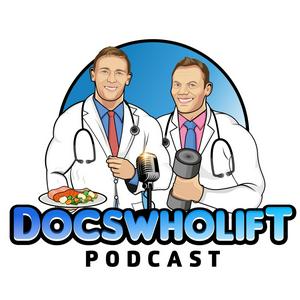
Drs. Spencer and Karl Nadolsky talk about nutrition, medicine, and fitness through the lens of two physicians who lift weights. Both doctors are former NCAA division 1 wrestlers who have gone into medicine. Dr. Spencer Nadolsky is a board certified family physician specialized in obesity medicine and lipidology. Dr. Karl Nadolsky is a board certified endocrinologist also specialized in obesity medicine.
Podcast websiteListen to Docs Who Lift, Tony Mantor: Why Not Me ? and many other podcasts from around the world with the radio.net app
Get the free radio.net app
- Stations and podcasts to bookmark
- Stream via Wi-Fi or Bluetooth
- Supports Carplay & Android Auto
- Many other app features
Get the free radio.net app
- Stations and podcasts to bookmark
- Stream via Wi-Fi or Bluetooth
- Supports Carplay & Android Auto
- Many other app features

Docs Who Lift
Scan code,
download the app,
start listening.
download the app,
start listening.
 USA
USA