

Listen to this podcast in the app for free: Download for free in the App Store
radio.net
Sleep timer
Save favorites
60 episodes
Episode 33: The Facial Injuries a Crash Can Leave Behind
10/08/2026 | 26 mins.A car crash can leave injuries that are easy to see, like a broken nose or facial bruising. Other changes may become clear later, when someone notices they cannot breathe as well, hear as well, or smell the way they did before.
In this episode of Crashes, Claims & Clarity, Darrell Burrow talks with Dr. Aaron Fletcher, an ear, nose, and throat surgeon who specializes in facial plastic and reconstructive surgery. They discuss what can happen to the face, nose, and ears during a collision, why some symptoms deserve a closer look, and how facial injuries can affect both daily function and a person’s sense of self.
Five key takeaways
✅ A facial injury may involve more than the damage visible on the outside.
✅ New trouble breathing through the nose, changes in smell or hearing, ringing in the ears, or dizziness are symptoms to discuss with a medical professional.
✅ Timing can matter with nasal fractures. Dr. Fletcher explains why he aims to evaluate these injuries before the bones heal in the wrong position.
✅ Recent photographs, imaging, and medical records can help document how an injury changed someone’s appearance or function.
✅ Recovery can mean breathing well and looking and feeling like yourself again.
Connect with Dr. Aaron Fletcher
Learn more about Dr. Fletcher and the Georgia Center for ENT and Facial Plastic Surgery at https://www.aaronfletchermd.com/ or call 678-902-9495.
Connect with Darrell Burrow
For information about Burrow & Associates and injury claims in Georgia, visit https://legalatlanta.com/.
Listen to Crashes, Claims & Clarity
https://podcasts.apple.com/us/podcast/crashes-claims-clarity/id1824256144
This episode is for general information and is not a substitute for medical or legal advice about your circumstances.Episode 32: The Legal Domino Effect of a Car Crash
10/01/2026 | 36 mins.A car crash rarely creates just one legal problem. The injury claim may receive the most attention, but the financial, insurance, traffic, bankruptcy, and estate-planning consequences can continue long after the vehicles are removed from the road.
In this episode of Crashes, Claims & Clarity, attorney Darrell Burrow speaks with Georgia attorney Terence O. “Terry” McGinn about the legal domino effect that can follow a serious collision.
Drawing on decades of experience in consumer finance and law, Terry explains why injured people need to consider the entire financial picture before making decisions that could affect their settlement or future security. He discusses the danger of borrowing against an anticipated settlement, the importance of disclosing a personal injury claim during bankruptcy, and how paying a traffic citation without first obtaining legal advice may create unintended consequences.
Darrell and Terry also examine what can happen when damages exceed an at-fault driver’s insurance limits, why realistic expectations matter in personal injury cases, and which estate-planning documents become critical when a crash leaves someone incapacitated or causes a death.
This conversation shows why a crash should never be treated as an isolated insurance claim. One accident can affect a person’s health, employment, debt, property, family, and financial future.
Listeners will learn:
✅ Why settlement advances can consume a substantial portion of an injured person’s recovery.
✅ How a personal injury claim may affect a pending bankruptcy case.
✅ Why drivers should seek legal advice before paying a citation or entering a plea.
✅ What can happen when accident damages exceed the responsible driver’s insurance coverage.
✅ Why a will, financial power of attorney, and advance directive for healthcare matter before an emergency occurs.
✅ How realistic expectations can prevent painful surprises at the end of a claim.
✅ Why catastrophic injury cases may require guidance from legal, financial, tax, and long-term-care professionals.
Listen to Crashes, Claims & Clarity:
https://podcasts.apple.com/us/podcast/crashes-claims-clarity/id1824256144
This episode is provided for general educational purposes and does not constitute legal, financial, or tax advice. Laws and individual circumstances vary. Consult an appropriate professional regarding your situation.Bonus: Financial Preparedness: How to Protect Your Family and Your Future
09/17/2026 | 21 mins.This special drop-feed episode features Crashes, Claims & Clarity host Darrell Burrow as the guest on Legacy Blueprint Plan It Forward, hosted by Georgia estate planning attorney Mike Bascom.
Darrell draws on more than 30 years of experience handling personal injury and bankruptcy matters to discuss what families can do before an accident, financial crisis, or other major life event turns their world upside down.
The conversation explores the financial mistakes people often make when trouble strikes, why waiting too long to seek legal advice can make a difficult situation worse, and what someone should do after receiving a significant personal injury settlement. Darrell also explains how preparation, trusted professional guidance, family support, and faith can help people recover and rebuild.
Five Key Takeaways
✅ Preparation matters because unexpected injuries, illnesses, and financial hardships can happen to any family.
✅ After receiving a substantial settlement, pause before making major purchases or financial decisions.
✅ Bankruptcy should not automatically be viewed as failure. In the right circumstances, it can provide a legal path toward rebuilding.
✅ Seeking advice early gives people more options and may prevent a challenging situation from becoming worse.
✅ Strong relationships, trusted advisors, family support, and faith can help people become more resilient during difficult seasons.
In This Episode
The financial mistakes families make before a crisis.
Why emergency savings and advance planning matter.
What to do immediately after receiving a personal injury settlement.
Common misconceptions about bankruptcy.
How delaying professional advice can cost someone valuable recovery time.
The role of family, community, and faith during a personal or financial crisis.
How contingency fees work in personal injury cases.
Three practical steps listeners can take to begin protecting their future.
This episode originally appeared on Legacy Blueprint Plan It Forward with host Mike Bascom and is being shared as a special drop-feed presentation on Crashes, Claims & Clarity.Episode 31: Functional Capacity Evaluations After an Injury
09/10/2026 | 32 mins.What Can You Really Do After an Injury?
An MRI or X-ray can show an injury, but it cannot always show how that injury affects someone’s ability to work, care for themselves, or return to everyday life.
On this episode of Crashes, Claims & Clarity, Darrell Burrow talks with occupational therapist Peggy Freedman, President of The Freedman Group in Marietta, Georgia.
With more than 35 years of experience, Peggy has completed more than 4,000 Functional Capacity Evaluations and over 30,000 treatments. She specializes in evaluating how injuries affect real-world function, from returning to work to managing daily activities safely and independently.
Peggy explains what Functional Capacity Evaluations can reveal, why job descriptions do not always reflect the real physical demands of a job, and how hidden injuries can impact recovery long after an accident.
5 Key Takeaways
✅ Medical stability does not always mean functional readiness.
A person may be considered medically stable while still having significant difficulty returning to work or handling everyday activities.
✅ Functional Capacity Evaluations look beyond the diagnosis.
An MRI or X-ray can identify pathology, but an FCE helps determine what someone can realistically and safely do.
✅ Real job duties may be very different from the written job description.
Lifting, reaching, pushing, pulling, and other physical demands are often missing or incomplete on paper.
✅ Some of the most serious limitations may not be obvious.
Peggy shares the example of a carpenter whose undiagnosed brain injury affected his ability to perform basic calculations even though his visible injury was healing.
✅ Recovery includes independence and quality of life.
Home assessments, job-site evaluations, and practical modifications can help injured individuals return to meaningful activities and function more safely.
Peggy also explains the purpose of validity testing, how pain and fatigue are considered during an evaluation, and why objectivity is essential when her findings may affect an injury claim, employment decision, or future treatment.
About Peggy Freedman
Peggy Freedman is an occupational therapist and President of The Freedman Group in Marietta, Georgia. With more than 35 years of experience, she specializes in Functional Capacity Evaluations, return-to-work programs, work conditioning, home and job-site assessments, and rehabilitation following workplace and personal injuries.
She has personally completed more than 4,000 Functional Capacity Evaluations and over 30,000 treatments and is frequently called upon as an expert witness in personal injury, workers’ compensation, and disability cases.
Connect With Peggy Freedman
The Freedman Group
1950 Spectrum Circle, Suite 125
Marietta, Georgia
770-541-7401
Listen to Crashes, Claims & Clarity:
https://podcasts.apple.com/us/podcast/crashes-claims-clarity/id1824256144
Visit Burrow & Associates website: Personal Injury & Bankruptcy Lawyers | Burrow & AssociatesEpisode 30: What Spine Scans Can Miss After a Crash
09/03/2026 | 49 mins.A patient leaves the emergency room after a crash and is told the imaging looks normal. But days later, the pain is worse, movement is limited, and everyday activities have become difficult.
What happens when the scan and the patient’s experience do not match?
In this episode of Crashes, Claims & Clarity, Darrell L. Burrow speaks with Dr. Ben Burch, a double board-certified orthopedic spine surgeon at the Atlanta Spine Institute.
Dr. Burch explains that emergency room imaging is designed to answer specific questions. A CT scan can provide valuable information about bones and traumatic injuries, but it may not reveal every soft-tissue injury, muscle or ligament strain, or other source of pain. A more obvious injury can also create “distracting pain,” causing a patient to overlook symptoms in another part of the body until later.
The conversation also examines one of the most difficult questions following an accident: Did the crash cause a spinal condition, or did it aggravate a condition that was already present?
Dr. Burch explains why imaging alone cannot always answer that question. The timing of symptoms, the patient’s history, previous medical records, physical examination, functional limitations, and response to treatment can all help provide a more complete clinical picture.
Darrell and Dr. Burch also discuss how physicians determine whether conservative treatment is working, when progress has plateaued, and when surgery may become an appropriate option. Dr. Burch describes his multimodal approach to nonsurgical care, which may include physical therapy, anti-inflammatory treatment, medications directed at nerve or muscle symptoms, and carefully targeted injections.
The episode then moves inside the operating room as Dr. Burch explains the difference between uniportal and biportal endoscopic spine surgery. He describes endoscopic surgery as a tool that allows surgeons to reach and treat spinal problems through narrow corridors while attempting to reduce unnecessary damage to surrounding tissue.
Listeners will learn:
Why a normal CT scan does not necessarily explain persistent pain
How distracting pain can hide a secondary injury after a crash
Why degenerative changes on an MRI may have existed without symptoms
How doctors evaluate whether a crash caused or aggravated a condition
Why functional progress may be more useful than a simple pain score
How physicians recognize when conservative care has stopped producing progress
The difference between uniportal and biportal endoscopic spine surgery
Why a small incision does not mean the underlying condition was minor
What patients should ask before agreeing to a spine procedure
Why AI can assist with measurements but should not replace human clinical judgment
Dr. Burch also encourages patients to seek another opinion when appropriate and to ask surgeons direct questions about alternative treatments and their experience performing a recommended procedure.
About Dr. Ben Burch
Dr. Ben Burch is a double board-certified orthopedic spine surgeon at the Atlanta Spine Institute. He specializes in nonsurgical care and advanced minimally invasive and endoscopic procedures, including both uniportal and biportal techniques.
Dr. Burch treats traumatic injuries, herniated discs, spinal stenosis, degenerative conditions, and other complex spinal disorders. He also trains surgeons, contributes to spine research, and performed Georgia’s first endoscopic spinal fusion procedures.
Learn more about Dr. Ben Burch and the Atlanta Spine Institute:
https://atlantaspineinstitute.com/our-practice/dr-ben-burch/
Listen to Crashes, Claims & Clarity:
https://podcasts.apple.com/us/podcast/crashes-claims-clarity/id1824256144
If you or someone you love has been injured in a Georgia accident, learn more about Darrell Burrow and Burrow & Associates at LegalAtlanta.com.
More Business podcasts
 The Diary Of A CEO with Steven BartlettBusiness, Education, Society & Culture
 The Ramsey ShowBusiness, Education, Investing, Self-Improvement
 REAL AF with Andy FrisellaBusiness, Entrepreneurship, Marketing
 The Home Service Expert PodcastBusiness, Management
 Unblinded with Sean CallagyBusiness, Education, News, Sports, Sports News
 Proven PodcastBusiness, Entrepreneurship
 Habits and HustleBusiness, Education, Entrepreneurship, Health & Wellness, Self-Improvement
 Young and Profiting (YAP) with Hala Taha: Entrepreneurship and Self-Improvement PodcastBusiness, Entrepreneurship
 Business MVPBusiness, Education, Entrepreneurship, Self-Improvement
 The Money MondaysBusiness, Entrepreneurship
Trending Business podcasts
 Afford Anything | Get Smarter With MoneyBusiness, Investing
 Financial Tea with Mrs. Dow JonesBusiness, Investing
 Franklin Planner PodcastBusiness, Education, Entrepreneurship, Management, Self-Improvement
 The MarketsBusiness
 Cornerstone Private OfficeBusiness
 Career SessionsBusiness, Careers, Entrepreneurship, Management
 Growth MavericksBusiness, Entrepreneurship
 The Chad Durfee ShowBusiness, Marketing
 Do Hard Things PodcastBusiness, Management, Marketing
 Change CycleBusiness, Earth Sciences, Management, News, News Commentary, Science
 Allyship in ActionBusiness, Careers, Management
 Thriving Minds with Alberto ZandiBusiness, Education, Entrepreneurship, Personal Journals, Self-Improvement, Society & Culture
 The Story of MoneyBusiness, Business News, Education, History, News, Society & Culture
 Barclays BriefBusiness, Business News, News, Society & Culture
 Earn Your LeisureBusiness, Business News, Education, Investing, News
 Eye On The MarketBusiness, Investing
 The MORE ShowBusiness, Careers, Education, Investing, Tutorials
 The Stacking Benjamins ShowBusiness, Education, Investing, Self-Improvement
 Proximity with Ken JoslinBusiness, Entrepreneurship
 Slate MoneyBusiness, Investing
 The Tyler Dickerhoof ShowBusiness, Business News, Entertainment News, Management, News
 The Entrepreneur DNABusiness, Entrepreneurship
About Crashes, Claims & Clarity
After an accident, life can feel like it’s been turned upside down. Pain, confusion, and uncertainty take over — and it’s hard to know who to trust or what to do next.
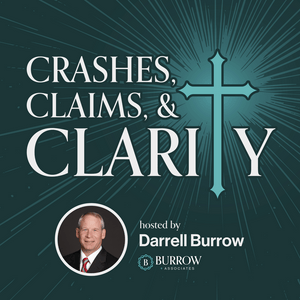
Welcome to Crashes, Claims, & Clarity, the podcast where personal injury law meets real-life recovery. Hosted by attorney Darrell Burrow — a legal veteran with over 30 years of experience and a strong foundation in Christian faith — this show goes beyond legal talk to explore the human side of healing.
Each week, Darrell meets with survivors, doctors, legal professionals, and advocates to share honest conversations and practical insights. From car crashes and insurance battles to emotional trauma and family impact, Crashes, Claims, & Clarity provides the information and encouragement people need to move forward with strength.
Whether you’re searching for answers, advocating for someone you love, or simply trying to understand the path to justice, this podcast offers clear direction, rooted in experience, compassion, and faith.
Podcast websiteListen to Crashes, Claims & Clarity, The Diary Of A CEO with Steven Bartlett and many other podcasts from around the world with the radio.net app
Get the free radio.net app
- Stations and podcasts to bookmark
- Stream via Wi-Fi or Bluetooth
- Supports Carplay & Android Auto
- Many other app features
Get the free radio.net app
- Stations and podcasts to bookmark
- Stream via Wi-Fi or Bluetooth
- Supports Carplay & Android Auto
- Many other app features

Crashes, Claims & Clarity
Scan code,
download the app,
start listening.
download the app,
start listening.
 USA
USA