

Listen to this podcast in the app for free: Download for free in the App Store
radio.net
Sleep timer
Save favorites
218 episodes
The Death of Barrett Walsh: Psychosis, a Murder Charge, and the Lindsay Clancy Connection
09/16/2026 | 41 mins.When I first started looking into the death of two-year-old Barrett Walsh, one detail immediately stood out to me: his mother, Corie Walsh, had reportedly been closely following the Lindsay Clancy trial and discussing it with friends just hours before Barrett was found.
The similarities between the two cases are difficult to ignore. Both involve mothers accused of killing young children inside their family homes, suicide attempts, ligatures, and defenses centered around severe mental illness or psychosis. But similarities aren't evidence, and they certainly don't prove that one case inspired another.
In this episode of Pushing Up Lilies, I want to slow the story down and look beyond that headline.
Barrett, whose nickname was Bear, was found in the basement of his Illinois home with a ligature around his neck. A neighbor lowered him, began CPR, and called 911. Corie was found elsewhere in the home with injuries believed to be self-inflicted. Prosecutors have since charged her with three counts of first-degree murder, while her attorneys say she was experiencing a psychotic episode.
From a death investigator's perspective, though, those facts are only the beginning.
I'm taking you through how I would approach a scene like this: documenting Barrett's original position before lifesaving efforts changed the scene, examining the ligature and suspension point, preserving digital evidence, reconstructing the timeline, documenting medications and other evidence inside the home, and separating what witnesses actually observed from what they interpreted.
Content Note: This episode discusses the death of a child, ligature asphyxia, self-harm, alleged homicide, suicide, and severe mental illness.The Death of Aria Talathi: When a Drowning Scene Tells a Different Story
09/09/2026 | 44 mins.Sometimes a death scene seems to tell you exactly what happened. A child is found submerged in a swimming pool, and the immediate assumption is drowning.
But as a death investigator, I've learned that where someone is found doesn't necessarily tell us where, or how, they died.
In this episode of Pushing Up Lilies, I'm taking you through the case of four-year-old Aria Talathi, who was found in the deep end of a swimming pool at a short-term rental in Florida while traveling with her mother, Dr. Neha Gupta. What initially appeared to be a devastating childhood drowning became something very different when investigators began looking more closely at the physical evidence.
According to the arrest affidavit discussed in this episode, investigators said Aria's lungs and stomach were considered dry, while the examination also documented cuts inside her mouth and bruising along the insides of her cheeks. Authorities alleged those injuries raised the possibility that she had been smothered and was already dead before being placed in the pool.
I'll take you behind the scenes of how I would approach a death investigation like this, including what I would photograph, what questions I would ask, how I would build the timeline, and why something as simple as a door latch, an undisturbed bed, a phone record, or the contents of a stomach can become important.
And there's something I don't want us to lose in all of the forensic details: Aria was four years old. Before her name appeared in an arrest affidavit or became part of a murder case, she was a little girl who went to the beach, rode jet skis, and traveled with her mother. Her life deserves to remain at the center of this story.
I also begin this episode with a brief update on the Lindsay Clancy case following the September 4 mistrial and what may happen next.
Content Note: This episode discusses the death of a child, possible smothering/asphyxiation, drowning, and alleged homicide.The Lindsay Clancy Trial: The Case Is Now in the Jury’s Hands
09/02/2026 | 42 mins.The Lindsay Clancy trial has reached one of its most important moments. The witnesses are finished, both sides have made their closing arguments, and now twelve jurors are left to decide what happened inside that home on January 24, 2023, and whether Lindsay was criminally responsible when Cora, Dawson, and Callan died.
In this episode of Pushing Up Lilies, I’m taking you through the final stretch of testimony without making you sit through every minute of psychiatrists and psychologists arguing over diagnoses. Because, y’all, even I recorded that version, and decided I wasn't going to do that to you.
Instead, I want to focus on what actually matters.
The Commonwealth brought in its final three experts, and while none of them suggested Lindsay was well or that her suicide attempt wasn't real, they disagreed with the defense over two critical issues: whether she was psychotic and whether she still had the capacity to understand that what she was doing was wrong.
We’ll also talk about the moment religion entered the testimony and the defense asked for a mistrial, what happened during closing arguments, and the five possible decisions the jury can reach for each child, including what a finding of lack of criminal responsibility would actually mean.
As a forensic nurse death investigator, I keep coming back to something I learned working scenes: evidence doesn't narrate itself. Phones, medications, searches, timelines, medical records and witness statements give us pieces. It's investigators, experts, attorneys, and ultimately jurors, who have to determine what those pieces mean.
And that is exactly where this case now sits.
The jury doesn't have to decide whether Lindsay suffered. Every expert agreed that she did. Their job is to determine whether the Commonwealth proved criminal responsibility beyond a reasonable doubt.
And while we talk about mental illness, diagnoses, criminal responsibility and everything surrounding this trial, I don't want us to lose sight of the reason that courtroom exists in the first place: Cora, Dawson, and Callan.
I'll continue following the case and bring you an update when something moves.
Content Note: This episode discusses the deaths of children, strangulation, suicide, self-harm, and serious mental illness.The Lindsay Clancy Trial: New Testimony, New Questions
08/26/2026 | 26 mins.The Lindsay Clancy trial continues, and with each new day of testimony, the questions surrounding this case seem to become even more complicated.
In this episode of Pushing Up Lilies, I’m continuing my coverage as the defense presents its case and the jury hears from family members, mental health professionals, and forensic experts offering very different perspectives on Lindsay’s state of mind.
As a forensic nurse death investigator, I’m especially interested in what happens when experts examine the same evidence and reach very different conclusions. What does the testimony tell us? What questions remain unanswered? And how will the jury ultimately determine where severe mental illness ends and criminal responsibility begins?
I’ll also take you inside some of the more unexpected moments in the courtroom and share my perspective on what stood out to me as the trial moves closer to its conclusion.
There is a lot to unpack in this week’s testimony, and some of it may change the way you look at this case.
Through it all, I’ll continue to keep Cora, Dawson, and Callan at the center of this story as we follow the evidence and wait to see what comes next.
Content Note: This episode discusses the deaths of children, suicide, self-harm, postpartum mental illness, and other subjects that may be difficult for some listeners.The Lindsay Clancy Trial: Psychosis, Premeditation, or Both?
08/19/2026 | 37 mins.Last week, I took you through the devastating events of January 24, 2023, the night Lindsay Clancy’s three young children, Cora, Dawson, and Callan, were fatally harmed inside their family home in Duxbury, Massachusetts.
This week, we move from the home to the courtroom.
In The Lindsay Clancy Trial: Psychosis, Premeditation, or Both?, I take a closer look at one of the most complicated questions surrounding this case:
What was happening in Lindsay Clancy’s mind when her children died?
Lindsay’s mental health before the deaths has become a critical part of understanding the case. Her treatment, medications, reported symptoms, and concerns surrounding postpartum mental illness raise difficult questions about postpartum depression and postpartum psychosis, and about how severe psychiatric illness affects criminal responsibility.
But there is another side to this case.
The circumstances surrounding that night also raise questions about planning and awareness. Lindsay’s husband, Patrick, left the home to run errands. During the relatively short period he was gone, the lives of all three children were changed forever.
So how does the legal system distinguish between an intentional, premeditated act and an act committed by someone experiencing profound psychosis?
Can a person appear organized or purposeful while simultaneously experiencing a severe break from reality?
And where does mental illness end and legal responsibility begin?
As a nurse and former forensic death investigator, I’m particularly interested in the intersection between the medical evidence and the investigative evidence. A case like this cannot be understood through one piece of information alone. We have to look at the timeline, behavior, medical and psychiatric history, physical evidence, statements, expert opinions, and what investigators were able to establish.
We also have to remember why this trial is happening.
Three young children lost their lives.
Whatever conclusions are ultimately reached about Lindsay’s mental state and criminal responsibility, Cora, Dawson, and Callan remain at the center of this case.
In this episode, I explore the competing questions surrounding the Lindsay Clancy trial and the challenge of evaluating a case in which mental illness and evidence of apparent planning may exist alongside one another.
Was this postpartum psychosis?
Was it premeditation?
Or is the truth more complicated than either explanation alone?
Join me for Part Two of the Lindsay Clancy case on Pushing Up Lilies:
The Lindsay Clancy Trial: Psychosis, Premeditation, or Both?
More Health & Wellness podcasts
 On Purpose with Jay ShettyBusiness, Health & Wellness, Mental Health
 The Dr. John Delony ShowHealth & Wellness, Mental Health, Relationships, Society & Culture
 Tony Mantor: Why Not Me ?Alternative Health, Health & Wellness, Mental Health
 Extend Podcast with Darshan Shah, MDHealth & Wellness, Medicine, Nutrition
 The Thyroid (and Hormone) Fixer Podcast: Thyropause, Menopause, Metabolism and How to Fix ItAlternative Health, Health & Wellness, Medicine, Nutrition
 Passion Struck with John R. MilesAlternative Health, Education, Health & Wellness, Mental Health, Self-Improvement
 Huberman LabHealth & Wellness, Life Sciences, Science
 Culture Apothecary with Alex ClarkHealth & Wellness
 10% Happier with Dan HarrisHealth & Wellness, Mental Health
 Nothing much happens: bedtime stories to help you sleepFiction, Health & Wellness
Trending Health & Wellness podcasts
 The Chalene Show | Pop Culture, Women's Health, & FitnessEducation, Entertainment News, Fitness, Health & Wellness, Mental Health, News, Nutrition, Relationships, Self-Improvement, Society & Culture
 Uniquely Human: The PodcastEducation, Health & Wellness, Mental Health
 Spoonful of SugarEducation, Health & Wellness, Medicine
 The People's PharmacyAlternative Health, Health & Wellness, Kids & Family, Medicine
 You Are Not BrokenHealth & Wellness, Medicine
 The Sober Mom LifeAlternative Health, Health & Wellness, Kids & Family, Mental Health, Parenting
 Choose StrongHealth & Wellness
 The Proof with Simon HillEducation, Health & Wellness, Nutrition, Self-Improvement
 Rain Sounds - 10 HoursAlternative Health, Health & Wellness, Nature, Science
 Sleep Wave: Sleep Meditation & Sleepy StoriesHealth & Wellness, Mental Health
 رواق / RavaqHealth & Wellness, Mental Health
 The Gabby Reece ShowBusiness, Entrepreneurship, Health & Wellness, Mental Health, Nutrition, Relationships, Society & Culture
 Drift Off - Bedtime Stories for AdultsAlternative Health, Health & Wellness, Mental Health
 TED HealthHealth & Wellness
 Brown Noise Sleep SoundsHealth & Wellness, Mental Health
 The Caring NeurologistAlternative Health, Fitness, Health & Wellness, Medicine
 Judging MeghanEducation, Health & Wellness, Kids & Family, Mental Health, Parenting, Personal Journals, Relationships, Self-Improvement, Society & Culture
 PLANTSTRONG PodcastAlternative Health, Health & Wellness, Medicine, Nutrition
 Lifespan with Dr. David SinclairHealth & Wellness
 You're Not Too MuchEducation, Health & Wellness, Mental Health, Personal Journals, Self-Improvement, Society & Culture
 The Empty BowlHealth & Wellness
About Pushing Up Lilies
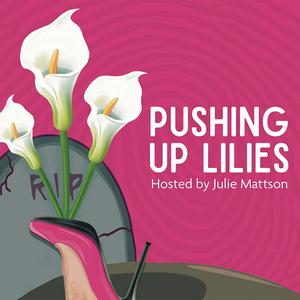
Dissect the science behind some of the most spine-tingling, unusual and terrifyingly true crime stories with Julie Mattson, a seasoned Forensic Nurse Death Investigator in this gripping weekly podcast.
Julie's unique approach to investigations is informed by her background in nursing, which allows her to provide an in-depth analysis of the medical intricacies and physiological aspects of each case.
With her compassionate storytelling and unwavering dedication to uncovering the truth, Julie takes you on a thrilling journey into the world of forensic science, shining a light on the intersection of medicine, justice and criminal investigation.
In “Pushing Up Lilies,” Julie's expert medical analysis will captivate your imagination and challenge your understanding of the human body's role in solving the most complex and enigmatic criminal case.
Podcast websiteListen to Pushing Up Lilies, On Purpose with Jay Shetty and many other podcasts from around the world with the radio.net app
Get the free radio.net app
- Stations and podcasts to bookmark
- Stream via Wi-Fi or Bluetooth
- Supports Carplay & Android Auto
- Many other app features
Get the free radio.net app
- Stations and podcasts to bookmark
- Stream via Wi-Fi or Bluetooth
- Supports Carplay & Android Auto
- Many other app features

Pushing Up Lilies
Scan code,
download the app,
start listening.
download the app,
start listening.
 USA
USA