

Listen to this podcast in the app for free: Download for free in the App Store
radio.net
Sleep timer
Save favorites
57 episodes

How Nike Built the Stories Behind Kobe and LeBron (And What Every Brand Can Learn From It)
10/01/2026 | 1 mins.Most people who stall out in their careers never find out why. They did the work and hit the numbers, then watched someone else get the room, the budget, and the title. The rules that decided it were never written down, and nobody was going to hand them over.
Arturo Nunez is the former VP of Marketing for Nike Basketball, where he shaped the public stories of Kobe Bryant and LeBron James. He ran Latin America for the NBA, spent four and a half years at Apple, and served as CMO of the largest digital bank in the world. He grew up in 1970s Harlem with no one in his family who had ever worked inside a corporation. His new book is the manual he wishes he'd been handed on day one.
Kayvon and Arturo start inside the locker room. Arturo explains how his personal friendship with Kobe produced better stories than any title could, and shares the question Kobe asked everyone around him: are you curious or are you committed? Then comes the LeBron problem. After The Decision, young players called him the best in the league, yet none called him their favorite. Arturo walks through how his team borrowed from Muhammad Ali in Zaire to build the "Training Day" campaign and flip the public story.
The second half turns to the unwritten rules: the difference between a mentor and a sponsor, why a win that costs you the relationship is a pyrrhic victory, and the rule he calls the meeting before the meeting.
Founders, executives, marketers, and operators who already have the skill and can't figure out why the next level isn't opening up. First-generation professionals without a family roadmap. Leaders building diverse teams. If you believe good work speaks for itself, this conversation will be uncomfortable, and it should be.
At its core, this episode is about influence inside organizations and how career growth happens once talent stops being the differentiator. Arturo makes the case that storytelling is the most powerful skill in marketing and leadership, and connects it to navigating a matrix organization, where results depend on relationship capital with people who don't report to you. The discussion covers stakeholder alignment before high-stakes presentations, the role of sponsorship in reaching the C-suite, and why diversity is a revenue decision for any business entering new markets.
QUESTIONS ANSWERED
How did Nike build authentic brand stories around Kobe Bryant and LeBron James?
What is the difference between a mentor and a sponsor?
How do you get buy-in before a high-stakes executive meeting?
Why do talented people get passed over for promotion?
How do you build win-win relationships in a matrix organization?
Why is diversity a business advantage?
How do first-generation professionals navigate corporate America?
Looking to dive deeper into these conversations and connect with our host and guest?
Follow Arturo Nunez:
Instagram
LinkedIn
Buy Arturo's Book
Website
Follow Kayvon:
Instagram
Facebook
LinkedIn
TikTok
Want to go deeper with Kayvon?
Subscribe to the newsletter
Book a discovery call
Get your Revenue Engine Scorecard™️
Hire the right salespeopleWhy Emotional Energy Is the Real X-Factor in Scaling a Business (Not Strategy)
09/23/2026 | 1h 4 mins.Most founders think strategy is what separates the businesses that scale from the ones that stall. It isn't. Lee Benson built an aerospace maintenance company from zero to over 100 million dollars with no outside investors and sold it for a 21.6x EBITDA multiple, in an industry where an 8x is considered a strong exit. He says the real driver wasn't the strategy. It was something almost nobody tracks.
Lee Benson is the founder of ETW, where he runs CEO mastermind groups and coaches roughly thirty CEOs at a time, and the founder of Dinner Table, a family value creation platform now serving over 40,000 parents. He has started eight companies from scratch, currently runs two as CEO, and wrote the book Your Most Important Number. His biggest exit, Able Aerospace Services, went from zero to a hundred million dollars in the aviation aftermarket business, repairing and overhauling aircraft parts, and sold in 2016 for a multiple most private equity buyers would never approach.
In this episode, Lee breaks down what he calls holistic value creation, a framework built on three inputs: material value, emotional energy, and spiritual value, which he defines as connectedness. He argues emotional energy is the scarcest resource in business because it supercharges everything a leader touches, and it is contagious inside a team whether a leader wants it to be or not. He walks through the specific habits, self-talk patterns, and recovery routines he uses to keep his own energy at a nine or ten instead of a three or four, and why he believes nobody actually knows the ceiling on what they are capable of building.
The conversation goes deep into how Lee structured Able Aerospace around a strict integrity model. Every team member had a clearly defined role, results were tracked without exception, and roughly 22 percent of pre-tax profit was distributed back to the team every month, proportionate to income, starting on day one of employment. No waiting period, no tiered eligibility. Lee explains why that structure outperformed traditional bonus models and how it turned frontline employees into people as invested in outcomes as leadership.
Lee also unpacks why he and his late business partner, former GE CEO Jack Welch, believed 80 to 90 percent of the 166 billion dollars spent annually on leadership development in the United States is wasted. He explains what most companies get wrong when they measure the wrong things, why he refuses to accept the idea that anyone is a victim of their own circumstances inside a business they lead, and the leadership traits he coaches into every CEO in his mastermind groups.
This episode is for founders, CEOs, and operators who are scaling past the point where hustle alone gets results. It is for leaders who have hit a ceiling they cannot explain with numbers and are starting to suspect the missing variable is not tactical. It is not for anyone looking for a motivational pep talk. Lee does not deal in that currency.
Throughout the conversation, Lee connects emotional energy to sales leadership, team performance, and long-term business growth, and explains why founders who ignore this input plateau no matter how strong their systems or strategy look on paper. He talks about building intentional culture, why productive engagement drives value creation at every level of an organization, and how leaders can diagnose whether their own energy is quietly lowering the output of everyone around them. The discussion also covers what it actually takes to scale a company without outside capital, why equity should be earned rather than granted, and why most leadership development spend never gets measured against real results.
Questions answered in this episode:
Why is emotional energy considered the real X-factor in scaling a business
How did Lee Benson scale Able Aerospace from zero to 100 million dollars with no outside investors
What is the holistic value creation framework
Why do most leadership development programs fail to change actual results
How should profit-sharing and bonus structures be built to actually drive performance
What leadership traits predict whether a leader can scale a team
How does self-talk and personal recovery affect a leader's decision-making under pressure
What did Lee Benson learn building his leadership philosophy alongside Jack Welch
Looking to dive deeper into these conversations and connect with our host and guest?
Follow Lee Benson:
Instagram
Facebook
LinkedIn
YouTube
Work with ETW
Work with Dinner Table
Follow Kayvon:
Instagram
Facebook
LinkedIn
TikTok
Want to go deeper with Kayvon?
Subscribe to the newsletter
Book a discovery call
Get your Revenue Engine Scorecard™️
Hire the right salespeopleHow to Increase Your Website Conversion Rate (3 Free Fixes Anyone Can Make)
09/16/2026 | 52 mins.Most businesses run their websites off of a feeling, pure gut instinct. A stock photo here, a red button there, a template because it "looked good." Sahil names that for what it is, then shows exactly what replaces it.
Sahil Patel CEO of Spiralyze, built his career two SaaS companies deep, and by the time he became a customer of Spiralyze, he had already sat through enough failed website redesigns to know the truth nobody wants to hear. Your best guess about what converts is still just a guess. Four years later he now owns the company, and what he found by analyzing other people's live A/B tests changes how you should think about every page on your site.
In this conversation, Sahil breaks down why A/B testing is the same double blind logic that proves a drug works, why B2B websites need bigger, bolder test variations than e-commerce sites pulling in millions of visitors, and why copying a single "winning" test from a competitor is a trap he calls the winner's curse. He explains what predictive CRO actually means: pulling winners and losers from hundreds of similar companies' public tests instead of betting on one anecdote.
Then he hands over three things anyone listening can fix today, for free, before hiring an agency or a data scientist. He names the exact mistake quietly killing conversions on most B2B homepages right now (stock photos of happy people with nothing to do with the product), the fastest way to find out if your imagery is actually working (a translation trick that takes five minutes), and the rule that decides whether your headline is a hook or noise. He closes with a bonus test that shows in about sixty seconds whether your homepage sounds like every competitor you have.
This episode is for founders and operators running B2B SaaS or service businesses who are making website and messaging decisions based on instinct, internal opinion, or "what worked at my last company." It is for marketing leads tired of hearing "best practice" as a justification and looking for an actual method instead. It matters most if your business does over fifty million in revenue and generates leads through your website, because that is exactly where this conversation lives. If your site gets under a hundred form fills a month, Sahil is direct about why testing is not your next move yet, and what is.
The conversation covers conversion rate optimization, A/B testing methodology, homepage design, lead generation, B2B SaaS growth strategy, sales funnel psychology, and the copywriting principles that turn a website into an actual salesperson instead of a digital brochure. Sahil also breaks down the difference between testing for direct to consumer traffic versus B2B traffic, how statistical significance actually works, and why the agency or in house team you already pay still has a data problem you may not know about.
Questions Answered:
What is A/B testing and how does it actually work
How much website traffic do you need before A/B testing is worth it
What is predictive conversion rate optimization and how is it different from standard CRO
Why do stock photos hurt website conversions
How can you tell if your website's imagery is doing its job
What makes a strong homepage headline versus a weak one
How do you know if your website messaging is actually different from your competitors
Looking to dive deeper into these conversations and connect with our host and guest?
Follow Sahil Patel:
LinkedIn
Website
Watch CRO Crimes
Follow Kayvon:
Instagram
Facebook
LinkedIn
TikTok
Want to go deeper with Kayvon?
Subscribe to the newsletter
Book a discovery call
Get your Revenue Engine Scorecard™️
Hire the right salespeopleWhy Agency Owners Get Stuck Between $1M and $10M (And Never Get Out)
09/09/2026 | 38 mins.Most agency owners hit seven figures and assume the hard part is behind them, but it isn't. Somewhere between one million and ten million dollars in revenue, growth stalls, hours multiply, and the business that was supposed to set you free starts running you into the ground instead. Nick Avaria has bought and sold seven agencies and watched this exact pattern repeat without exception. If your revenue has plateaued and you can't explain why, this conversation names the reason.
Nick Avaria is the founder of Agency Acquisitions, where he works exclusively with agency owners caught in this stretch. In this conversation with Kayvon Kay, he maps out what he calls the swamp: the zone between one and ten million dollars in revenue where founders get stuck longer than anywhere else in the business lifecycle, and where up to 65% of middle managers add negative value instead of freeing up the owner's time.
Nick breaks down why the jump from founder to CEO has nothing to do with revenue and everything to do with whether the people around you are smarter than you. He explains the single hiring mistake responsible for most broken management layers: promoting the best individual contributor into a role that requires a completely different skill set. And he lays out the triple net win framework his clients use to align employee performance, business results, and client outcomes into one measurable system.
The conversation also covers lifetime value as the first number Nick checks in any business, why some agencies can profitably spend $40,000 to acquire a single client, and how smaller agencies use service and retention to compete against holding companies spending millions a month on ads.
This episode is built for agency owners and founders generating between one and ten million dollars in annual revenue who feel busier now than when they started. It's for operators who have hired managers and still find themselves doing the work anyway, and for anyone deciding whether to stay the technical expert in their business or build the systems required to actually leave the day to day. If the business runs fine without you in the room, this isn't for you. If it doesn't, listen closely.
This conversation covers the operational and leadership systems required to scale an agency past the seven-figure ceiling, including middle management structure, KPI design, customer acquisition cost, and lifetime value benchmarking. Nick and Kayvon also unpack the mindset shift between founder-led sales and CEO-level leadership, what separates a strategic partner from a vendor in B2B service relationships, and how the right behavior-change systems replace founder dependency with sustainable growth.
Questions Answered
Why do agency owners get stuck between $1 million and $10 million in revenue?
What's the actual difference between a founder and a CEO?
Why do most middle managers fail to add value to a business?
What's the biggest mistake owners make when promoting employees into management?
How do you calculate customer lifetime value for an agency?
Why can some agencies afford a higher customer acquisition cost than their competitors?
What are triple net wins and how do they improve team performance?
How do you build a management layer without losing control of the business?
Looking to dive deeper into these conversations and connect with our host and guest?
Follow Nick Avaria:
Instagram
LinkedIn
Website
Follow Kayvon:
Instagram
Facebook
LinkedIn
TikTok
Want to go deeper with Kayvon?
Subscribe to the newsletter
Book a discovery call
Get your Revenue Engine Scorecard™️
Hire the right salespeopleWhy Most E-Commerce Brands Are Measuring the Wrong Metrics (And Paying for It)
09/02/2026 | 59 mins.Most e-commerce brands are not losing because their product is bad or their ads are off. They are losing because they are measuring the wrong things and making decisions based on data that was never designed to tell the whole story.
Mark Young is the founder of RYZE Agency, a PhD in functional medicine, a career educator, and one of the sharper strategic minds operating in direct-to-consumer and health and wellness e-commerce today. His five-book series, the E-Commerce Guide to the Galaxy, is built for founders who refuse to be taken advantage of by agencies again.
ROAS is not a health metric. It is a signal. And the business owners who treat it as a target are handing their agencies a blueprint for smoke and mirrors. Mark Young, PhD has spent over a decade watching this play out in real time, walking into client relationships already contaminated by bad metrics, bad incentives, and the kind of blind trust that costs brands their momentum. He wrote five books on it because the problem is not a tactic problem, it's a literacy problem.
In this conversation, Mark breaks down the specific metrics that actually drive e-commerce growth and explains why the ones most brands obsess over are actively working against them. Kayvon and Mark go deep on the Holy Trinity of Metrics: lifetime value, average order value, and new customer acquisition cost. They walk through how a business can rationally spend $300 to acquire a $100 customer, why blended MER matters more than account-level ROAS, how cross-channel attribution is being double-counted across Meta, Google, and email simultaneously, and how the "ready, fire, aim" wiring of most entrepreneurs is exactly what makes them vulnerable to the metrics game agencies play.
They also cover AI, hiring, and the structural shift happening inside lean agencies: fewer people running more sophisticated operations, with intellectual curiosity replacing credentials as the primary hiring filter.
This conversation is for founders, operators, and marketers managing e-commerce brands or working inside them. It is for people who want to understand how to read a marketing dashboard like a business owner, not a media buyer. If you are running paid ads, managing agency relationships, or trying to understand why your numbers look fine but growth feels stuck, this one will reframe how you see the whole game.
Topics covered include e-commerce marketing strategy, return on ad spend, customer acquisition cost, new customer acquisition cost, direct-to-consumer marketing, lifetime value optimization, average order value, media efficiency ratio, cross-channel attribution, marketing analytics, agency accountability, e-commerce brand building, AI in marketing operations, digital marketing metrics, and health and wellness brand growth.
Questions Answered:
Why is ROAS a bad metric for most e-commerce brands?
What is the Holy Trinity of Metrics for e-commerce growth?
What is the difference between CAC, NCAC, and CPA?
How do you calculate how much to spend acquiring a new customer?
What is blended MER and why does it matter more than account-level ROAS?
How do agencies use metrics to hide underperformance?
How does cross-channel attribution work, and why is double-counting so common?
When is it rational to lose money on the first sale?
How is AI changing the structure of lean marketing agencies?
What should founders look for when evaluating an agency relationship?
Looking to dive deeper into these conversations and connect with our host and guest?
Follow Mark Young:
Instagram
Facebook
LinkedIn
Website
Shop Mark's Books
Ryze Agency
Follow Kayvon:
Instagram
Facebook
LinkedIn
TikTok
Want to go deeper with Kayvon?
Subscribe to the newsletter
Book a discovery call
Get your Revenue Engine Scorecard™️
Hire the right salespeople
More Business podcasts
 The Ramsey ShowBusiness, Education, Investing, Self-Improvement
 Habits and HustleBusiness, Education, Entrepreneurship, Health & Wellness, Self-Improvement
 the bossbabe podcastBusiness, Education, Entrepreneurship, Self-Improvement
 The Money MondaysBusiness, Entrepreneurship
 The Home Service Expert PodcastBusiness, Management
 REAL AF with Andy FrisellaBusiness, Entrepreneurship, Marketing
 BILFPODBusiness, Education, Entrepreneurship, Self-Improvement
 Young and Profiting (YAP) with Hala Taha: Entrepreneurship and Self-Improvement PodcastBusiness, Entrepreneurship
 Proven PodcastBusiness, Entrepreneurship
 Unblinded with Sean CallagyBusiness, Education, News, Sports, Sports News
Trending Business podcasts
 Marketplace Morning ReportBusiness, News
 Real Estate Investing Mastery PodcastBusiness, Entrepreneurship, Investing, Management
 The Best One YetBusiness, Business News, Investing, News
 ChooseFI | Financial Independence PodcastBusiness, Careers, Investing
 Working Hard with Grace BeverleyBusiness, Education, Health & Wellness, Marketing, Self-Improvement
 半拿铁 | 商业沉浮录Business, Business News, Entrepreneurship, History, News
 Your Money Guide on the SideBusiness, Education, Entrepreneurship, Investing, Tutorials
 My First MillionBusiness, Entrepreneurship
 Human Capital LeadershipBusiness, Education, Management, Self-Improvement
 The GaryVee Audio ExperienceBusiness, Marketing
 Allyship in ActionBusiness, Careers, Management
 All the Hacks: Money, Points & LifeBusiness, Education, Investing, Places & Travel, Self-Improvement, Society & Culture
 Career SessionsBusiness, Careers, Entrepreneurship, Management
 The Science of Scaling AudiobookBusiness, Entrepreneurship
 Invest Like the Best with Patrick O'ShaughnessyBusiness, Investing, Technology
 BigDealBusiness, Entrepreneurship
 The Economics of Everyday ThingsBusiness
 Franklin Planner PodcastBusiness, Education, Entrepreneurship, Management, Self-Improvement
 The Abundant Accountant Podcast: Sales & Business Growth for Accounting, Tax, and Bookkeeping Firm OwnersBusiness, Careers, Entrepreneurship
 The Modern ManagerBusiness, Education, Entrepreneurship, Management, Self-Improvement
 BiggerPockets Real Estate PodcastBusiness, Education, Investing
 Craig Groeschel Leadership PodcastBusiness, Christianity, Entrepreneurship, Management, Religion & Spirituality
 Networth and Chill with Your Rich BFFBusiness, Business News, Entrepreneurship, News
 David SenraBusiness
 DecaMillionaire DecodedBusiness, Entrepreneurship, Technology
About The Vault Unlocked
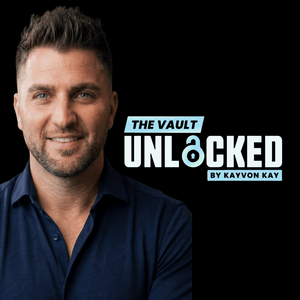
Vault Unlocked is for founders who don't want to learn the hard way.
If you're building something real and you care about growing revenue faster, cleaner, and with fewer blind spots, this podcast is your unfair advantage.
Hosted by Kayvon Kay, Vault Unlocked brings elite founders and operators into conversations they normally keep private. Not the public story. The real one.
The fumbles that cost them millions.
The decision they almost didn't make.
The strategy they only understood after it finally worked.
Every episode is built around one question founders actually care about:
"What do you know now that would have saved you time, money, and pain if you learned it earlier?"
Kayvon goes deep on purpose.
The guests don't hide.
Because surface-level answers don't grow companies.
This is where you learn what not to do, what actually moved the needle, and how the best founders think when things are on the line.
No motivation.
No recycled playbooks.
Just inside access to hard-earned lessons that help you grow faster by learning from other people's mistakes, missteps, and breakthroughs.
If you want to shortcut the learning curve without gambling your own business, Vault Unlocked is for you.
Listen like a founder who plans to win.
Podcast websiteListen to The Vault Unlocked, The Ramsey Show and many other podcasts from around the world with the radio.net app
Get the free radio.net app
- Stations and podcasts to bookmark
- Stream via Wi-Fi or Bluetooth
- Supports Carplay & Android Auto
- Many other app features
Get the free radio.net app
- Stations and podcasts to bookmark
- Stream via Wi-Fi or Bluetooth
- Supports Carplay & Android Auto
- Many other app features

The Vault Unlocked
Scan code,
download the app,
start listening.
download the app,
start listening.
The Vault Unlocked: Podcasts in Family
 USA
USA