

Listen to this podcast in the app for free: Download for free in the App Store
radio.net
Sleep timer
Save favorites
45 episodes

An interview with NIST's outgoing cyber workforce director
12/29/2025 | 27 mins.Over his decade of service at the National Institute of Standards and Technology, Rodney Petersen has had a front row seat to the evolving state of the cyber workforce across government, industry and academia. In his role as director of education and workforce at NIST’s Applied Cybersecurity Division, Petersen led efforts to standardize cyber workforce roles and better understand skills gaps that are now a recurring theme in cyber policy discussions.
With Petersen retiring at the end of 2025, I spoke with him about the evolution of NIST's cyber workforce programs, the progress made on the pernicious cyber talent gap, and what comes next for cyber workforce and education amid the rise of artificial intelligence.
See Privacy Policy at https://art19.com/privacy and California Privacy Notice at https://art19.com/privacy#do-not-sell-my-info.Grappling with a shortage of cleared workers
08/14/2025 | 28 mins.Tim Brennan, VP of technology policy and government relations at the Professional Services Council, joins me to discuss the latest legislative proposals to help streamline the gargantuan security clearance process. One of the priorities for PSC's members, which includes many cleared contractors, is developing a bigger bench of people with security clearances. "We are fishing in such a small pond right now with folks that are cleared and then have the expertise to do that cleared work that I'm a little nervous about it," Tim told me.
See Privacy Policy at https://art19.com/privacy and California Privacy Notice at https://art19.com/privacy#do-not-sell-my-info.Former officials debate OSINT in the IC
07/08/2025 | 1h 5 mins.Open-source intelligence, or OSINT, has reached an inflection point in the IC. Several agencies in recent years have published strategies aimed at better harnessing OSINT. Now, they're embarking on new initiatives to improve data collection and management, train the workforce, and share best practices across the community. But a multitude of challenges remain, including skills gaps, data siloes, bureaucratic and cultural barriers, funding challenges, and more.
Recently, I brought together a panel of experts to debate and discuss the past, present and future of OSINT in the intelligence community. The guests on this episode are:
David Gauthier, the chief strategy officer for CXO, and the visiting fellow at the National Security Institute and former director of commercial operations at the National Geospatial-Intelligence Agency
Ellen McCarthy, the CEO of the Trust in Media Cooperative, and former assistant secretary of state for the bureau of intelligence and research
Chip Usher, the senior director for intelligence at the Special Competitive Studies Project, and a former CIA executive
Eliot Jardines, the founder and director of the OSINT Foundation, and former assistant deputy director of national intelligence for open source
See Privacy Policy at https://art19.com/privacy and California Privacy Notice at https://art19.com/privacy#do-not-sell-my-info.Espionage operations targeting laid off feds
05/27/2025 | 24 mins.The widespread layoffs and resignations unfolding across the federal government represent a prime opportunity for foreign spy agencies. In an April bulletin, the National Counterintelligence and Security Center warned that foreign intelligence organizations are targeting current and former U.S. government employees by posing as consulting firms, corporate headhunters and other job opportunities.
Max Lesser, a senior analyst on emerging threats for the Foundation for Defense of Democracies, recently uncovered a likely Chinese intelligence operation that targets laid off federal employees using fake consulting firms. I spoke with Max about how he investigated the operation and what feds, current and former, should look out for when they’re scrolling LinkedIn and online job boards.
See Privacy Policy at https://art19.com/privacy and California Privacy Notice at https://art19.com/privacy#do-not-sell-my-info.Ethics and intelligence: Tradecraft in the age of AI
03/10/2025 | 32 mins.Cortney Weinbaum, a senior management scientist at RAND, joins the show to discuss her recent paper, “Intelligence officers have an ethical responsibility to use tradecraft.” Countless professional disciplines have a code of ethics. But such a code does not exist for the intelligence community. Weinbaum argues that intelligence officers have an ethical responsibility to use the right tools and methods -- aka “tradecraft” -- and that recent intelligence failures stemmed from bad tradecraft. Meanwhile, the increasing reliance on AI within the IC means it’s crucial that intelligence officers understand the technology they use, along with its limitations.
See Privacy Policy at https://art19.com/privacy and California Privacy Notice at https://art19.com/privacy#do-not-sell-my-info.
More Government podcasts
 DC EKGGovernment, Health & Wellness, Medicine, News, Politics
 5-4Government, News, News Commentary
 Red Eye RadioDaily News, Government, News
 Strict ScrutinyGovernment, News, Philosophy, Society & Culture
 Optimist EconomyGovernment, Society & Culture
 American PotentialEducation, Government, News, News Commentary, Personal Journals, Politics, Self-Improvement, Society & Culture
 You Might Be RightGovernment, News, Politics
 The DSR NetworkGovernment
 The Lawfare PodcastGovernment, History, News, Politics
 The Jedburgh PodcastBusiness, Daily News, Education, Entrepreneurship, Fitness, Government, Health & Wellness, History, Management, Mental Health, News, News Commentary, Personal Journals, Self-Improvement, Society & Culture, Sports News
Trending Government podcasts
 The Virginia Press RoomGovernment, News, Politics
 Supreme Court Decision Syllabus (SCOTUS Podcast)Education, Government, News, Politics
 The Permanent ProblemGovernment, History, Society & Culture
 Advancing HealthGovernment, Health & Wellness, Medicine, News, Politics
 The AssetGovernment, History, True Crime
 Social Media and PoliticsGovernment, News, Politics, Science, Social Sciences
 The FARcast: Navigating Federal Acquisition Regulations with AIGovernment
 Former Action Guys PodcastGovernment, History, Society & Culture
 The High Court ReportBusiness, Education, Government, Society & Culture
 In Session: Leading the JudiciaryGovernment
 CommissionED: The Air Force Officer PodcastBusiness, Careers, Education, Government
 Space StrategyGovernment
 The Federal Drive with Terry GertonBusiness, Careers, Government, News, Society & Culture
 Legal DocketGovernment
 Talk'n the BeatGovernment
 Outside the Secret Service PodcastGovernment, History, True Crime
 The Ray Stevens ShowGovernment, News, Politics
 State of PlayGovernment
 AEI Podcast ChannelGovernment, History, News, Politics
 The Cognitive CrucibleGovernment, Science
 This Means WarGovernment
 The Week in WestminsterGovernment
 Talking Headways: A Streetsblog PodcastGovernment, News
 The Truth of the MatterBusiness, Government, Non-Profit
 Gray MattersGovernment
 EU ScreamGovernment, News, News Commentary, Politics
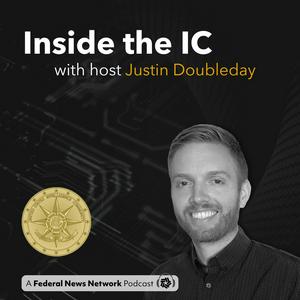
About Inside the IC
Inside the IC explores how U.S. intelligence agencies are adapting to 21st century challenges. The show features interviews with intelligence community leaders and experts about their most pressing issues involving technology, workforce, and management.
Podcast websiteListen to Inside the IC, DC EKG and many other podcasts from around the world with the radio.net app
Get the free radio.net app
- Stations and podcasts to bookmark
- Stream via Wi-Fi or Bluetooth
- Supports Carplay & Android Auto
- Many other app features
Get the free radio.net app
- Stations and podcasts to bookmark
- Stream via Wi-Fi or Bluetooth
- Supports Carplay & Android Auto
- Many other app features

Inside the IC
Scan code,
download the app,
start listening.
download the app,
start listening.
Inside the IC: Podcasts in Family
 USA
USA