

Listen to this podcast in the app for free: Download for free in the App Store
radio.net
Sleep timer
Save favorites
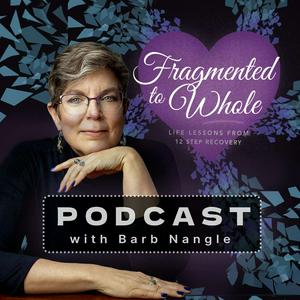
Fragmented to Whole: Life Lessons from 12 Step Recovery
Barb Nangle
Latest episode
367 episodes
How to Use Life Transitions to Become Who You Want to Be | Episode 363
08/03/2026 | 16 mins.Send us Fan Mail
In this week’s episode 363 of the Fragmented to Whole Podcast, I’m talking about life transitions and why the biggest change often isn’t what’s happening around you—it’s the shift in your identity.
Whether you’re becoming an empty nester, changing careers, retiring, ending a relationship, or entering a new season of life, transitions often invite you to ask, “Who am I now?” In this episode, I explore a different question that can be even more helpful: “Who do I want to be?”
Some of the talking points I go over in this episode include:
Why life transitions are often identity transitions
How boundaries and routines help shape the person you’re becoming
The difference between creating routines for productivity and creating routines that support the life you want
Why approaching new routines as experiments can make change feel more manageable
Questions to help you move intentionally into your next season of life
I also share examples from coaching clients, including an empty nester navigating a new stage of motherhood and a professional experimenting with focused work time instead of reacting to email all day.
This episode is a reminder that you don’t need to have your entire future figured out. You simply need something meaningful to reach toward—a value, a relationship, or a routine that helps you become more grounded in the person you want to be.
Be sure to tune in to all the episodes to receive tons of practical tips on living a more whole life and to hear even more about the points outlined above.
Thank you for listening! If you enjoyed this episode, take a screenshot of the episode to post in your stories and tag me! And don’t forget to follow, rate and review the podcast and tell me your key takeaways!
Learn more about Fragmented to Whole at Fragmented to Whole Podcast
New to my work: START HERE
CONNECT WITH BARB NANGLE:
Subscribe to “Friday Fragments” weekly newsletter
Linkedin
Work with Barb!
Book a “Say No Without Guilt” SessionWhy Making Decisions Feels So Unsafe and How to Trust Yourself Anyway | Episode 362
07/27/2026 | 21 mins.Send us Fan Mail
In this week’s episode 362 of the Fragmented to Whole Podcast, I’m talking about why so many people struggle to make decisions—and why the real issue often isn’t a lack of information. It’s a lack of internal safety.
Many of us spend hours weighing options, asking for advice, researching every possibility, and trying to predict the outcome before making a choice. But no decision-making method can guarantee that no one will be disappointed, that you'll never regret your choice, or that life will unfold exactly as you hope. This episode explores what it means to trust yourself even when certainty isn’t possible.
Some of the talking points I go over in this episode include:
Why decision-making is often an internal safety issue rather than a lack of information
The difference between reflection and rumination
How self-trust means staying on your own side after making a decision
Why you're allowed to change your mind as new information becomes available
Practical questions to help you make decisions without abandoning yourself
I also revisit several ideas from Episode 171 on decision-making and explain how my understanding of self-trust has evolved over the years.
This episode is a reminder that the goal isn't to make the perfect decision. The goal is to become someone who can stay connected to yourself through uncertainty, learn from what unfolds, and make adjustments when needed.
Be sure to tune in to all the episodes to receive tons of practical tips on living a more whole life and to hear even more about the points outlined above.
Thank you for listening! If you enjoyed this episode, take a screenshot of the episode to post in your stories and tag me! And don’t forget to follow, rate and review the podcast and tell me your key takeaways!
Learn more about Fragmented to Whole at Fragmented to Whole Podcast
New to my work: START HERE
CONNECT WITH BARB NANGLE:
Subscribe to “Friday Fragments” weekly newsletter
Linkedin
Work with Barb!
Book a “Say No Without Guilt” SessionHow Recovery and Boundaries Changed One Woman’s Relationship with Herself with Guest Ilene Z| Episode 361
07/20/2026 | 1h 8 mins.Send us Fan Mail
In this week’s episode 361 of the Fragmented to Whole Podcast, I’m joined by my former private coaching client, Ilene, for a heartfelt conversation about what happened after years of doing the work of recovery and boundary-building.
Rather than focusing on theory, this episode explores what these concepts actually looked like in one woman’s life—how learning to honor her preferences, stop managing other people’s reactions, and build internal safety transformed the relationship she has with herself. The conversation was inspired by a thoughtful email Ilene sent after reflecting on two recent podcast episodes, and together we unpack the changes she experienced along the way.
Some of the talking points I go over in this episode include:
How recovery shifted Ilene’s relationship with herself over time
What changed when she began honoring her own preferences and needs
The impact of building internal safety instead of seeking it from others
Why boundaries became an essential part of her healing journey
How real-life recovery looks beyond understanding the concepts intellectually
Throughout our conversation, Ilene shares honest reflections about her personal growth and the ways recovery has influenced her relationships, decision-making, and ability to stay connected to herself.
This episode is a reminder that healing isn't about becoming a different person. It's about building a relationship with yourself that is grounded in self-awareness, self-trust, and healthy boundaries—one choice at a time.
Be sure to tune in to all the episodes to receive tons of practical tips on living a more whole life and to hear even more about the points outlined above.
Thank you for listening! If you enjoyed this episode, take a screenshot of the episode to post in your stories and tag me! And don’t forget to follow, rate and review the podcast and tell me your key takeaways!
Here's the link to ep. 99 How to Actually Understand the Difference Between Intention and Impact
Learn more about Fragmented to Whole at Fragmented to Whole Podcast
New to my work: START HERE
CONNECT WITH BARB NANGLE:
Subscribe to “Friday Fragments” weekly newsletter
Linkedin
Work with Barb!
Book a “Say No Without Guilt” SessionHow I Learned to Trust Myself (and Why Boundaries Were the Missing Piece) | Episode 360
07/13/2026 | 12 mins.Send us Fan Mail
In this week’s episode 360 of the Fragmented to Whole Podcast, I’m sharing how my understanding of self-trust completely changed through recovery.
For years, I believed I had a "bad picker" when it came to relationships. But over time, I realized the bigger issue wasn't choosing unhealthy partners—it was staying long after I knew the relationship wasn't healthy. What ultimately changed my life wasn't trying harder to trust myself. It was learning to build healthy boundaries.
Some of the talking points I go over in this episode include:
Why self-trust isn't something you decide—it's something you build over time
How discovering your preferences, needs, and limits is the foundation of healthy boundaries
Why honoring your own limits creates evidence that you can rely on yourself
The difference between blindly trusting people and discerning trust through consistent patterns of behavior
How boundaries strengthen the most important relationship you'll ever have: the relationship with yourself
This episode explores why trust grows through evidence, not intention. Every time you notice what's true for you, honor your limits, and follow through on your commitments to yourself, you're strengthening your ability to trust yourself.
Because boundaries aren't just about protecting yourself from other people. They're about becoming someone you can count on.
Be sure to tune in to all the episodes to receive tons of practical tips on living a more whole life and to hear even more about the points outlined above.
Thank you for listening! If you enjoyed this episode, take a screenshot of the episode to post in your stories and tag me! And don’t forget to follow, rate and review the podcast and tell me your key takeaways!
Learn more about Fragmented to Whole at Fragmented to Whole Podcast
New to my work: START HERE
CONNECT WITH BARB NANGLE:
Subscribe to “Friday Fragments” weekly newsletter
Linkedin
Work with Barb!
Book a “Say No Without Guilt” Session5 Things to Say When Someone Is Trying to Make You Question Your Reality | Episode 359
07/06/2026 | 13 mins.Send us Fan Mail
In this week’s episode 359 of the Fragmented to Whole Podcast, I’m talking about something many of us have experienced but struggle to describe: what to do when someone makes you question your own reality.
If you grew up in an environment where your feelings were dismissed, your experiences were minimized, or your perception was constantly challenged, learning to trust yourself can feel incredibly difficult. In this episode, I share five simple responses that can help you stay grounded in your own experience without getting pulled into endless arguments or self-doubt.
Some of the talking points I go over in this episode include:
Why self-trust is essential for healthy boundaries and decision-making
Five simple phrases that help you stay anchored in your own reality
The difference between acknowledging someone’s perspective and abandoning your own
How to recognize when a conversation is no longer productive
Why boundaries become easier as you strengthen self-trust
This episode explores how self-trust is built in ordinary moments—every time you honor your own experience instead of looking to someone else to tell you what's real.
Because boundaries don't begin with controlling other people. They begin with trusting yourself enough to stay connected to your own reality, even when someone else disagrees.
Be sure to tune in to all the episodes to receive tons of practical tips on living a more whole life and to hear even more about the points outlined above.
Thank you for listening! If you enjoyed this episode, take a screenshot of the episode to post in your stories and tag me! And don’t forget to follow, rate and review the podcast and tell me your key takeaways!
5 statements:
"That's not my experience."
"I'm not going to argue with you about what happened."
“I hear you."
"I've said everything I'm going to say."
"What is your goal with this conversation?"
Learn more about Fragmented to Whole at Fragmented to Whole Podcast
New to my work: START HERE
CONNECT WITH BARB NANGLE:
Subscribe to “Friday Fragments” weekly newsletter
Linkedin
Work with Barb!
Book a “Say No Without Guilt” Session
More Education podcasts
 The Jefferson Fisher PodcastEducation, Relationships, Self-Improvement, Society & Culture
 IMO with Michelle Obama and Craig RobinsonEducation, Self-Improvement, Society & Culture
 Makes Sense - with Dr. JC DoornickEducation, Self-Improvement
 The Table with Anthony ONealBusiness, Christianity, Education, Entrepreneurship, Investing, Religion & Spirituality, Self-Improvement
 How to Be a Better HumanEducation, Self-Improvement
 Digital Social HourBusiness, Careers, Daily News, Education, Entrepreneurship, News, Self-Improvement, Society & Culture, Sports
 Finding Peak with Ryan HanleyBusiness, Education, Entrepreneurship, Management, Self-Improvement
 The Jamie Kern Lima ShowBusiness, Education, Entrepreneurship, Health & Wellness, Mental Health, Self-Improvement
 The Mel Robbins PodcastEducation, Health & Wellness, Mental Health, Relationships, Self-Improvement, Society & Culture
 Becoming UnDone® with Dr. Toby BrooksDocumentary, Education, Health & Wellness, Self-Improvement, Society & Culture
Trending Education podcasts
 BEING HER with Margarita NazarenkoEducation, Health & Wellness, Relationships, Sexuality, Society & Culture
 The Radio Free Hillsdale HourEducation
 Platypus Economics with Justin WolfersBusiness, Courses, Education, Science, Social Sciences
 The Scriptures Are RealCourses, Education, Religion & Spirituality
 صلح درونEducation, Self-Improvement
 Amas Talks PodcastEducation, Self-Improvement
 Conversations with TylerEducation, Society & Culture
 This Naked Mind PodcastEducation, Self-Improvement
 DianaUribe.fmEducation
 Grounded Wellness by Primally PureAlternative Health, Education, Health & Wellness, Self-Improvement
 Españolistos | Learn Spanish With Fun Conversations!Education
 The Tony Robbins ChannelBusiness, Education, Marketing
 Hillsdale DialoguesEducation
 Trauma RewiredEducation, Life Sciences, Science, Self-Improvement
 The PreambleEducation, Government, History
 The SignalEducation, Technology
 How I WriteArts, Books, Education, Society & Culture
 Habits of A GoddessEducation, Self-Improvement
 The Momset PodcastEducation, Self-Improvement
 The Art of AwakeningAlternative Health, Education, Health & Wellness, Religion & Spirituality, Self-Improvement, Spirituality
 The Divorce Survival Guide PodcastEducation, Relationships, Self-Improvement, Society & Culture
 Breakthrough with Thais Gibson PodcastEducation, Self-Improvement
 Cram The PanceCourses, Education
 SOLVED with Mark MansonEducation, Self-Improvement
About Fragmented to Whole: Life Lessons from 12 Step Recovery
Tired of feeling fragmented and overwhelmed? Fragmented to Whole: Life Lessons from 12-Step Recovery is your guide to creating a life of wholeness, authenticity, and healthy boundaries. Join Barb Nangle, a boundaries coach and speaker, as she shares raw and honest insights from her own journey and the principles of 12-step recovery. Discover how to set boundaries without guilt or shame, overcome people-pleasing tendencies, manage your emotions effectively, cultivate a stronger sense of self, and build healthier relationships. Barb's approach is raw, honest, and sometimes a little bit (okay, a lot) sweary. Barb doesn't speak for or endorse any particular 12 step program of recovery. Though she's a huge fan of 12 step recovery, and a member of two 12 step fellowships, she cannot speak for them. If you're ready for real talk and practical tools for transformation, tune in! To learn more about Barb, go to https://higherpowercc.com/
Podcast websiteListen to Fragmented to Whole: Life Lessons from 12 Step Recovery, The Jefferson Fisher Podcast and many other podcasts from around the world with the radio.net app
Get the free radio.net app
- Stations and podcasts to bookmark
- Stream via Wi-Fi or Bluetooth
- Supports Carplay & Android Auto
- Many other app features
Get the free radio.net app
- Stations and podcasts to bookmark
- Stream via Wi-Fi or Bluetooth
- Supports Carplay & Android Auto
- Many other app features
Fragmented to Whole: Life Lessons from 12 Step Recovery
Scan code,
download the app,
start listening.
download the app,
start listening.
Fragmented to Whole: Life Lessons from 12 Step Recovery: Podcasts in Family
 USA
USA