

Listen to this podcast in the app for free: Download for free in the App Store
radio.net
Sleep timer
Save favorites
40 episodes
S3E12: Most Joyful Show on Earth: Inclusion in Circus and Variety Arts With Guest Mark Hayward
09/02/2026 | 1h 3 mins.We invite guest Mark Hayward, a highly accomplished international performer with multiple world titles and world records, to talk about bias and inclusion in circus and variety arts. (Spoiler alert: It might sound oddly specific, but the stuff we talk about is entirely generalizable).
For this episode, Mark’s joy is the sense of community he gets from spending time with fellow jugglers, performing artists, and circus folks. Amber’s joy is her project watching all the Disney animated feature films (an idea she got from producer Eric Roman)! And Will shares about his husband Eric Roman’s amazing baking, which you can check out on Instagram @SuperGayBakes.
For the main discussion, Mark talks about inclusion and bias in the past and present of circus and variety arts. The world of the circus has an interesting and rich, but complex, relationship with diversity. On the negative side, of course sometimes circuses used differences to make spectacle (e.g., “freak shows”). On the more positive side, the circus was often a place where people of color, LGBTQ+ folks, and disabled folks could make a living and find a sense of community, in times when traditional financial opportunities were often closed to them. We also discuss how activities like juggling and yo-yo are forms of play that can contribute positively to mental health.
During Story Time, Mark shares a story related gender and belonging/inclusion in competitive environments, and a story related to being receptive when someone pointed out a misuse of power during a performance.
This episode’s question is about how changing social norms related to inclusion, has played out when working in performance arts, and the importance of knowing how to grow and change with the times.
This episodes bias habit-breaking skill is to Think Ahead. We’re less likely to show bias when we’ve thought things through ahead of time.
Mark’s joyful recommendation (which Amber also loves!) is Murderbot, a sci-fi TV show and book series that connects to many issues related to classism and culture, with a diverse cast of characters–without the show being about diversity.
CSAW Nonprofit: https://www.csawcircus.org/about
@TheMarkHayward
To be notified when you can preorder Mark’s book about how to be an MC, sign up here: http://Www.modernvaudevillepress.com/mc
Dr. Cox’s book is available for preorder! The publisher is University of California Press, and the full title is Overcoming Bias Habits: An Evidence-Based Guide to Creating a Joyfully Inclusive World.
Check your small local bookstores!
From Amazon: https://a.co/d/iwnakbM
From Barnes and Noble: https://www.barnesandnoble.com/w/overcoming-bias-habits-william-t-l-cox-phd/1148276458?ean=9780520410428
We now have merch! Buy some to support the show at https://www.biashabit.com/store
Follow Diverse Joy on social media, including Facebook, Instagram, Twitter/X, Threads, and Bluesky.S3E11: Joy as a Wellness Practice
08/05/2026 | 56 mins.Will and Amber are dressed as pirates for “Arrgust,” which is International Pirate Month. While Amber sports a more traditional pirate outfit, Will’s takes inspiration from Star Wars and includes a Kowakian monkey-lizard puppet that he wears on his shoulder.
While sharing their joys for the month, Amber discusses her collection of Loungefly bags and mini backpacks (a vast collection that includes many that have been gifted to her, because so many people know she collects them, making her easy to shop for) which she uses for her various Disneybounds; and Will discusses the joy of cruises he and Eric Roman have been on (a couple of them with his parents).
This episode’s discussion is about how to work joy into your life to promote your mental and physical health. Amber shares science and practical skills, as found in the field of positive psychology, related to joy and health, to help your nervous system, prefrontal cortex, and more. She also shares some new-to-the-show acronyms: PERMA and SMILE to help you remember the tools she discusses.
In Story Time, Will shares an experience related to racism in high school, and Amber shares a story connected to microdosing joy and her cultural heritage.
This episode’s question: Is there a difference between happiness and joy? (Spoiler alert: For technical and diagnostic reasons, yes, there is.)
This episode’s Bias Habit-Breaking Skill is Seeking Individuating Information, which is getting to know the details of what makes someone unique, rather than relying on group membership to distinguish them - this comes more naturally when dealing with majority culture folks in a group, as you have to rely on more individuating information to tell them apart, but less naturally for folks not in the majority: It’s a numbers game!
Will’s joyful recommendation is the touching, LGBTQ+ Netflix show–which recently concluded with a movie–Heartstopper! (It’s based on a graphic novel, so a double recommendation.) We highly recommend it if you like adorable romance and need more queer representation and joy in your life!
Dr. Cox’s book is available for preorder! The publisher is University of California Press, and the full title is Overcoming Bias Habits: An Evidence-Based Guide to Creating a Joyfully Inclusive World.
Check your small local bookstores!
From Amazon: https://a.co/d/iwnakbM
From Barnes and Noble: https://www.barnesandnoble.com/w/overcoming-bias-habits-william-t-l-cox-phd/1148276458?ean=9780520410428
We now have merch! Buy some to support the show at https://www.biashabit.com/store
Follow Diverse Joy on social media, including Facebook, Instagram, Twitter/X, Threads, and Bluesky.S3E10: Avoiding Demotivational Traps When Consuming Educational Diversity Media
07/01/2026 | 53 mins.We start this July episode discussing joy, including: Will’s is a trip he took with Roman and friends to Skywalker Ranch! Amber’s is “dopamine dressing,” in which you dress to bring yourself, and others, joy - usually through mixing patterns and colors (it’s kind of maximalist).
This episode’s discussion topic is Avoiding Demotivational Traps — there are many ways people try to face problems like racism and disparities that end up resulting in less motivation, rather than more motivation, to solve the problems. Many involve misusing “educational media” to achieve catharsis or avoid seeing or facing real problems (”entertainment” and “educational media” can certainly mix and overlap, when we say “educational media” in this capacity, we mean the kind of movies or books where even the marketing is trying to make sure you “know” this is some kind of “inspirational” piece that you “should get something out of,” even though many pieces of “entertainment” can also accomplish the same thing - they just tend to be more subtle about it).
Amber shares the idea of Sankofa (a word from Akan, one of the many languages spoken in Ghana), which involves having your feet firmly facing forward, to make positive progress to the future, but also looking back to remember the past, both to learn from it and to bring forward what was good.
During Story Time, Will shares a story about someone who got censored by her work place, with them saying she could not be a guest on Diverse Joy, because they were afraid of federal backlash for the show focusing on DEI. The more positive story was about another popular podcast, Stop Podcasting Yourself, doing a very nice job with diversity among its guests (having women, people of color, and folks with disabilities make up a large portion of its guest list).
This episode’s Question is “Why are ‘checklist’ approaches to DEI bad?” Checklist approaches can give a “catharsis” effect–you’ve finished a thing, check it off–that demotivates people, making diversity and inclusion efforts something that you “get over with” rather than an approach that is about maintaining inclusion over time with ongoing effort.
Our Bias Habit-Breaking Skill is Broadening Your Input via Increasing Representation in your Social, Physical, and Digital Environments. This takes many forms, such as increasing diversity of speakers you invite to your organizations (Social), in whose pictures or art is displayed in your work or home (Physical), or the picture on your website (Digital).
The skills segment leads to an excellent chat about Amber’s church and how her pastor does a great job of Increasing Representation in invited speakers and even in different representations of Jesus found throughout the church.
Amber’s joyful recommendation is KPop Demon Hunters, a movie that became a cultural sensation over the year. It’s a fun, goofy, musical action movie set in a reality centered around (generations of) K-Pop musical group(s) that must stop demons from entering reality through music! (Amber got Will and Eric Roman watch it soon after we recorded this episode, and they agree that it is fantastic!)
Dr. Cox’s book is available for preorder! The publisher is University of California Press, and the full title is Overcoming Bias Habits: An Evidence-Based Guide to Creating a Joyfully Inclusive World.
Check your small local bookstores!
From Amazon: https://a.co/d/iwnakbM
From Barnes and Noble: https://www.barnesandnoble.com/w/overcoming-bias-habits-william-t-l-cox-phd/1148276458?ean=9780520410428
We now have merch! Buy some to support the show at https://www.biashabit.com/store
Follow Diverse Joy on social media, including Facebook, Instagram, Twitter/X, Threads, and Bluesky.S3E09: What a Drag! Queens Past and Present! With Guest Cynthia Mooseknuckle
06/03/2026 | 1hIt’s June, which means it is Pride Month, so we invited a special guest–drag queen Cynthia Mooseknuckle, a Madison legend–to talk drag and the LGBTQ+ community!
For “What’s bringing us joy?” Cynthia’s is hot beverages in the morning, to help awaken the senses! Amber’s is attending Vogue Balls in Portland. And for Will, it‘s his recent trend of discovering new (and old) music albums every morning.
This episode’s discussion topic is the history and contemporary use of drag performance as both an art form and a form of community and protest. Cynthia shares how drag has been a way to bolster her self-confidence, both in and out of drag. The conversation touches on acceptance and self-acceptance, authenticity, the influx of competitiveness into drag, and related topics and tangents (it’s a great conversation)!
In Story Time, Cynthia shares a negative story about drag is–sometimes–more exploitative and exclusionary as it has become more mainstream, competitive, commodified, and profit-motivated. For her more positive story, she shares about going back to her small Midwestern hometown to be celebrated and honored in drag!
This episode’s question is about whether it is difficult to remain sober within the drag community. Cynthia shares her personal journey with sobriety.
This episode’s bias habit-breaking skill is to Broaden Your Input via Genuine Connections. Making friendships with people different from you can help push back against biases in your mind. While talking about genuine connections and friendships, the discussion taps into recent tragic experiences with persecution of immigrant communities in the United States.
As always, we close out the episode with a joyful recommendation. Whenever we have a guest, we let them give theirs, and Cynthia’s is “retro gaming,” or playing classic video games, which can bring in good feelings of nostalgia and comfort that can bolster your mental health! She recommends classic Pokémon games, in particular. (Cynthia Mooseknuckle’s name actually comes from the character of Cynthia, introduced in Pokémon Diamond and Pearl.)
Dr. Cox’s book is available for preorder! The publisher is University of California Press, and the full title is Overcoming Bias Habits: An Evidence-Based Guide to Creating a Joyfully Inclusive World.
Check your small local bookstores!
From Amazon: https://a.co/d/iwnakbM
From Barnes and Noble: https://www.barnesandnoble.com/w/overcoming-bias-habits-william-t-l-cox-phd/1148276458?ean=9780520410428
We now have merch! Buy some to support the show at https://www.biashabit.com/store
Follow Diverse Joy on social media, including Facebook, Instagram, Twitter/X, Threads, and Bluesky.S3E08: Neurospicy and Thriving: ADHD and Neurodiversity
05/06/2026 | 59 mins.For this late-spring episode, Amber and Will dressed up to express their love of the Netflix series Bridgerton.
Will’s shares that his joy is his recent ADHD diagnosis (attention deficit hyperactivity disorder). While Amber’s joy is her job as a full-time pediatric clinical psychologist and the lives she can impact through that work, which includes doing ADHD testing and being able to tell people, “yes, that’s what this is,” or, “no, it’s this other thing” and helping folks get the treatment they need.
The main discussion topic of this episode is learning about ADHD and, more broadly, neurodiversity. Amber discusses what ADHD is (including how ADD, attention deficit disorder, which you’ve probably also heard of, is now classified as one of three types of ADHD rather than being its own thing), some of how it is diagnosed, how it shows up in people’s lives, and some coping mechanisms–including another Amber Acronym: BOOST. As people with ADHD diagnoses themselves, Will and Amber both pull on their own life experiences as well as the research and clinical literature to discuss all of the above.
During Story Time, there are stories related to testing for ADHD, and how an early diagnosis can be helpful for avoiding addiction issues later in life (because proper treatment will help with how the brain’s reward system handles an ADHD person’s dopamine requirements).
This episode’s Question is, “What is neurodiversity?” (Hint: It’s an umbrella term for conditions that are neurodevelopmental and neurological in their etiology.)
Will shares two Bias Habit-Breaking Skills this month: Considering Situational Explanations for Behavior and Doing Perspective-Taking. Both of which are handy tools for helping to reduce bias and create inclusion.
Amber and Will close out the episode with the joyful recommendation of the hilarious and musical TV show that touches on many great diversity and mental health topics, Crazy Ex-Girlfriend! (It acknowledges that its title is a bit problematic.) (If you were expecting the recommendation to be Bridgerton, and are confused about why it isn’t - go give season 1, episode 5 a listen.)
Dr. Cox’s book becomes available for preorder! The publisher is University of California Press, and the full title is Overcoming Bias Habits: An Evidence-Based Guide to Creating a Joyfully Inclusive World.
Check your small local bookstores!
From Amazon: https://a.co/d/iwnakbM
From Barnes and Noble: https://www.barnesandnoble.com/w/overcoming-bias-habits-william-t-l-cox-phd/1148276458?ean=9780520410428
We now have merch! Buy some to support the show at https://www.biashabit.com/store
Follow Diverse Joy on social media, including Facebook, Instagram, Twitter/X, Threads, and Bluesky.
More Education podcasts
 Makes Sense - with Dr. JC DoornickEducation, Self-Improvement
 Business Alchemy with Jackie MinskyEducation
 Mick UnpluggedBusiness, Education, Entrepreneurship, Management, Self-Improvement
 Living Your LegacyBusiness, Education, Entrepreneurship, Film Interviews, Self-Improvement, TV & Film
 Becoming UnDone® with Dr. Toby BrooksDocumentary, Education, Health & Wellness, Self-Improvement, Society & Culture
 The Mel Robbins PodcastEducation, Health & Wellness, Mental Health, Relationships, Self-Improvement, Society & Culture
 Building Champions for LifeBusiness, Education, Management, Relationships, Self-Improvement, Society & Culture
 The Jamie Kern Lima ShowBusiness, Education, Entrepreneurship, Health & Wellness, Mental Health, Self-Improvement
 Finding Peak with Ryan HanleyBusiness, Education, Entrepreneurship, Management, Self-Improvement
Trending Education podcasts
 it's cringe, but it's trueEducation, Self-Improvement
 Trying Not to CareEducation, Health & Wellness, Mental Health, Personal Journals, Relationships, Self-Improvement, Society & Culture
 Learn Spanish: Fluency in Real Life with HandyspanishEducation
 Financial Coaching for Women: How To Budget, Manage Money, Pay Off Debt, Save Money, Paycheck PlansEducation, Tutorials
 Ketab Jibi | پادکست کتاب جیبیEducation, Self-Improvement
 A Changed Mind | Mindset That MattersEducation, Philosophy, Religion & Spirituality, Self-Improvement, Society & Culture, Spirituality
 The Tamsen ShowEducation, Health & Wellness, Self-Improvement, Society & Culture
 Grounded Wellness by Primally PureAlternative Health, Education, Health & Wellness, Self-Improvement
 Pulling The Thread with Elise LoehnenEducation, Religion & Spirituality, Self-Improvement
 The Rachel Hollis PodcastEducation, Relationships, Religion & Spirituality, Self-Improvement, Society & Culture, Spirituality, Tutorials
 EPIC Begins With 1 Step ForwardBusiness, Careers, Education, Management, Self-Improvement
 EconTalkCourses, Education, Philosophy, Science, Social Sciences, Society & Culture
 Space for LifeChristianity, Education, Religion & Spirituality, Self-Improvement
 Dear GabbyEducation, Health & Wellness, Mental Health, Religion & Spirituality, Self-Improvement, Spirituality
 How I WriteArts, Books, Education, Society & Culture
 Navigating Narcissism with Dr. RamaniEducation, Relationships, Self-Improvement, Society & Culture, True Crime
 Optimal Living Daily - Personal Development and Self-ImprovementEducation, Health & Wellness, Mental Health, Self-Improvement
 MARGARET ROACH A WAY TO GARDENEducation, Hobbies, Leisure, Natural Sciences, Science, Society & Culture, Sports
 Cram The PanceCourses, Education
 English Learning PodcastEducation, Language Learning
About Diverse Joy
Infusing science, practical skills, and joy into diversity discussions!
Follow @DiverseJoy on social media!
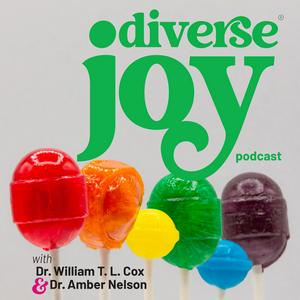
In each episode, Dr. William T. L. Cox and Dr. Amber Nelson share something that is bringing them joy, talk about a diversity topic, share stories, teach a bias habit-breaking skill, and give a media recommendation of something that brings them joy. Their goal is jointly to provide entertainment and education, and they infuse science, practicality, and most of all, joy into conversations about diversity, equity, and inclusion.
Every episode also exists as a standalone educational video that you can find on YouTube, or through our website at DiverseJoy.com.
Diverse Joy is hosted by Dr. William T. L. Cox and Dr. Amber Nelson, produced by Eric Roman Beining, with music by Jay Arner. New episodes release the first Wednesday of each month. Learn more at DiverseJoy.com.
Development of the first season of Diverse Joy was sponsored in part by the National Institute of General Medical Sciences of the National Institutes of Health under award number R35GM128888. The content is solely the responsibility of the authors and does not necessarily represent the official views of the National Institutes of Health. Production is also supported by donations to our nonprofit, Inequity Agents of Change. Learn more at BiasHabit.com.
Podcast websiteListen to Diverse Joy, Makes Sense - with Dr. JC Doornick and many other podcasts from around the world with the radio.net app
Get the free radio.net app
- Stations and podcasts to bookmark
- Stream via Wi-Fi or Bluetooth
- Supports Carplay & Android Auto
- Many other app features
Get the free radio.net app
- Stations and podcasts to bookmark
- Stream via Wi-Fi or Bluetooth
- Supports Carplay & Android Auto
- Many other app features
Diverse Joy
Scan code,
download the app,
start listening.
download the app,
start listening.
 USA
USA