
Listen to this podcast in the app for free: Download for free in the App Store
radio.net
Sleep timer
Save favorites
46 episodes
Sky Tavern’s 99 year lease (Reno City Council Meeting 10.21.26)
10/26/2026 | 14 mins.This episode heads up the mountain to explore Sky Tavern, a place where generations of local families have learned to ski, snowboard and enjoy the outdoors. We talk with Sky Tavern CEO and Executive Director Chris Brown and Parks and Recreation Manager Danny Gleich about the 49-year lease extension, which brings the total lease term to 99 years.
The conversation covers Sky Tavern’s history, its partnership with the City, and how its nonprofit programs help more young people experience outdoor recreation. Chris also shares future plans, including a master plan for the property and scenic chairlift rides.The Budget, Explained. (Reno City Council Meeting 10.7.26)
10/12/2026 | 16 mins.The City’s budget is back on the agenda. So, where do things stand?
In this episode of On the Agenda, we welcome Director of Finance Vicki Van Buren to break down the latest budget adjustments, including how $600,000 in additional consolidated tax revenue will restore funding for six previously frozen police officer positions.
What changed to make that possible? How does the City plan for the ongoing cost? And does additional revenue mean the budget challenges are behind us? We explore those questions, explain why some funding carries over from year to year and look at what’s ahead as planning begins for the next budget.
Plus, we recap highlights from the October 7 Reno City Council meeting and preview what’s coming on October 21.RDA is Debt Free (Reno City Council Meeting 9.23.26)
09/28/2026 | 18 mins.Paying off debt may not be as visible as a new building, park or streetscape, but it can help make future redevelopment projects possible.
In this episode of On the Agenda, Assistant City Manager Ashley Turney explains the Reno Redevelopment Agency’s decision to pay off two series of tax increment bonds issued in 2007. They break down what terms like “redemption,” “defeasance” and “tax increment” mean, where the funding comes from and why this action does not create a new tax or increase anyone’s tax rate.
The conversation also explores how eliminating the debt reduces future interest costs and gives the Agency greater flexibility to invest future tax increment in eligible projects that improve public spaces, support housing, strengthen local businesses and encourage private investment.Dickerson to Idlewild Bridge (Reno City Council Meeting 9.9.26)
09/14/2026 | 11 mins.In this episode of On the Agenda, we explore the proposed Dickerson Trail Bridge, a new bicycle and pedestrian connection that could one day link the Dickerson Road neighborhood and Oxbow Nature Study Area with Idlewild Park and the Tahoe-Pyramid Trail.
Public Works Senior Management Analyst Brynna Nichols explains how a newly accepted $250,000 state grant, along with a $50,000 City match, will support the project’s planning, design, environmental review and permitting. We also clarify what Council approved, what must happen before construction can begin and how the bridge could close an important gap in Reno’s regional trail network.Reno Housing Authority $10 Purchase (Reno City Council Meeting 8.26.26)
08/31/2026 | 12 mins.Today, we’re talking about a recent Reno City Council decision involving a City-owned property in the Stead community.
Council approved the sale of the property at 14180 Mt. Charleston Street to the Reno Housing Authority, or RHA, for a nominal $10 plus closing costs.
Now, if you hear that the City sold a piece of property for $10, you might have some questions.
Why $10? What is actually on the property? Why did the City sell it to RHA? And what does the decision mean for the residents who live there?
We’re answering those questions today.
More Government podcasts




Trending Government podcasts






About On the Agenda: A City of Reno Podcast
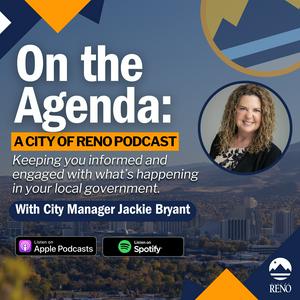
“On the Agenda” is a podcast produced by the City of Reno and hosted by City Manager Jackie Bryant. In each episode, we’ll highlight important topics, provide context on council actions, and share how these decisions impact the Biggest Little City and its residents. Whether you are a longtime resident or new to our community, On the Agenda keeps you informed and engaged with what’s happening in your local government.
Podcast websiteListen to On the Agenda: A City of Reno Podcast, Red Eye Radio and many other podcasts from around the world with the radio.net app
Get the free radio.net app
- Stations and podcasts to bookmark
- Stream via Wi-Fi or Bluetooth
- Supports Carplay & Android Auto
- Many other app features
Get the free radio.net app
- Stations and podcasts to bookmark
- Stream via Wi-Fi or Bluetooth
- Supports Carplay & Android Auto
- Many other app features
On the Agenda: A City of Reno Podcast
Scan code,
download the app,
start listening.
download the app,
start listening.
 USA
USA