

Listen to this podcast in the app for free: Download for free in the App Store
radio.net
Sleep timer
Save favorites
76 episodes
The Bayeux Tapestry Comes Home After 1000 Years
09/03/2026 | 31 mins.In a few day's time the Bayeux Tapestry goes on show at the British Museum in London. The famous embroidery that depicts the Norman conquest of England has returned to the country where it was stitched for the first since it was made almost a thousand years ago.
It was created by defeated Anglo-Saxon women, commissioned by their Norman conquerors, and they stitched it to serve a very particular political purpose. We will never know their names but they made one of the most extraordinary works of art to survive from early medieval Europe. Down the centuries it has exerted a powerful hold over many imaginations: it was taken to Paris by Napoleon to rally his troops as he planned to invade Britain, and later eyed by Hitler for the same reason.
But the Tapestry is much more than a beautiful object. It is a brilliant piece of communication and in this episode, with the help of Michael Lewis, Curator of the Bayeux Tapestry at the British Museum, we look at the labour behind it and the story it was designed to tell.
For more information about this episode and pictures of the people and places mentioned in this episode please go to https://hapticandhue.com/tales-of-textiles-series-8/
And if you would like to find out about Friends of Haptic & Hue with an extra podcast every month hosted by Jo Andrews and Bill Taylor – here's the link: https://hapticandhue.com/join/The Return of Canada's Forgotten Wartime Quilts
07/02/2026 | 48 mins.A number of very special quilts have been arriving in North America over the past few weeks. A collection of more than 40 are being returned to Canada, 85 years after they were made in communities all over the country.
Most of them are tattered and deeply worn but they have an extraordinary story to tell. They are the last evidence we have of an astonishing operation that saw Canadian women and children make over 400,000 quilts during the Second World War. These were sent, largely, to Britain to comfort children orphaned in the conflict, families bombed out of their houses, soldiers convalescing, land girls in hostels far from home and a myriad of other uses.
In Britain, the Canadian wartime quilts were often loved and cherished. But gradually, as the years passed they faded from memory. A few hundred have survived and many museums in the UK hold them. In Canada they were completely forgotten. Now it is hoped that with the return of this major collection a new generation will come to understand the work of their grandmothers and great grandmothers. The aim is that there will be a permanent exhibit of the entire collection to stand as a memorial, not just to the women of Canada, but to all those around the world who use their textile skills in times of conflict to bring comfort, compassion and care.
If you would liket o see pictures of the quilts of read a transcript of this podcast then please follow the link to https://hapticandhue.com/tales-of-textiles-series-8/The Mysterious Origins of Knitting
06/04/2026 | 42 mins.This month's episode is a little different: as many of you know we run a second podcast for Friends of Haptic & Hue called Travels with Textiles, in which we explore all kinds of textile topics that crop up in the news or that we come across in our travels and that we don't get the chance to talk about in the main podcast. Once a year we give you a special taste of what Friends of Haptic & Hue sounds like and invite you to join us.
This time we are giving you a listen to an episode of Friends that went out earlier this year. We know that knitting is one of the most popular textile crafts today, it's estimated that there are well over a hundred million active knitters globally. But where does it come from? When did knitting first appear and what do we know about how it spread around the world?
This episode of is devoted to knitting and its history. We explore the origins of knitting and what we know about some of the earliest surviving knitted pieces we have from North Africa. We travel to a small island in the North Atlantic that is home to some of the world's most iconic knitting and we hear about knitting traditions that grew up in America's Appalachia region with waves of different migrants arriving in the area.
For more information about this episode and pictures of the people and places mentioned in this episode please go to https://hapticandhue.com/tales-of-textiles-series-8/
And if you would like to find out about Friends of Haptic & Hue with an extra podcast every month hosted by Jo Andrews and Bill Taylor – here's the link: https://hapticandhue.com/join/Community Makes a Nation: America's Folly Cove Designers
05/07/2026 | 38 mins.This summer marks the 250th anniversary of America's founding as nation, born in a successful rebellion from the British crown. Events and politics tell us one tale, but textiles always give us another view. Much of the textile history of America is deeply painful – a story of enslavement and hardship in Victorian mills and garment sweatshops. But there is another side to this, because creating textiles for the home has always involved community, and throughout the two and half centuries America has been in existence, quilting, knitting, sewing and mending have been deeply social activities.
This episode of Haptic & Hue is about one group of people who designed and made craft textiles at a particular moment in America's history. The Folly Cove Designers came from a little-known area of Massachusetts. They had no professional qualifications and they were taught around a kitchen table by one woman. For nearly thirty years in the mid-twentieth century they formed a close creative and supportive network making work of the highest quality. Even today, over seventy years later their story has a lot to tell us about how communities help individuals shine.
For more information about this episode and pictures of the people and places mentioned in this episode please go to https://hapticandhue.com/tales-of-textiles-series-8/
And if you would like to find out about Friends of Haptic & Hue with an extra podcast every month hosted by Jo Andrews and Bill Taylor – here's the link: https://hapticandhue.com/join/Fashion and Pandora Dolls: How Style Travelled The World Before Printing and Cameras.
04/02/2026 | 36 mins.There is a little mannequin which has played a hidden role in history. We admire the portraits of the great men and women of the past dressed in the height of fashion. But how, in an age without cameras or magazines, did they know what was in style?
Step forward the Pandora doll, who may be as much as 3,500 years old. These miniature mannequins have played a role in communicating fashion down the centuries from the time of the Egyptian pharaohs, through the Second World War, right up into the era of COVID.
We know that the fashion dolls were owned by Mary Queen of Scots, and Jane Seymour, wife of Henry the Eighth of England. Elizabeth the First of England was sent a set by the Queen of France. They played an important role in diplomacy amongst the royal houses of Europe and above all they worked hard to cement the role of Paris, and French dress-making, as the world's style-makers.
For more information about this episode and pictures of the people and places mentioned in this episode please go to https://hapticandhue.com/tales-of-textiles-series-8/
And if you would like to find out about Friends of Haptic & Hue with an extra podcast every month hosted by Jo Andrews and Bill Taylor – here's the link: https://hapticandhue.com/join/
More Crafts podcasts
 VeryPink Knits - Knitting Q and ACrafts, Hobbies, Leisure
 Check Your Thread: Sewing More SustainablyCrafts, Hobbies, Leisure
 The Straight Stitch: A Podcast About Sewing and Other Fiber ArtsArts, Crafts, Design, Hobbies, Leisure
 The Yarniacs: A Knitting PodcastCrafts, Hobbies, Leisure
 The Long Thread PodcastArts, Crafts, Hobbies, Leisure
 Scrapbook Your WayCrafts, Education, Leisure, Self-Improvement
 Inappropriate QuiltersCrafts, Hobbies, Leisure
Trending Crafts podcasts
About Haptic & Hue
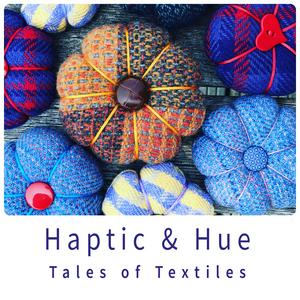
Haptic & Hue's Tales of Textiles explores the way in which cloth speaks to us and the impact it has on our lives. It looks at the different light textiles cast on the story of humanity. It thinks about the skills that go into constructing it and what it means to the people who use it.
Podcast websiteListen to Haptic & Hue, VeryPink Knits - Knitting Q and A and many other podcasts from around the world with the radio.net app
Get the free radio.net app
- Stations and podcasts to bookmark
- Stream via Wi-Fi or Bluetooth
- Supports Carplay & Android Auto
- Many other app features
Get the free radio.net app
- Stations and podcasts to bookmark
- Stream via Wi-Fi or Bluetooth
- Supports Carplay & Android Auto
- Many other app features

Haptic & Hue
Scan code,
download the app,
start listening.
download the app,
start listening.
 USA
USA