

Listen to this podcast in the app for free: Download for free in the App Store
radio.net
Sleep timer
Save favorites
8 episodes
How do we actually make museums more diverse? (with Peggy Levitt)
10/06/2026 | 47 mins.Vote for Call 'Em Like Museum in the 2026 Signal Awards
Good museums are centers of art, culture, and education. But the richest and most famous museums are clustered in North America and Europe, and that matters more than you might realize.
Sociologist and Wellesley College professor Peggy Levitt describes herself as a decenterer for just that reason. In her books "Artifacts and Allegiances" and "Move Over Mona Lisa," she has explored how art has been shaped by colonialism, globalization and inequality.
In "Move Over Mona Lisa," Peggy asks what it might take to decenter this world. Historically, she explains, many well-intentioned museums have diversified their collection by invited artists from the Global South to relocate to Paris, London, or New York. But the center has not moved.
"There are people that are looking for a harder reform," Peggy says. "So they are happy to take less critical acclaim, less financial acclaim, if they can create their own institutions, their own networks of circulation, their own nodes of activity that don't rely on North America or Europe for permission or facilitation."
Today on Call 'Em Like Museum, we talk about how museums can represent the whole world more fairly; whether artists in the Global South should entirely opt out of the existing systems; and the importance of "having a spine" when your museum comes under scrutiny from donors & politicians.
Full transcript of this episode
Subscribe to the newsletter
This episode was hosted, produced, and edited by Eric Johnson from LightningPod
Chapters
(00:00) - Introduction
(04:11) - Museums and Nation Building
(13:53) - Culture Wars at the Smithsonian
(15:32) - How to Read Power in Museum Spaces
(21:11) - Globalization, Colonialism, and Immigration
(25:53) - Who Drives Change in Museums?
(30:37) - Move Over, Mona Lisa: Decentering Art
(36:49) - Opting Out of Traditional Centers of Power
(40:41) - Standing Up to Museum Donors
(42:38) - Gift Shops and Favorite Museums
Music: www.purple-planet.com
Peggy's Books:
Artifacts and Allegiances: How Museums Put the Nation and the World on Display
Move Over, Mona Lisa: Reimagining What We Read, Look At, and Learn
Images:
Met Christmas Tree
Danish Vikings
Museum of Islamic Art
National Museum of Singapore
Smithsonian National Museum of American History
Musée nationale de l'histoire de l'immigrationWhat's inside that fancy old house? (with Woody LaBounty)
09/29/2026 | 46 mins.Vote for Call 'Em Like Museum in the 2026 Signal Awards
The Haas-Lilienthal House is one of San Francisco’s most beautiful architectural landmarks, a gorgeous Queen Anne Victorian that stands out amid a modern landscape of grocery stores and car dealerships. Built in the 1880s in the Pacific Heights neighborhood, this beautifully preserved home offers a unique glimpse into the city's 19th-century history.
While many historic house museums are dedicated to diplomats or the incredibly wealthy, original inhabitants William and Bertha Haas were upper-middle-class merchants moving up in the world. As San Francisco Heritage CEO Woody LaBounty explains, their home's location was chosen carefully to be near the true locus of power just one block over on Van Ness Avenue, which was then a showplace boulevard of massive, elaborate estates.
Today on Call ‘Em Like Museum, Woody talks about why the Haas-Lilienthal House is now the headquarters of SF Heritage and how the organization uses it to tell the city’s story. We also discuss what makes this house museum different from so many others, why it’s so important to preserve historic architecture, and why his favorite room in the house is the bathroom.
Visit the Haas-Lilienthal House: https://www.haas-lilienthalhouse.org/
The Halloween Experience, House of Weird: https://www.haas-lilienthalhouse.org/halloween
Full transcript of this episode
Subscribe to the newsletter
This episode was hosted, produced, and edited by Eric Johnson from LightningPod
Chapters
Music: www.purple-planet.com
Images:
House exterior
The Ashe-Hobart Residence
Residence of Mr. Charles Holbrook
Claus Spreckel's residence (which also survived the fire!)
1906 firefighters
The burning of the Mission District
The dining room chandelier
The house in 1975
The dining room
Golden Gate Park, c. 1925
De Young Museum, 1921
San Francisco burning
The Haas-Lilienthal House entrance
The bathroom
100 McAllister Street in the 1930s
Castro Camera
Queer Arts Featured
Salvador Dalí Museum
Salvador Dalí, 1939The living history of radio & broadcasting (with Rachel Lee)
09/22/2026 | 46 mins.Vote for Call 'Em Like Museum in the 2026 Signal Awards
When you visit a museum, do you see it as just a collection of artifacts from the past? The California Historical Radio Society (CHRS) is hoping you don't.
Although their museum in Alameda, California has a great collection of preserved & restored vintage radios, their work is really about the present, the future, and building a vibrant community of audio enthusiasts.
For Executive Director Rachel Lee, the real goal of the CHRS is to create a dynamic space where different generations can connect and engage. This welcoming environment often turns casual visitors into dedicated volunteers. As Lee notes, the most rewarding part of her work is watching visitors' eyes light up when they discover a historical space that feels incredibly "alive."
Today on Call 'Em Like Museum, Rachel talks about how different generations of visitors respond to the history of radio; why it’s so important to preserve the medium’s roots; and why radio matters a lot more for life in 2026 than you probably realize. Plus: The story of the huge “music box” machines that replaced live xylophone players at NBC.
Full transcript of this episode
Subscribe to the newsletter
This episode was hosted, produced, and edited by Eric Johnson from LightningPod
Chapters
(00:00) - Introduction
(02:49) - The Story of the California Historical Radio Society
(09:47) - Touring the Radio Museum's Exhibits
(16:02) - The NBC Chimes Machine & Vintage Broadcast Studio
(20:19) - Restoring Radios and Preserving Lost Broadcasts
(26:46) - Funding the Museum and Future Projects
(31:27) - The Meaning & Community Value of Museums
(39:53) - Cultivating the Next Generation of Makers
(43:39) - Profound Museum Memories & the Gift Shop
Music: www.purple-planet.comHow museums make cities stronger (with Tayana Panova)
09/15/2026 | 48 mins.Vote for Call 'Em Like Museum in the 2026 Signal Awards
Museums already do a lot: they educate the public, preserve important works of art and culture, and inspire people to create art of their own. But they have the potential to do even more. By adopting principles of urban design, museums can transform into essential "third places"—vibrant social spaces where communities gather, friendships are formed, and societies grow stronger.
"The third place is essential to being healthy and happy because you need to have a place where you can just relax, be yourself, have fun, connect with friends, and meet new people," explains urbanist and psychologist Dr. Tayana Panova.
How we experience a space depends entirely on its design, she says. An engaging environment filled with life makes time fly, whether you are walking down a vibrant city street or exploring a beautiful museum gallery.
Today on Call 'Em Like Museum, Dr. Panova—co-host of The Perfect City podcast and a popular creator exploring how urban design affects our brains—discusses what museums can learn from the design of cities, and vice versa. We also explore the vital, real-world stimulation we get from third places that our screens simply cannot replicate, the right way to integrate technology into an exhibit, and what modern cultural institutions might want to borrow from American shopping malls.
Full transcript of this episode
Subscribe to the newsletter
This episode was hosted, produced, and edited by Eric Johnson from LightningPod
Chapters
(00:00) - Introduction
(02:26) - The Role of Museums in a City
(06:56) - European vs. American Museums
(10:17) - Designing Human-Scale Cities
(15:08) - Smartphones vs. Real-World Stimulation
(19:33) - The Role of Technology in Museums
(23:21) - Can Museums Be Third Places?
(28:53) - Building Community Through Museum Programs
(35:42) - What Museums Can Learn From Urban Design
(40:21) - What Cities Can Learn From Museums
Music: www.purple-planet.com
Follow Tayana on Instagram, TikTok, and YouTube @dr.tpanova
The KunstHausWien in ViennaWalt Disney's life wasn't always magical (with Kirsten Komoroske)
09/08/2026 | 43 mins.Vote for Call 'Em Like Museum in the 2026 Signal Awards
The Walt Disney Family Museum in San Francisco faces a unique challenge: How do you tell the story of one of history's most important storytellers? When Diane Disney Miller founded the museum, her goal was to let her father tell his own story. To achieve this, she amassed 30,000 artifacts and extensive archival media to create a deeply personal look at the man behind the magic.
"She really wanted to debunk these myths that he was not a family man, not committed to his friends and family," says Kirsten Komoroske, the executive director of the museum. "She wanted to tell the truth about all of the challenges, the failures, the setbacks."
Those challenges include the devastating loss of his first hit character, Oswald the Lucky Rabbit; a polarizing animators' strike that led to Walt testifying before the House Un-American Activities Committee; and the lifelong smoking habit that ultimately ended his life at age 65.
Today on Call 'Em Like Museum, Kirsten shares how the Walt Disney Family Museum stays fresh as a single-subject institution, the importance of a "good, hard failure," and why there is a plaque next to one of the museum's benches explicitly telling visitors to sit down.
Full transcript of this episode
Subscribe to the newsletter
This episode was hosted, produced, and edited by Eric Johnson from LightningPod
Chapters
(00:00) - Introduction
(02:18) - Kirsten Komoroske's Museum Memories
(06:20) - How Diane Disney Miller Shaped the Story
(09:38) - Walt Disney's Failures and Perseverance
(12:09) - The Animators' Strike and HUAC Testimony
(19:00) - Becoming the Museum's Executive Director
(24:46) - The Museum's Enormous Collection
(28:21) - The Ribbon Room and Griffith Park Bench
(37:08) - The Disneyland Model Explained
Music: www.purple-planet.com
Images:
The museum exterior
Walt Disney
Narcissa Niblack Thorne
Thorne's "English Cottage Kitchen of the Queen Anne Period"
Gates of Hell
River of Stone
Faultline
Wood Line
Spire
Earth Wall
Videos:
Walt Disney Testifies at HUAC (1947)
More Arts podcasts
 The Book ReviewArts, Books
 THEMOVEArts, Sports
 Stories of ArtArts, History, Visual Arts
 SpookedArts, Leisure, Performing Arts, Society & Culture
 The Magnus ArchivesArts, Drama, Fiction, Performing Arts, Science Fiction
 Fresh AirArts, Books, Society & Culture, TV & Film
 Snap JudgmentArts, Performing Arts
 Fantasy FangirlsArts, Books
 99% InvisibleArts, Design
 The MothArts, Performing Arts
Trending Arts podcasts
 The Inner Game PodcastArts
 Every OutfitArts, Fashion & Beauty
 The Christian Health Club PodcastArts, Christianity, Religion & Spirituality
 Reading Ferdowsi فردوسی خوانیArts, Books
 Shelf RespectArts, Books, Comedy
 The Art AngleArts, News, Visual Arts
 The Maria Liberati ShowArts, Food
 The Greatest True Crime Stories Ever ToldArts, Books, True Crime
 The Splendid Table: Conversations & Recipes For Curious Cooks & EatersArts, Food
 Fool Coverage with Manny MUA and Laura LeeArts, Business, Society & Culture
 Old Time Radio WesternsArts, Kids & Family, Performing Arts
 92NY TalksArts, Music, News
 Gunsmoke | OTRWesterns.comArts, Drama, Fiction, Kids & Family, Performing Arts
 蜜獾吃书Arts, Books
 Nostalgic Mystery RadioArts, Drama, Fiction, Performing Arts, TV & Film
 Down These Mean Streets (Old Time Radio Detectives)Arts, Performing Arts, TV & Film
 BitefullyArts, Food, Personal Journals, Society & Culture
 The Lou Young ShowArts
 Books, Beach, & BeyondArts, Books
 She's My Cherry PieArts, Education, Food, Personal Journals, Society & Culture, Tutorials
 Sarah's Bookshelves LiveArts, Books
About Call 'Em Like Museum with Eric Johnson
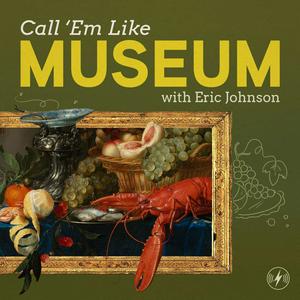
Call 'Em Like Museum is a weekly podcast exploring how museums really work, and why we love them. Host Eric Johnson talks with museum directors, curators, experts, and passionate fans about what drives them, from homegrown passion projects to world-famous institutions. Each episode digs into museum curation, exhibit design, and the visitor experience — plus the essential question: What's actually worth buying in the gift shop? Season One spotlights museums in the San Francisco Bay Area, including the Walt Disney Family Museum, the de Young Museum, and the Winchester Mystery House.
Podcast websiteListen to Call 'Em Like Museum with Eric Johnson, The Book Review and many other podcasts from around the world with the radio.net app
Get the free radio.net app
- Stations and podcasts to bookmark
- Stream via Wi-Fi or Bluetooth
- Supports Carplay & Android Auto
- Many other app features
Get the free radio.net app
- Stations and podcasts to bookmark
- Stream via Wi-Fi or Bluetooth
- Supports Carplay & Android Auto
- Many other app features
Call 'Em Like Museum with Eric Johnson
Scan code,
download the app,
start listening.
download the app,
start listening.
Call 'Em Like Museum with Eric Johnson: Podcasts in Family
 USA
USA