
Listen to this podcast in the app for free: Download for free in the App Store
radio.net
Sleep timer
Save favorites
Science of Perception Box
Unlikely Collaborators | Pod People
Latest episode
22 episodes
Can a Plant, a Chatbot, or Your Gut Be Conscious? With Michael Pollan
10/14/2026 | 59 mins.In this special live episode, journalist and bestselling author Michael Pollan explains how a psychedelic experience “smudged the windshield” of his consciousness and started the search behind his new book, A World Appears. He explains the difference between sentience and consciousness and shares some surprising plant research: corn that solves mazes, plants that recognize their relatives, and anesthetics that knock out a Venus flytrap. Pollan’s exploration of consciousness reveals a central idea of the Perception Box, a framework developed by Elizabeth R. Koch for understanding the forces within us that shape how we see ourselves, relate to others, and move through the world.
Dr. Heather Berlin is a neuroscientist, clinical psychologist, and Professor of Psychiatry and Neuroscience at the Icahn School of Medicine at Mount Sinai in New York City.
Dr. Christof Koch is Chief Scientist for the Tiny Blue Dot Foundation and the current Meritorious Investigator and former President of the Allen Institute for Brain Science.
Join us for new episodes every Thursday. Follow the show on YouTube, Spotify, Apple Podcasts, Amazon Music, or wherever podcasts are found.
Love the show? Write us a review on your podcast app, or tell a friend about the show.
Visit unlikelycollaborators.com for more information.
Chapters:
00:00 Intro
03:29 How psychedelics “smudged the windshield”
08:41 Are plants conscious?
16:03 Can machines be conscious?
18:53 Do we need a cortex to be conscious?
23:53 Materialism vs. idealism
33:17 The microbiome and embodied consciousness
34:53 Why the brain isn’t a computer
40:15 How gut bacteria shape the mind
48:55 Consciousness hygiene
55:00 The Perception Box questionThe ‘Self’ You Can’t Find with Sam Harris
10/07/2026 | 43 mins.Most of us feel like there's a "me" behind our eyes, a thinker of our thoughts and author of our choices. Author and Waking Up founder Sam Harris argues that when you look closely enough, that self disappears. Dr. Heather Berlin and Dr. Christof Koch dig into why the sense of self may be something the brain constructs moment to moment, and why free will, in Sam's view, doesn't hold up to either physics or careful attention. Along the way they explore what meditation and psychedelics reveal about the mind, why denying free will isn't fatalism, and why Sam sees that as grounds for optimism about how much we can change. Sam’s exploration into free will reveals a central idea of the Perception Box, a framework developed by Elizabeth R. Koch for understanding the forces within us that shape how we see ourselves, relate to others, and move through the world.
Dr. Heather Berlin is a neuroscientist, clinical psychologist, and Professor of Psychiatry and Neuroscience at the Icahn School of Medicine at Mount Sinai in New York City.
Dr. Christof Koch is Chief Scientist for the Tiny Blue Dot Foundation and the current Meritorious Investigator and former President of the Allen Institute for Brain Science.
Join us for new episodes every Thursday. Follow the show on YouTube, Spotify, Apple Podcasts, Amazon Music, or wherever podcasts are found.
Love the show? Write us a review on your podcast app, or tell a friend about the show.
Visit unlikelycollaborators.com for more information.
Chapters:
0:00 Intro
6:50 Self-consciousness and the neuroscience of self
12:50 Do we have free will?
24:00 Waking up: lucid dreaming and meditation
29:20 Intrusive thoughts and what we can control
31:00 Psychedelics and meditation
38:45 Can free will be settled?The Physics of Consciousness
09/30/2026 | 26 mins.Theoretical physicist Dr. Michio Kaku joins hosts Dr. Heather Berlin and Dr. Christof Koch to explore what physics can teach us about consciousness and reality itself. Dr. Kaku argues that consciousness is best understood as feedback loops, shaping the walls of our own Perception Box™ long before we're aware of it. The conversation asks if quantum mechanics has anything to do with a "warm, wet" brain, illuminating a central idea of the Perception Box, a framework developed by Elizabeth R. Koch for understanding the forces within us that shape how we see ourselves, relate to others, and move through the world.
Dr. Michio Kaku is a theoretical physicist, bestselling author, acclaimed public speaker, renowned futurist, and popularizer of science. As co-founder of String Field Theory, Dr. Kaku carries on Einstein's quest to unite the four fundamental forces of nature into a single grand unified theory of everything. He received a B.S. (summa cum laude) from Harvard University in 1968, then went on to the Berkeley Radiation Laboratory at the University of California, Berkeley, where he received a Ph.D. in 1972. In 1973, he held a lectureship at Princeton University.
Dr. Heather Berlin is a neuroscientist, clinical psychologist, and Professor of Psychiatry and Neuroscience at the Icahn School of Medicine at Mount Sinai in New York City.
Dr. Christof Koch is Chief Scientist for the Tiny Blue Dot Foundation and the current Meritorious Investigator and former President of the Allen Institute for Brain Science.
Join us for new episodes every Thursday. Follow the show on YouTube, Spotify, Apple Podcasts, Amazon Music, or wherever podcasts are found.
Love the show? Write us a review on your podcast app, or tell a friend about the show.
Visit unlikelycollaborators.com for more information.
Chapters:
00:00 Intro
01:48 Can Physics Explain Consciousness?
03:24 Defining Consciousness vs. Intelligence
09:57 Schrödinger's Cat and the Many-Worlds Theory
12:47 Do Quantum Effects Scale Up to the Brain?
16:13 Could AI Ever Be Conscious?
21:04 Perception Box Question: How Do Others Perceive You?
23:15 Kaku's Multiple Identities Through LifeHow to Recover From Decades of Chronic Stress
09/23/2026 | 46 mins.Stress researcher Dr. Elissa Epel explains why the goal isn't to eliminate stress but to get better at recovering from it. She says that a sharp, short stress response followed by real rest is the hallmark of a young, healthy nervous system. She breaks down the science of why chronic vigilance quietly ages our cells and shortens telomeres. Plus: why lying down can defuse an argument, how someone can recover from years of chronic stress, and why nature, ritual, and even a good nap belong in everyone's stress prescription. Dr. Epel's research reveals a central idea of the Perception Box, a framework developed by Elizabeth R. Koch for understanding the forces within us that shape how we see ourselves, relate to others, and move through the world.
Elissa Epel, Ph.D., is a professor of psychiatry at UCSF, where she directs the Aging, Metabolism, and Emotions Center. She co-wrote the New York Times bestseller The Telomere Effect with Nobel laureate Elizabeth Blackburn, and her latest book is The Stress Prescription. A member of the National Academy of Medicine, her research has been featured on 60 Minutes, NPR, and in the New York Times and Wall Street Journal.
Dr. Heather Berlin is a neuroscientist, clinical psychologist, and Professor of Psychiatry and Neuroscience at the Icahn School of Medicine at Mount Sinai in New York City.
Dr. Christof Koch is Chief Scientist for the Tiny Blue Dot Foundation and the current Meritorious Investigator and former President of the Allen Institute for Brain Science.
Join us for new episodes every Thursday. Follow the show on YouTube, Spotify, Apple Podcasts, Amazon Music, or wherever podcasts are found.
Love the show? Write us a review on your podcast app, or tell a friend about the show.
Visit unlikelycollaborators.com for more information.
Chapters:
03:00 What happens in mind and body under stress
05:16 Why too little stress ages you faster
13:20 Is chronic stress damage reversible?
15:12 What a healthy stress response looks like
18:06 Tunnel vision: the Perception Box under stress
24:15 Building recovery into your day
27:37 The stress prescription, part two: practices
31:13 Deep rest as a gateway to transformation
32:38 Recovering from years of chronic stress
38:41 Highly sensitive people and anxiety
40:09 Perception Box question: what do you want people to believe about you?Are Your Emotions Telling You the Truth?
09/16/2026 | 48 mins.Dr. Lisa Feldman Barrett, psychologist and neuroscientist, joins hosts Dr. Heather Berlin and Dr. Christof Koch to unpack her theory of constructed emotion: the idea that emotions aren't hardwired reactions but stories the brain builds to explain physical signals like a racing heart or a furrowed brow. Dr. Barrett explains why there's no universal facial expression for anger or fear, how the same racing heart can be read as fear or excitement depending on your Perception Box™, and why "you have more control over your interpretation than you think," even if that control takes practice to build.
Dr. Lisa Feldman Barrett is a psychological scientist and neuroscientist, University Distinguished Professor of Psychology at Northeastern University, and originator of the theory of constructed emotion. She is the author of How Emotions Are Made and Seven and a Half Lessons About the Brain.
Dr. Heather Berlin is a neuroscientist, clinical psychologist, and Professor of Psychiatry and Neuroscience at the Icahn School of Medicine at Mount Sinai in New York City.
Dr. Christof Koch is Chief Scientist for the Tiny Blue Dot Foundation and the current Meritorious Investigator and former President of the Allen Institute for Brain Science.
Join us for new episodes of Science of Perception Box every Wednesday. Follow the show on YouTube, Spotify, Apple Podcasts, Amazon Music, or wherever you get your podcasts.
Love Science of Perception Box? Write us a review on your podcast app, or tell a friend!
Visit unlikelycollaborators.com for more information.
Chapters:
03:17 Brain as Prediction Machine
07:41 Why Predictions Feel Invisible
13:55 Feelings Versus Emotions
18:43 No Universal Expressions
30:31 Babies And Basic Affect
32:03 Training Emotional Flexibility
38:42 Rewiring Predictions Over Time
41:45 Letting Go Of Convictions
More Health & Wellness podcasts






Trending Health & Wellness podcasts





















About Science of Perception Box
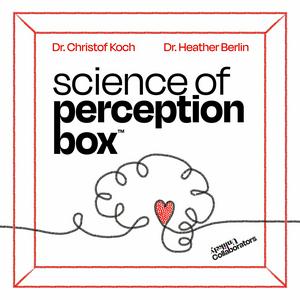
Join renowned scientists Dr. Heather Berlin and Dr. Christof Koch on the Science of Perception Box, where they delve into the Perception Box—a groundbreaking concept developed by Elizabeth R. Koch, that reveals how our beliefs, biases, and neural wiring shape our reality and define how we experience the world.
Through captivating conversations with expert guests like psychiatrist Dr. Judson Brewer, anthropologist Dr. Helen Fisher, and journalist Michael Pollan, the show explores how the Perception Box expands in states of awe, curiosity, and love, and contracts during fear, anxiety, or anger.
From mindfulness and romantic relationships to psychedelics and human connection, each episode uncovers transformative insights into unlocking greater awareness, fostering curiosity, and reshaping how we perceive the world.
New episodes drop every Thursday on YouTube, Spotify, Apple Podcasts, Amazon Music, or wherever you listen to podcasts. Follow the journey and redefine your reality.
Listen to Science of Perception Box, unPAUSED with Dr. Mary Claire Haver and many other podcasts from around the world with the radio.net app
Get the free radio.net app
- Stations and podcasts to bookmark
- Stream via Wi-Fi or Bluetooth
- Supports Carplay & Android Auto
- Many other app features
Get the free radio.net app
- Stations and podcasts to bookmark
- Stream via Wi-Fi or Bluetooth
- Supports Carplay & Android Auto
- Many other app features

Science of Perception Box
Scan code,
download the app,
start listening.
download the app,
start listening.
 USA
USA