
Listen to this podcast in the app for free: Download for free in the App Store
radio.net
Sleep timer
Save favorites
Aggressively Human: For experts choosing expansion over extraction.
Meg Casebolt & Jessica Lackey
Latest episode
93 episodes
The role of a website with Eleanor Mayrhofer
10/15/2026 | 52 mins.Anyone can spin up a website with AI now. But for experts who built their careers offline, the hard part was never the tool. It’s knowing what to publish, where, and why.
In this episode, we talk with Eleanor Mayrhofer, a digital strategist and web designer who helps people and organizations that regularly publish ideas consolidate, streamline, and showcase their work online. Eleanor came up through design school and the Web 1.0 boom, spent more than a decade in UX and global methodology work at Publicis Sapient in Munich, and now works with executives, academics, novelists, and think tanks who are great at what they do and have no interest in learning Claude Code.
We get into why the website is usually just the presenting symptom, how Eleanor matches a distribution plan to someone’s temperament, and why she still builds on Squarespace while getting excited about Claude Design for mockups. We also talk about AI copy flattening niche expertise, what book design teaches you about websites, and the two domains everyone should buy today.
* Why “I need a website” is often the presenting symptom of a bigger digital strategy problem
* Matching the platform to the person: a blog for the contemplative exec, philosophy talk radio for the professor, a Substack for one specific think tank project
* Eleanor’s six-ingredient recipe: goal, positioning, brand, platform, content, and distribution network
* “Posting my head off on LinkedIn and nothing’s happening,” and what to build instead
* Squarespace, WordPress, and vibe-coded sites: which ones your clients can actually maintain
* How AI copy struggles with niche jargon, contested terms, and human stories
* AI raising the floor on design while squashing the ceiling, and what book design teaches about structure and hierarchy
* Buy your name. Buy your book title. (Or Meg will, just to mess with you.)
“If you have this think tank, you need to build it out as a website. It’s like you need to showcase what you can do, and then you need to find bigger publications and point them to that body of work, and then write for those publications. “I’m posting my head off on LinkedIn, and nothing’s happening.” It’s like, well, nothing is gonna keep happening. You need to just have this infrastructure to show to the right people and be able to point to those.” - Eleanor
About our Guest
Eleanor Mayrhofer
Connect with Us
Listen on Spotify
Listen on Apple Podcasts
Meg Casebolt
Jessica Lackey
This is a public episode. If you would like to discuss this with other subscribers or get access to bonus episodes, visit aggressivelyhuman.substack.comOur fall launches: What worked, what didn't, and what changed mid-launch
10/08/2026 | 56 mins.Spoiler Alert: Neither of us “sold out” our fall launches. But looking at who joined and why, we don’t think that’s the whole story.
In this episode, we look back at our fall launches. Last month we walked through what we planned to launch, and both of us ended up pivoting partway through. Jessica walks through a membership price increase, about 60 welcome calls, a cohort that filled 15 of 20 seats, and the realization mid-launch that the membership—not the cohort—had become the place to actually define your foundations. Meg shares why her Signal launch came in at 11 people instead of 15 to 20, what she’d change about her small group workshops, and why she’s moved away from low-cost public challenges.
We talk about readiness, longer decision timelines, hand-selling, and why the best-fit buyers this time came from people who’d been engaging with our work for months.
* “Which launch?” Juggling a membership price raise, a member cap, and a public and private cohort at the same time
* When your product suite changes on you in the middle of a launch
* Why almost everyone in Jessica’s cohort had already read the book, joined the membership, or taken a course
* Meg’s small group workshops, and how benchmarking can feel like “now I know what to do”
* Why low-cost, high-volume public challenges stopped feeling good
* Readiness over budget: why buyers are fewer, slower, and more discerning
* Follow-up matters more than the sales sequence, and what personal outreach looks like at this stage
* Selling integration and discernment, not just information
* The staggered launch: why the people buying now first heard from you six months ago
“It used to be that the conventional launch strategy was get people on your newsletter six to eight weeks before the launch, have some webinar content, and then sell. And I think what you and I are both discovering is that they need to engage with you and your work six months in advance. They need to understand your way of thinking, not just through newsletters, but through live content, through engaging with your work for a substantially longer period of time. So your launch is really a staggered launch. The people who are joining now, you actually launched to them six months ago in the spring.” - Jessica
Programs
Deeper Foundations Membership
Signal Mentorship
Connect with Us
Listen on Spotify
Listen on Apple Podcasts
Meg Casebolt
Jessica Lackey
This is a public episode. If you would like to discuss this with other subscribers or get access to bonus episodes, visit aggressivelyhuman.substack.com“How do I know what I sound like” with Samantha Pollack
10/01/2026 | 55 mins.Most of the conversation about AI and writing is stuck on whether it can write well. Samantha Pollack thinks that’s the wrong question. The one that matters for your business is whether it can write like you, and whether you’d recognize your own voice if you saw it.
For the second episode in our series on voice, we welcome back developmental editor and writing coach Samantha Pollack. Sam runs Indie Copy Studio and works with business owners, authors, and academics who share a healthy side-eye for anything artificial, and she explains what developmental editing looks like when it’s applied to sales pages and emails instead of manuscripts. Her answer to “how do I know what I sound like?” is refreshingly unglamorous: you have to write a lot before you can hear it.
We talk about why writing to format is how the internet got so much slop long before AI showed up, and the difference between writing to get something from your reader and writing to give them something. Sam also makes the case that reading fiction, and even Hamlet, might be the most useful homework a business owner can take on.
* Why “is AI good at writing?” is the wrong question, and what to ask instead
* What a developmental editor actually does, and how that applies to a sales page
* Why you can’t find your voice before you’ve written enough to see it
* Spotting a writer’s signature quirks, and knowing when they tip over into a gimmick
* Writing as craft vs. writing to format: how LinkedIn templates and 2016-era copywriting formulas gave us slop long before AI
* Free-writing prompts that get you out of outcome mode (starting with “tell me the story of an object on your desk”)
* Writing to get vs. writing to give, and the “empathy switch” that keeps flipping mid-draft
* Why reading outside the business bubble, especially fiction, makes you a better business writer
* Why “I only use AI to edit” is riskier than it sounds if you don’t know how to edit
“There are people who will be like, ‘I don’t use AI to write, I just use it to edit.’ And that makes my little editor heart cry, because if you don’t understand how to edit writing, you’re not gonna be able to discern whether or not AI did a good job. And in your mind you’ll be like, ‘Oh, this looks fine,’ because objectively it will look fine. It will be grammatically correct, it will have some kind of varied rhythm. It’s just gonna feel flat and hollow because it isn’t basing anything on a feeling. When you read writing, it creates a feeling. And that’s why AI writing sounds like AI writing, because you don’t feel anything when you read it.” - Sam
About our Guest
Indie Copy Studio
Anarchy on the Blank Page
Connect with Us
Listen on Spotify
Listen on Apple Podcasts
Meg Casebolt
Jessica Lackey
This is a public episode. If you would like to discuss this with other subscribers or get access to bonus episodes, visit aggressivelyhuman.substack.comBrand Voice vs. AI Voice with Justin Blackman
09/24/2026 | 54 mins.Most of us can spot AI-written copy now, even if we can’t say exactly why. With tools like Pangram scanning content for it, sounding like the default has real consequences, and a clearly defined brand voice is one of the best ways to sound like a specific person again.
In this episode, we talk with brand voice expert Justin Blackman, creator of Voice Finder and the Verbatim tool, about what brand voice actually is and how to find yours. Justin breaks it down into three things you can measure: vocabulary, cadence, and tone. He explains why AI copy drifts toward the average of every human on the planet, and how he pushes clients to defend each word they use to describe themselves until it earns its keep.
We get into Latinate versus Germanic words, why AI and copywriters both write shorter sentences than most people, and what separates optimistic from confident on the page. We also compare what ChatGPT and Claude say our own brand voices are, and hear about the GIF that took Justin an hour to choose.
* The phrases that give AI away: “where the center holds,” “load-bearing,” closing the gap, “it’s not X, it’s Y”
* Justin’s three measurable parts of brand voice: vocabulary, cadence, and tone
* Why jargon and insider language can be a feature when they attract the right people and repel the wrong ones
* “Friendly, human, and casual” as the trifecta of nothingness
* Latinate vs. Germanic words, and why “prickly” lands differently than “deflating”
* Building a vocabulary theme from your background, from roots-to-fruits and broadcast signals to Indiana Jones
* Why AI sentences run shorter than most human writing, and how that’s changing the way all of us write
* Why a book written like an email is so hard to get lost in
* Optimistic, hopeful, or confident? How each one changes the words you put on the page
* What your GIF choices reveal about your brand voice
“If you ask most people, and just about damn near every brand on the planet, what they sound like, they’re gonna default to the same thing. They’re gonna say friendly, human, and casual. It’s the trifecta of nothingness. It’s in damn near every brand voice guide I’ve ever seen. Friendly is more of a personality. It’s the way that you show up. It’s what you do for people. It doesn’t define how you talk.” - Justin Blackman
About our Guest
Justin Blackman
Voice Finder
Connect with Us
Listen on Spotify
Listen on Apple Podcasts
Meg Casebolt
Jessica Lackey
This is a public episode. If you would like to discuss this with other subscribers or get access to bonus episodes, visit aggressivelyhuman.substack.comHumanizing Data (and Strengthening Sales) with Tanisha Tate Woodson
09/17/2026 | 57 mins.Most research gets done to communities: someone extracts the data, publishes the paper, and is never heard from again. Tanisha Tate Woodson built a firm on the opposite premise — and then did the less glamorous thing, which was turn that premise into an actual codified method.
In this episode, we talk with Tanisha Tate Woodson, who runs Woodson Insights Research and Evaluation, working with nonprofits, government agencies, and funders to humanize data and show the impact of their work. She walks us through her approach: four dimensions that get dialed up or down for every engagement, culturally responsive methods that let people tell their stories the way they actually want to, and a sense-making session at the end so the report doesn’t die on a shelf.
Then we get into what having a method has done for the business. Tanisha’s RFP win rate is around 50% in a field where 15-20% is normal, because she’s bidding on one or two instead of five and can answer a proposal from a process she’s already written down. She built an AI skill that knows her red flags and tells her when to pass. And she’s growing on referrals and community relationships with limited social media presence. This is a meta episode — premise, method, methodology in action.
* Storytelling as data: why observation and conversation are data, not just spreadsheets
* Why funders and the nonprofits they fund are speaking two different languages
* Research done to communities vs. research done with them — and the harm history behind the suspicion
* Why every engagement ends with a two-to-three-hour sense-making session, not a report on a shelf
* The through line from a promise made to a community to an artifact that actually goes back to them
* The four dimensions that get dialed up or down for every client — and the myth that community-engaged work is less rigorous
* Culturally responsive method in practice: PhotoVoice, video, and a focus group built on Chutes and Ladders
* Building the Black Data Pulse panel so recruitment stops eating clients’ budgets
* Why a codified process doubled her RFP win rate — and how she decides what not to bid on
* Using AI as a trained junior team member, not a proposal generator
* Growing a business on relationships and referrals with no Instagram account
* What “know yourself first” has to do with whether your AI output sounds like you
“There’s a huge myth in the field that when you’re close to the communities, when you’re doing community engagement work, it’s no longer rigorous, and that’s not true. It’s more rigorous because now we’re embedding community perspectives into their work. We’re not only embedding them into the work, but we’re also articulating the cultural relevance of the work that we’re doing.
Are people telling the stories in a way in which they wanna be told? So if, for instance, if you wanna hear from students, do students wanna take a survey? No. So we think about the culturally responsive methods as also thinking about who you wanna hear from and how do they want their stories to be told.” - Tanisha Tate Woodson
About our Guest
Woodson Insights
Connect with Us
Listen on Spotify
Listen on Apple Podcasts
Meg Casebolt
Jessica Lackey
This is a public episode. If you would like to discuss this with other subscribers or get access to bonus episodes, visit aggressivelyhuman.substack.com
More Business podcasts






Trending Business podcasts



























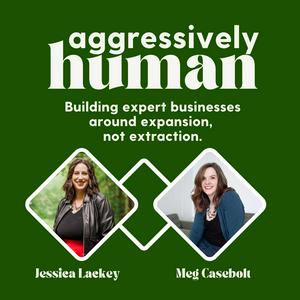
About Aggressively Human: For experts choosing expansion over extraction.
Aggressively Human is a podcast about building expert-led businesses around expansion, not extraction.
Hosted by Meg Casebolt and Jessica Lackey, the show explores what happens when conventional business advice meets the reality of the people who actually have to live with its consequences.
We talk about sustainable growth and business models, marketing and algorithms, AI and automation, expertise and authority, mental health and capacity, relationships, and the choices underneath all of it: What are you optimizing for? What do you gain? What does it cost? And does the tradeoff make sense for the actual humans involved?
We’re not here to prescribe a new set of rules for running your business. We’re interested in helping independent experts make thoughtful decisions about what to grow, what to automate, what to protect, and what they want their businesses to make possible.
Because your business should support your life. Not the other way around. aggressivelyhuman.substack.com
Podcast websiteListen to Aggressively Human: For experts choosing expansion over extraction., The Level Up Podcast w/ Paul Alex and many other podcasts from around the world with the radio.net app
Get the free radio.net app
- Stations and podcasts to bookmark
- Stream via Wi-Fi or Bluetooth
- Supports Carplay & Android Auto
- Many other app features
Get the free radio.net app
- Stations and podcasts to bookmark
- Stream via Wi-Fi or Bluetooth
- Supports Carplay & Android Auto
- Many other app features
Aggressively Human: For experts choosing expansion over extraction.
Scan code,
download the app,
start listening.
download the app,
start listening.
 USA
USA