

Listen to this podcast in the app for free: Download for free in the App Store
radio.net
Sleep timer
Save favorites
225 episodes
#110: Worldschooling, Homeschooling and Creating a Boundless Education with Rekha Magon
09/16/2026 | 42 mins.What if homeschooling could give your children more than academic knowledge? What if education could become a life filled with curiosity, real-world learning, meaningful relationships, travel, and experiences that prepare them to thrive anywhere?
In this episode of The Homeschool Feast, Julie Ross talks with Rekha Magon, co-founder and Chief Education Officer of Boundless Life, about rethinking traditional education and creating a more flexible, experiential approach to learning.
Rekha shares how her own homeschool journey began when she noticed her son’s natural curiosity fading after starting kindergarten. That experience led her to question the traditional school model, follow her children’s interests, incorporate travel and hands-on learning, and eventually help create Boundless Life, a global living and learning community for families.
We talk about worldschooling, alternative education, project-based learning, raising globally minded kids, experiential learning, homeschool travel, slow travel with kids, and how parents can create meaningful cultural experiences even if international travel isn’t realistic for their family.
You’ll hear encouragement to trust your intuition as a homeschool parent, follow your child’s natural curiosity, use the real world as your classroom, and rethink what it really means to prepare children for the future.
Whether you are already homeschooling, considering homeschooling, interested in worldschooling, or simply looking for ways to make learning more life-giving and meaningful, this conversation will inspire you to think beyond the traditional classroom and imagine what a truly boundless education could look like.
In this episode, you will learn about:
Homeschooling and alternative education
Worldschooling and travel with kids
Experiential and project-based learning
Following your child’s curiosity
Raising globally minded children
Real-world learning
Slow travel for families
Building homeschool community
Trusting your intuition as a parent
Creating a life-giving education
Connect with Rekha Magon:
Boundless Life Website
Rekha's LinkedIn
Youtube: Worldschooling TV channel
Instagram: @boundlesslife
Resources Mentioned:
Visit thehomeschoolfeast.me/blog/110 for additional resources and links
Just Getting Started? Get our FREE Charlotte Mason Workshops to see if this powerful approach can transform your homeschool inside our new Homeschool Feast app. http://www.thehomeschoolfeast.com/app
Connect with Us:
Website: The Homeschool Feast
Facebook: The Homeschool Feast Community
Instagram: @agentlefeast
Prefer video or closed captions? Watch all our episodes on YouTube. http://youtube.com/@AGentleFeast
Today’s episode is sponsored by the award winning Charlotte Mason curriculum A Gentle Feast. Get started with smooth and easy days inside our new membership at http://www.thehomeschoolfeast.com/table#109: Four Homeschool Eras That May Be Keeping You Stuck
09/02/2026 | 47 mins.What if the biggest problem in your homeschool is not the curriculum you chose, the lessons you did not finish, or the plan that fell apart?
What if you have simply slipped into a way of homeschooling that no longer feels alive?
You may be piecing together resources from a dozen different places, endlessly perfecting your plans, recreating the classroom at your kitchen table, or competently going through the motions while quietly losing sight of why you began.
In this episode, Julie shares four common “homeschool eras” that can leave mothers feeling exhausted, pressured, disconnected, or numb. She also offers a hopeful invitation into something different: a life-giving education rooted in rich ideas, meaningful relationships, spacious conversations, and the belief that every child is a capable person.
Drawing from Charlotte Mason’s philosophy, her own family’s story, and her experience watching her children grow into thoughtful young adults, Julie reminds us that education is about far more than transcripts, completed assignments, or checked boxes. It is about the people our children are becoming—and the kind of life we are building together.
This conversation will help you recognize where your homeschool may be stuck, release the pressure to perform, and rediscover an education that feels as natural and sustaining as breathing.
5 Key Takeaways
1. A cohesive homeschool cannot be created through endless patchwork.
Gathering beautiful books, plans, podcasts, recommendations, and resources can feel productive, but constantly assembling disconnected pieces places an enormous burden on the parent. When every part comes from a different source, Mom becomes responsible for forcing everything to fit.
A life-giving homeschool needs more than good individual pieces. It needs a clear through line—a sense that the subjects, ideas, relationships, and years belong to a meaningful whole.
2. Planning should support your homeschool, not replace living it.
A detailed plan can provide clarity and peace, but planning can also become a comfortable hiding place. It is easier to adjust a spreadsheet than to sit with a frustrated child, begin an imperfect lesson, or remain present when the morning does not unfold as expected.
Children do not experience our planners. They experience us.
Some of the richest homeschool moments will never appear on a schedule: a long walk that becomes a meaningful conversation, imaginative play inspired by history, or a child making an unexpected connection between two powerful ideas.
3. You can leave school without leaving the school mindset.
Many parents begin homeschooling because they want something different, yet unknowingly recreate the same system at home. The desks may be gone, but the internal bells continue ringing.
When the day is measured primarily by minutes, subjects, performance, and whether everyone is “caught up,” the family may carry the pressure of traditional school without receiving the freedom homeschooling can offer.
The solution is not to perform the old model more successfully. It is to choose a different vision of education.
4. A successful homeschool can still lose its sense of meaning.
The most difficult season may not be the chaotic one. It may be the season when everything functions, but no one feels fully present.
A homeschool can run efficiently while the mother quietly disconnects from her purpose. Lessons are completed, routines continue, and the outside world assumes everything is going well—but the education has slipped into autopilot.
Education is deeply relational and formative. It is discipleship, and discipleship requires presence. Returning to your why can help restore the connection and meaning that were always supposed to be at the heart of your home.
5. The future needs deeply human people.
As technology becomes increasingly capable of performing technical and informational tasks, qualities such as empathy, creativity, communication, resilience, judgment, and critical thinking become even more important.
These capacities are not developed through hurried worksheets or constant performance. They grow through living books, thoughtful conversations, unstructured time, close relationships, real experiences, and opportunities to wrestle with meaningful ideas.
The goal is not to train a child for one specific job that may change or disappear. The goal is to help form a person who can think carefully, adapt wisely, communicate clearly, love others well, and continue learning throughout life.
A Life-Giving Vision for Education
Charlotte Mason described education as a life. This means education is not merely preparation for some future season. It is not a tedious waiting room before adulthood.
Children are living now.
They are capable of encountering profound stories, beautiful language, complex questions, history, art, nature, faith, and ideas that nourish their minds and souls. They may need support, scaffolding, audiobooks, shorter portions, oral narration, or additional time—but they should not be denied rich ideas simply because learning comes differently for them.
When we trust that children are born persons and invite them into a generous feast, we make room for discoveries that no test could adequately measure.
A struggling reader may fall in love with Frankenstein. A teenage boy may compare its themes to the moral universe of Star Wars. A child who once cried over handwriting may grow into a confident young woman prepared to step into college and advocate for herself.
This is the fruit we may not see during the hardest days.
Encouragement for the Homeschool Mom
You are not behind because your days do not resemble a classroom.
You are not failing because the most meaningful learning cannot always be measured.
You are not wasting time when you read beautiful books, linger over a conversation, go outside, allow boredom, or give your child space to think.
You are forming a human being.
And as you read, learn, wonder, and nourish your own mind, you are shaping the atmosphere of your home in ways that may influence your children for the rest of their lives.
The invitation is not simply to find a better system.
It is to learn to live.
Resources Mentioned:
Visit thehomeschoolfeast.me/blog/100 for additional resources and links
Just Getting Started? Get our FREE Charlotte Mason Workshops to see if this powerful approach can transform your homeschool inside our new Homeschool Feast app. http://www.thehomeschoolfeast.com/app
Connect with Us:
Website: The Homeschool Feast
Facebook: The Homeschool Feast Community
Instagram: @agentlefeast
Prefer video or closed captions? Watch all our episodes on YouTube. http://youtube.com/@AGentleFeast
Today’s episode is sponsored by the award winning Charlotte Mason curriculum A Gentle Feast. Get started with smooth and easy days inside our new membership at http://www.thehomeschoolfeast.com/table#108: Raising Generous, Compassionate, and Globally Minded Kids with Petra Kooman
08/26/2026 | 38 mins.Raising Generous, Compassionate, and Globally Minded Kids with Petra Kooman
How do we teach our children about poverty and injustice without overwhelming them?
As parents, we want our children to recognize the needs of others, grow in compassion, and become generous people. But conversations about hunger, poverty, human trafficking, and global inequality can feel heavy—especially when our children are young.
In this episode, Julie talks with Petra Kooman of Compassion International about how parents can raise globally minded children in practical, age-appropriate, and hope-filled ways.
Petra reminds us that cultivating compassion does not require completely restructuring family life. It begins with small, intentional choices: making room in our schedules to notice people, helping children connect with individual stories, praying together, giving away what we no longer need, and looking for simple opportunities to serve.
In This Episode
Julie and Petra discuss how to introduce children to difficult global realities without placing burdens on them that they are not developmentally ready to carry.
They explore the connection between simplicity and generosity, the importance of creating margin in family life, and the many ways children can be generous beyond giving money.
Petra also shares how prayer can help sensitive children release the feeling that they must fix every problem. Families can respond faithfully to the needs in front of them while trusting God to carry what is beyond their control.
You’ll also hear practical ideas for developing a global perspective through child sponsorship, travel, diverse relationships, food, stories, service, and everyday family conversations.
Five Key Takeaways
1. Begin with age-appropriate, personal stories
Young children do not need to understand every complex cause of global poverty. They can begin by understanding simple realities: some children do not know when they will eat next, some families cannot afford school, and some people do not have safe homes.
Instead of presenting poverty as a large, abstract problem, help children connect with the story of one real person. A name, face, family, country, and place on a map make compassion more personal and understandable.
As children mature, parents can gradually expand these conversations to include more complex issues such as injustice, inequality, and the systems that affect communities.
2. Generosity includes more than money
Financial giving is one expression of generosity, but Petra encourages families to think more broadly.
Children can be generous with their time, prayers, attention, possessions, forgiveness, hospitality, and willingness to notice another person.
Generosity may look like writing a letter to a sponsored child, praying for a family, passing clothing to someone who can use it, keeping water in the car for someone in need, or giving another person room to be fully themselves.
3. Margin helps families notice opportunities to serve
It is difficult to notice the needs around us when every moment of the day is rushed.
Petra explains that her family tries to create enough margin in their schedule to allow for spontaneous generosity. When families have space to slow down, children can observe the people around them and respond with compassion.
Not every season of life will feel spacious, but busyness does not have to become the permanent structure of family life. Even one small, thoughtful practice can help a family begin living more consistently from its values.
4. Children should not feel responsible for fixing the world
Some children are especially sensitive to suffering and injustice. When they hear about poverty, they may begin to feel that it is their responsibility to solve every problem.
Parents can acknowledge that something is wrong while reminding children that God cares even more deeply than they do.
Families can pray for a specific person, respond to the needs within their reach, and then release the larger burden to God. Children can learn that they have a meaningful role to play without believing that the weight of the world rests on their shoulders.
5. Global awareness can grow through ordinary family life
International travel can broaden a child’s perspective, develop adaptability, and help children recognize that their own way of life is not the only way to live. However, families do not need to travel across the world to raise globally minded children.
Parents can visit a nearby town, try food from another culture, develop relationships with people from different backgrounds, attend a diverse church, read stories from around the world, locate countries on a map, or sponsor a child.
The goal is not to add another complicated subject to the homeschool schedule. It is to help children understand that they are part of a beautiful, interconnected human family—and that their lives can contribute to the flourishing of others.
A Simple Place to Begin
For the parent who already feels overwhelmed, Petra’s encouragement is simple: do not overcomplicate it.
Choose one small action.
Begin a five-minute conversation at the dinner table. Pray for one child or family. Pass along something your family no longer needs. Read a story set in another country. Place a bag of helpful supplies in the car. Sponsor a child and learn about that child’s community together.
Raising compassionate children happens through small choices repeated over time.
Memorable Idea
We give our children both roots and wings.
Roots provide stability, safety, faith, family rhythms, and a secure place to belong. Wings help them move beyond the boundaries of their own experience, encounter other people, become adaptable, and recognize that they are not the center of the universe.
Listen and Reflect
What is one small way your family could practice generosity this week?
How can you help your children notice the needs of others without making them feel fearful or overwhelmed?
Where could your family create a little more margin to make room for compassion?
Resources Mentioned
Visit thehomeschoolfeast.me/blog/108 for additional resources and links
Compassion International: http://www.compassion.com
The Power of a Praying Mom resource: https://www.compassion.com/unto-jesus/
Connect with Petra Kooman
Website: Compassion International
Instagram: @Compassion
Just Getting Started? Get our FREE Charlotte Mason Workshops to see if this powerful approach can transform your homeschool inside our new Homeschool Feast app. http://www.thehomeschoolfeast.com/app
Connect with Us:
Website: The Homeschool Feast
Facebook: The Homeschool Feast Community
Instagram: @agentlefeast
Prefer video or closed captions? Watch all our episodes on YouTube. http://youtube.com/@AGentleFeast
Today’s episode is sponsored by the award winning Charlotte Mason curriculum A Gentle Feast. Get started with smooth and easy days inside our new membership at http://www.thehomeschoolfeast.com/table#107: The Inspired Homeschool with Jennifer Pepito
07/20/2026 | 44 mins.The Inspired Homeschool with Jennifer Pepito
What if creating an inspired homeschool has less to do with finding the perfect curriculum—and more to do with cultivating curiosity, strong habits, meaningful relationships, and a clear vision for your family?
In this episode, Julie welcomes back longtime homeschooler, author, and founder of The Peaceful Press, Jennifer Pepito. Jennifer shares the inspiration behind her new book, The Inspired Homeschool: How History’s Heroes Light a Path Toward Joyful, Confident Learning, which explores the childhoods and educational experiences of ten remarkable people, including Laura Ingalls Wilder, C.S. Lewis, Leonardo da Vinci, Booker T. Washington, Blaise Pascal, and Joan of Arc.
Julie and Jennifer discuss the many different ways these historical figures were educated and the common threads that helped their gifts flourish. They also explore why homeschooling should not simply recreate the classroom at home, how a parent’s own curiosity shapes the atmosphere of learning, and why gentleness and academic depth are not opposites.
This conversation also offers encouragement for parents walking through difficult seasons. Jennifer reminds us that homeschooling is not about controlling the outcome or producing a flawless child. It is about remaining faithful, creating a home filled with truth and beauty, and trusting God with the results.
Five Key Takeaways
1. There is no single perfect way to homeschool
The historical figures featured in Jennifer’s book experienced many forms of education. Some learned primarily from parents, some had tutors or mentors, and others had very little formal schooling at all.
What mattered most was not one particular method, but the presence of supportive adults, access to meaningful ideas, freedom to explore, and someone willing to recognize and nurture their gifts.
2. An inspired homeschool begins with an inspired parent
Children often absorb more from the way we live than from the lessons we formally teach. A parent who reads, asks questions, explores new interests, appreciates beauty, and remains curious creates an atmosphere in which learning feels natural and meaningful.
Rather than focusing only on completing assignments, parents can ask themselves whether they are modeling the kind of thoughtful, engaged life they hope their children will develop.
3. Gentle education can still be rigorous
Gentle homeschooling does not mean lowering expectations, eliminating boundaries, or allowing learning to become directionless. It means respecting children as persons and offering work that is developmentally appropriate.
Reading rich literature, studying Scripture, observing nature, discussing ideas, practicing narration, and building strong habits can be deeply challenging without being rushed, harsh, or unnecessarily tedious.
4. Habits create room for freedom and creativity
Structure does not have to stifle creativity. Healthy rhythms and habits can actually make creativity possible by reducing chaos and creating space for meaningful work.
Jennifer and Julie discuss how figures such as Benjamin Franklin used disciplined routines to support learning and accomplishment. Homeschool families can begin with small habits that support spiritual life, household responsibilities, schoolwork, and family relationships.
5. Parents are called to faithfulness, not control
Homeschooling is important, but it does not give parents complete control over who their children become. Children will grow, struggle, make decisions, and follow paths that may not look exactly as their parents imagined.
Jennifer points to the story of Joan of Arc’s mother as an example of remaining steady and faithful through heartbreak. Parents can continue praying, living according to their values, and trusting God to complete the work He has begun—even when the journey is messier than expected.
About Jennifer Pepito
Jennifer Pepito is the host of the Restoration Home podcast, the bestselling author of Habits for a Sacred Home, and the founder of The Peaceful Press. She has spent 27 years homeschooling her seven children and has devoted her work to helping families create peaceful, purposeful homes.
Her writing has appeared in Wild + Free, Commonplace Quarterly, and Home Educating Family. She has also appeared on podcasts including 1000 Hours Outside, At Home with Sally, and The Read-Aloud Revival.
Her newest book, The Inspired Homeschool: How History’s Heroes Light a Path Toward Joyful, Confident Learning, draws lessons from the lives of influential writers, artists, scientists, leaders, and people of faith to help today’s parents cultivate homes filled with curiosity, creativity, confidence, and purpose.
Resources Mentioned
Visit https://www.thehomeschoolfeast.com/blog/107 for additional resources and links
Website: The Peaceful Press
Instagram: @jenniferpepito
Facebook: @thepeacefulpress
Pinterest: @thepeacefulpress
Podcast: Restoration Home
Just Getting Started? Get our FREE Charlotte Mason Workshops to see if this powerful approach can transform your homeschool inside our new Homeschool Feast app. http://www.thehomeschoolfeast.com/app
Connect with Us:
Website: The Homeschool Feast
Facebook: The Homeschool Feast Community
Instagram: @agentlefeast
Prefer video or closed captions? Watch all our episodes on YouTube. http://youtube.com/@AGentleFeast
Today’s episode is sponsored by the award winning Charlotte Mason curriculum A Gentle Feast. Get started with smooth and easy days inside our new membership at http://www.thehomeschoolfeast.com/table#106 Healing Childhood Eczema from the Inside Out with Andra McHugh of Eczema Kids
06/10/2026 | 28 mins.What if eczema is not just a skin issue, but a signal that something deeper in the body needs attention? In this episode of The Homeschool Feast, Julie sits down with Andra McHugh, founder of Eczema Kids, to talk about her family’s journey through severe childhood eczema and how that experience led her to a root cause, whole body approach to healing. After conventional treatments left her feeling discouraged, Andra began searching for a better way and now helps families support their children through nutrition, environment, topical care, and practical steps that address eczema from the inside out. This conversation explores what eczema really is, why it often goes deeper than the skin, how gut health and inflammation may play a role, and what parents can do when they feel overwhelmed by conflicting advice. Julie and Andra also talk honestly about the emotional toll eczema can take on families, especially the guilt, exhaustion, and helplessness many parents experience when watching a child suffer.
EczemaKids.com 7 Eczema Friendly Meals and Snacks Kids Will Actually Eat https://eczemakids.com/pages/7-eczema-friendly-meals-and-snacks-kids-will-actually-eat
https://www.instagram.com/eczema.kids/
Just Getting Started? Get our FREE Charlotte Mason Workshops to see if this powerful approach can transform your homeschool inside our new Homeschool Feast app. http://www.thehomeschoolfeast.com/app
Connect with Us:
Website: The Homeschool Feast
Facebook: The Homeschool Feast Community
Instagram: @agentlefeast
Prefer video or closed captions? Watch all our episodes on YouTube. http://youtube.com/@AGentleFeast
Today’s episode is sponsored by the award winning Charlotte Mason curriculum A Gentle Feast. Get started with smooth and easy days inside our new membership at http://www.thehomeschoolfeast.com/table
More Education podcasts
 Mick UnpluggedBusiness, Education, Entrepreneurship, Management, Self-Improvement
 Becoming UnDone® with Dr. Toby BrooksDocumentary, Education, Health & Wellness, Self-Improvement, Society & Culture
 Law of Attraction SECRETSEducation, Self-Improvement
 Makes Sense - with Dr. JC DoornickEducation, Self-Improvement
 Building Champions for LifeBusiness, Education, Management, Relationships, Self-Improvement, Society & Culture
 Finding Peak with Ryan HanleyBusiness, Education, Entrepreneurship, Management, Self-Improvement
 Living Your LegacyBusiness, Education, Entrepreneurship, Film Interviews, Self-Improvement, TV & Film
 Business Alchemy with Jackie MinskyEducation
 The Jamie Kern Lima ShowBusiness, Education, Entrepreneurship, Health & Wellness, Mental Health, Self-Improvement
 IMO with Michelle Obama and Craig RobinsonEducation, Self-Improvement, Society & Culture
Trending Education podcasts
 Light Up Your LifeEducation, Self-Improvement
 The Radio Free Hillsdale HourEducation
 This Naked Mind PodcastEducation, Self-Improvement
 Trying Not to CareEducation, Health & Wellness, Mental Health, Personal Journals, Relationships, Self-Improvement, Society & Culture
 Coffee Break GermanCourses, Education, Language Learning
 The Hillsdale College Online Courses PodcastCourses, Education, Government, History, Society & Culture
 纵横四海Education, Health & Wellness, Mental Health, Relationships, Self-Improvement, Society & Culture
 Grounded Wellness by Primally PureAlternative Health, Education, Health & Wellness, Self-Improvement
 Better Than HappyChristianity, Education, Religion & Spirituality, Self-Improvement
 Easy French: Learn French through authentic conversations | Conversations authentiques pour apprendre le françaisCourses, Education, Language Learning, Places & Travel, Society & Culture
 The Scriptures Are RealCourses, Education, Religion & Spirituality
 Organize 365 PodcastBusiness, Education, Entrepreneurship, Self-Improvement
 Tantric🌹Awakening™Education, Health & Wellness, Relationships, Self-Improvement, Sexuality, Society & Culture
 Spanish for BeginnersEducation, Language Learning
 Melissa & Lori Love Literacy ® | Science of Reading for TeachersCourses, Education, Tutorials
 Japanese podcast for beginners (Nihongo con Teppei)Education, Language Learning
About The Homeschool Feast
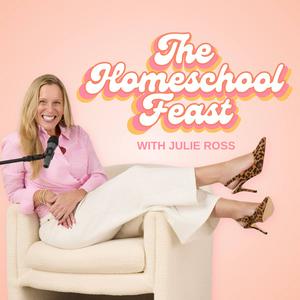
Welcome to 'The Homeschool Feast' podcast, where we empower modern moms to design a life and homeschool they truly love. Join us as we explore the art of creating a lifestyle founded on the values of family, freedom, and FUN. Our episodes are packed with inspirational stories, practical tips, and expert insights to help you embark on a homeschooling journey that not only educates your children, but also enriches your life. Join Julie Ross, creator of the homeschool curriculum A Gentle Feast and certified life coach, to discover how you can make everyday moments a celebration of learning, love, and laughter. If you need help escaping survival mode and want to create a thriving life and homeschool- Pull up a chair, you are welcome at this table! Find out more at thehomeschoolfeast.com
Podcast websiteListen to The Homeschool Feast, Mick Unplugged and many other podcasts from around the world with the radio.net app
Get the free radio.net app
- Stations and podcasts to bookmark
- Stream via Wi-Fi or Bluetooth
- Supports Carplay & Android Auto
- Many other app features
Get the free radio.net app
- Stations and podcasts to bookmark
- Stream via Wi-Fi or Bluetooth
- Supports Carplay & Android Auto
- Many other app features

The Homeschool Feast
Scan code,
download the app,
start listening.
download the app,
start listening.
 USA
USA