
Listen to this podcast in the app for free: Download for free in the App Store
radio.net
Sleep timer
Save favorites
291 episodes
Ep. 285: Why you should talk to strangers w/ Fin Colleton and Kratima Divakar
10/21/2026 | 39 mins.Growing up, most of us learned one simple rule: don't talk to strangers.
But American Dialogues is betting on the opposite.
In New York City parks, the group's organizers set out folding chairs and invite anybody passing by to sit down and talk about politics, culture, and everyday life. The goal is to get strangers to speak honestly and keep listening when the conversation becomes difficult.
Joining us to discuss how American Dialogues began, what happens when strangers disagree, and whether these conversations can help bridge America's divides are:
Fin Colleton, student fellow at Columbia University's Trust Collaboratory and the creator of the public conversation tables that grew into American Dialogues
Kratima Divakar, graduate student at Columbia's School of International and Public Affairs and a Trust Collaboratory student fellow who leads American Dialogues' outreach
Check out more about American Dialogues' work at americandialogues.org or @americandialogues on Instagram.
Preorder Nico's book now! The form to claim your t-shirt will be live later today. Check back here for the link, and keep your receipt in the meantime.
Timestamps:
00:00 Preorder Nico's book and get a free tshirt!
01:55 Intro
03:36 Fin's first experiment with talking to strangers
05:54 Kratima's introduction to Listening Tables
07:32 Bringing American Dialogues to New York City
10:43 Conversations across political divides
14:32 How do they handle disruptive participants?
19:52 The purpose of American Dialogues
28:16 Why New York City is the perfect venue
32:07 Online versus face-to-face conversations
33:56 Expanding American Dialogues
37:34 Outro
Enjoy listening to the podcast? Donate to FIRE today and get exclusive content like member webinars, special episodes, and more.
If you became a FIRE Member through a donation to FIRE at fire.org and would like access to Substack's paid subscriber podcast feed, please email sotospeak@fire.org.Ep. 284: Venezuela is a cautionary tale w/ Jim Epstein and Germania Rodriguez Poleo
10/07/2026 | 1h 4 mins.For more than half a century, Radio Caracas Televisión, or RCTV, broadcast news, sports, comedies, and telenovelas in Venezuela. Its news coverage was also fiercely critical of President Hugo Chávez.
When RCTV's broadcast license expired, the government refused to renew it. Minutes later, a state-funded channel took its place.
RCTV was one target in a broader campaign to silence dissent. Under Hugo Chávez and Nicolás Maduro, the government gradually tightened its grip on the media, punished political dissent, and weakened institutions that had protected democratic freedoms.
A new documentary, Escaping Venezuela, traces the erosion of free speech and press freedom through the story of Carlos Mora, who was imprisoned and tortured after helping Venezuelan dissidents escape to Colombia.
Joining us are director Jim Epstein and narrator Germania Rodríguez Poleo to discuss the film and how Venezuela's democratic institutions broke down.
Read more about Escaping Venezuela here.
Read Germania's Reason article here.
Timestamps:
00:00 Intro
03:12 Fear and self-censorship under Chavez
07:39 Making Escaping Venezuela
12:53 Germania's family and the crackdown on journalists
18:41 The destruction of Venezuela's free press
22:43 How Venezuela silenced dissent
32:56 RCTV as a symbol for press freedom
39:31 Venezuela after Maduro's capture
44:41 How Venezuela embraced socialism and Chavez came to power
50:13 Venezuelan immigrants and the end of TPS
52:44 Can Venezuela become a democracy again?
01:01:01 Where to watch Escaping Venezuela
01:04:05 Outro
Enjoy listening to the podcast? Donate to FIRE today and get exclusive content like member webinars, special episodes, and more.
If you became a FIRE Member through a donation to FIRE at fire.org and would like access to Substack's paid subscriber podcast feed, please email sotospeak@fire.org.FIRE Reacts: Trump's media ban
09/23/2026 | 46 mins.FIRE staff responds to President Trump's decision to ban CNN, MS NOW, and Politico from the White House, with President Trump citing their "constant 'reporting'" of "FAKE NEWS!" Barring journalists from the White House because of their coverage raises serious First Amendment concerns and strikes at the heart of a free and independent press. FIRE experts break down what happened and answer your questions about the ban.
Timestamps
00:00 Intro
02:06 Why does the White House Correspondents Association decide who serves in the White House press pool?
05:32 Can the president ban anyone from the White House?
07:07 Obama and Biden-era restrictions on press access
10:38 Access to the press room vs. being called on to ask a question
11:55 Could TrumpTV have a chilling effect on the press?
13:39 Can the White House reject a reporter but not their news organization?
14:56 What is a temporary restraining order?
17:27 The government's argument
22:03 National security and the First Amendment
23:57 What if a news organization publishes false information?
27:31 Does the White House have to justify press restrictions?
28:27 Is there something wrong with "a country that can allow people to write purposely negative stories"?
32:04 The scope of the White House restrictions
34:03 Public distrust of the press
36:48 Does restricting press access really address any national security concerns?
39:22 Can future administrations exclude partisan or influencer journalists?
41:05 Is barring journalists from the White House a prior restraint?
42:17 The impacts of a collective media boycott
45:04 Outro
Joining us:
Marie McMullan — SPFI program manager and counsel
Jacob Gaba — Staff attorney
Aaron Terr — Director of public advocacy
Become a paid subscriber today to receive invitations to future live webinars.
If you became a FIRE Member through a donation to FIRE at fire.org and would like access to Substack's paid subscriber podcast feed, please email sotospeak@fire.org.
If you already are a paid subscriber and would like to listen to this episode via Apple Podcasts, click on the "Apple Podcasts" icon at the top right of this page!Ep. 283: Robby Soave on Trump's press ban, Macklemore, and free speech culture wars
09/22/2026 | 59 mins.The free speech culture wars look different than they did a decade ago.
Reason senior editor and Rising host Robby Soave joins us to discuss the White House's restrictions on media access, Macklemore getting dropped from Ed Sheeran's tour, and why efforts to suppress controversial speech so often backfire.
We also look back at how the free speech debate has changed since Robby and Nico began covering it — from campus censorship and cancel culture to social media moderation and the changing politics of free speech.
Timestamps:
00:00 Intro
01:44 How Robby prepares for Rising
03:35 How the media landscape has changed
10:44 Trump, the press, and censorship
20:26 Cancel culture
23:55 Macklemore, Ed Sheeran, and the Streisand Effect
30:31 Why should we defend the media?
36:58 Campus free speech
43:48 The changing politics of free speech
58:34 Outro
Enjoy listening to the podcast? Donate to FIRE today and get exclusive content like member webinars, special episodes, and more.
If you became a FIRE Member through a donation to FIRE at fire.org and would like access to Substack's paid subscriber podcast feed, please email sotospeak@fire.org.Ep. 282: Breaking down our 2027 College Free Speech Rankings
09/11/2026 | 1h 2 mins.Harvard, institutional neutrality, how we determine the rankings, partisan censorship, how schools can improve their ranking, and more!
Timestamps:
00:00 Intro
03:18 Learn about our inaugural Soapbox conference
04:02 Preorder Nico's book Free Speech Generation
5:00 Check out FIRE's 2027 College Free Speech rankings
06:05 Who are the top- and bottom-ranked schools?
09:27 What's new with the Harvard evaluation?
13:08 How does FIRE choose which schools to rank?
13:46 What can universities do to improve their ranking?
15:54 What is institutional neutrality?
18:05 What exactly are students being asked about campus speech?
21:25 How does FIRE make sure defending free speech doesn't inadvertently protect censorship in the classroom?
25:19 Is campus censorship coming more from the "right" or the "left"?
26:53 Did the University of Washington settlement involving Professor Stuart Reges affect its ranking?
30:45 What does it mean to pre-register our methodology?
31:35 Why did Claremont McKenna drop in the rankings?
33:07 What advice does FIRE have for students at low-ranked schools facing censorship?
36:47 Do politically homogeneous campuses make students more comfortable speaking freely?
40:26 Do low-ranked colleges tell FIRE how they are improving?
42:56 What can administrators do now to improve next year's ranking?
43:50 Does FIRE account for turnover in university leadership?
45:47 What do the rankings reveal about different student demographic groups?
49:41 Does FIRE account for differences between types of institutions?
52:00 What's up with MIT?
56:02 Should attacks on tenured professors carry more weight than actions against other faculty?
57:02 Who does FIRE contact when evaluating a university?
58:09 Are there regional patterns in the rankings?
58:57 Were there bigger ranking swings than usual this year?
01:00:44 Outro
Joining us:
Nico Perrino, executive vice president
Angela Erickson, vice president of research
Sean Stevens, chief researcher
Ronnie London, general counsel and director of litigation
Connor Murnane, campus advocacy chief of staff
Become a paid subscriber today to receive invitations to future live webinars.
If you became a FIRE Member through a donation to FIRE at fire.org and would like access to Substack's paid subscriber podcast feed, please email sotospeak@fire.org.
If you already are a paid subscriber and would like to listen to this episode via Apple Podcasts, click on the "Apple Podcasts" icon at the top right of this page!
More News podcasts
Trending News podcasts


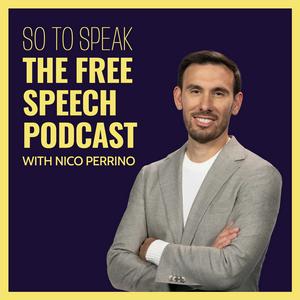
About So to Speak: The Free Speech Podcast
So to Speak: The Free Speech Podcast takes an uncensored look at the world of free expression through the law, philosophy, and stories that define your right to free speech. Hosted by FIRE's Nico Perrino.
New episodes post every other week.
Podcast websiteListen to So to Speak: The Free Speech Podcast, The Bulwark Daily and many other podcasts from around the world with the radio.net app
Get the free radio.net app
- Stations and podcasts to bookmark
- Stream via Wi-Fi or Bluetooth
- Supports Carplay & Android Auto
- Many other app features
Get the free radio.net app
- Stations and podcasts to bookmark
- Stream via Wi-Fi or Bluetooth
- Supports Carplay & Android Auto
- Many other app features
So to Speak: The Free Speech Podcast
Scan code,
download the app,
start listening.
download the app,
start listening.
So to Speak: The Free Speech Podcast: Podcasts in Family
 USA
USA