
Listen to this podcast in the app for free: Download for free in the App Store
radio.net
Sleep timer
Save favorites
159 episodes
Staying Relevant: Treating a New Skill as an Investment
10/24/2026 | 15 mins.In this episode of Money Lessons, Andy treats a new skill the way he'd treat any other investment: what it costs, what it returns, and when to make it.
He defines skill gap, upskilling, and reskilling; explains why skills go stale, with the World Economic Forum's finding that workers can expect 39 percent of their skills to be transformed or outdated by 2030; and works through a $3,000 certificate step by step, counting the money, the hours, and the years the skill will keep earning.
Fun fact: an employer with an educational-assistance plan can pay up to $5,250 a year toward your education — or, since the 2025 tax law, your student loans — with no tax on it.
AndrewTemte.comPurpose at Work: What a Job That Doesn't Fit Costs You
10/17/2026 | 12 mins.In this episode of Money Lessons, Andy asks whether the work you're paid for fits the purpose you have — and what it costs you when it doesn't.
He defines purpose, alignment, misalignment, and golden handcuffs, then prices misalignment three ways in dollars: disengagement that lets your skills fade, golden handcuffs that make leaving a calculation instead of a feeling, and drift that keeps your human capital from growing.
Gallup's newest numbers are here, including the fun fact that low engagement cost the world economy about $10 trillion in 2025.
AndrewTemte.comHuman Capital: Your Earning Power Is Your Biggest Asset
10/10/2026 | 14 mins.In this episode of Money Lessons, Andy turns from what you earn this year to what you can earn over a working life.
He defines human capital — the competence, experience, and health an employer or customer will pay for — and measures it against the asset most families count as their largest, home equity.
Drawing on the Federal Reserve's survey of family finances, Georgetown's lifetime-earnings estimates, and the World Bank's wealth accounts, he shows why earning power is the largest asset most people will ever own, even though it never appears on a personal balance sheet.
He explains why a raise compounds the way investment returns do, why that makes skills built early worth more, and why only skills that last keep compounding.
AndrewTemte.comSelf-Employment Tax, Estimated Payments, and the Side Gig
10/03/2026 | 15 mins.In this episode of Money Lessons, Andy turns to the earners the pay stub episodes left out: the self-employed, the independent contractor, and the side gig.
He defines the five terms that matter — self-employed, the 1099, net earnings, self-employment tax, and estimated payments — and works through the tax bill on the same $50,000 last week's employee earned, so listeners hear what happens when both halves of Social Security and Medicare land on the self employed.
A trip back to 1943 explains why the self-employed still pay the way every American once did, and why the IRS wants four payments a year instead of one. The episode closes with Andy's rule for anyone earning without a pay stub: set the tax money aside the day the payment arrives, and put the four dates on the calendar.
AndrewTemte.comBenefits Are Pay: Total Compensation and the Employer Match
09/26/2026 | 13 mins.In this episode of Money Lessons, Andy adds up what a job is worth beyond the salary: the employer's share of the health premium, the employer's half of Social Security and Medicare, and the retirement match.
He follows one employee earning $50,000 and shows that total compensation comes to $63,100, and $750 less when a default contribution rate leaves half the match uncollected. Along the way he defines vesting, points to the one line on a W-2 that shows what your health coverage costs, and shares the Bureau of Labor Statistics finding that benefits are 30 percent of what private employers spend on pay.
AndrewTemte.com
More Business podcasts





Trending Business podcasts










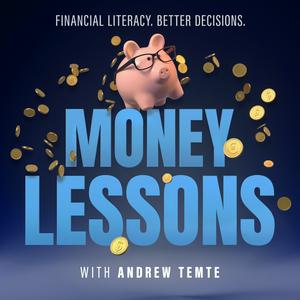
About Money Lessons with Andrew Temte, PhD, CFA
Make Financial Literacy Accessible Through Compelling Storytelling
Join Dr. Andrew Temte every Saturday for Money Lessons—a weekly financial education podcast that transforms complex economic concepts into accessible, engaging stories. Each bite-sized 10-minute episode builds your financial knowledge through historical narratives and practical applications, making this the perfect podcast for anyone seeking to improve their money management skills and investment understanding.
What You'll Learn:
From the ancient origins of money and banking to modern stock markets and retirement planning, Money Lessons covers essential financial literacy topics including:
How insurance and risk management work
Stock market fundamentals and investment principles
Banking systems and monetary policy
Interest rates, inflation, and economic cycles
Credit, debt, and smart borrowing decisions
Foundational macro and microeconomic principles that directly apply to personal financial decision-making
Building wealth through informed financial decisions
Your Host:
Dr. Andrew Temte brings unparalleled expertise as a PhD in finance, CFA Charterholder, and former CEO of Kaplan Professional. With over 15 years of university teaching experience, Andy makes finance education approachable for everyone—from high school graduates to seasoned professionals seeking to sharpen their financial acumen.
Why Money Lessons:
Unlike traditional personal finance podcasts, Money Lessons uses historical storytelling to reveal how financial systems evolved and why they matter today. Whether you're learning about the Knights Templar inventing banking, the Dutch East India Company creating stock markets, or Benjamin Franklin's compound interest experiments, each episode connects past innovations to your present financial decisions.
Perfect for young professionals starting their investment journey, parents teaching financial responsibility, or anyone building a foundation for long-term wealth creation.
New episodes every Saturday. Subscribe today and start your journey of financial literacy.
Podcast websiteListen to Money Lessons with Andrew Temte, PhD, CFA, The Learning Leader Show With Ryan Hawk and many other podcasts from around the world with the radio.net app
Get the free radio.net app
- Stations and podcasts to bookmark
- Stream via Wi-Fi or Bluetooth
- Supports Carplay & Android Auto
- Many other app features
Get the free radio.net app
- Stations and podcasts to bookmark
- Stream via Wi-Fi or Bluetooth
- Supports Carplay & Android Auto
- Many other app features

Money Lessons with Andrew Temte, PhD, CFA
Scan code,
download the app,
start listening.
download the app,
start listening.
Money Lessons with Andrew Temte, PhD, CFA: Podcasts in Family
 USA
USA