

Listen to this podcast in the app for free: Download for free in the App Store
radio.net
Sleep timer
Save favorites
100 episodes
The Future of Wellbeing in an Automated World
05/24/2022 | 43 mins.This season of Better Life Lab, we’ve been taking a close look at work stress and the future of work and wellbeing.
Parts of the American economy are looking tough for many workers — even “dystopian. People are quitting their jobs at record rates.
We know what many of the problems are. Yet the fixes are not so simple. So on this closing episode of our fourth season, we ask: Are bad jobs an inherent part of the workplace — or can we actually do what it takes to make the jobs of the future good jobs, big enough to support real human life for all of us?
Guests
Rep. Jim Himes, D-Ct, chair of the House Select Committee on Economic Disparity and Fairness in Growth
Zeynep Ton, founder, Good Jobs Institute
Warren Valdmanis, private equity investor and partner with Two Sigma Impact, who will only invest in companies that provide good jobs
Resources
What if Progress meant Wellbeing for All?, The Metropolitan Group
Making wellbeing a policy priority. Lessons from the 2021 World Happiness Report, Carol Graham, Brookings, 2021
The Business Roundtable Redefines the Purpose of a Corporation to Promote an Economy that Serves All, 2019
Hearing Recap: Our Changing Economy: The Effects of Technological Innovation, Automation and the Future of Work, House Select Committee on Economic Disparity and Fairness in Growth, Nov. 2021
Economists pin more blame on tech for inequality, New York Times, January 2022
Hosted on Acast. See acast.com/privacy for more information.The Future of Wellbeing in an Automated World
05/24/2022 | 46 mins.This season of Better Life Lab, we’ve been taking a close look at work stress and the future of work and wellbeing.
Parts of the American economy are looking tough for many workers — even “dystopian. People are quitting their jobs at record rates.
We know what many of the problems are. Yet the fixes are not so simple. So on this closing episode of our fourth season, we ask: Are bad jobs an inherent part of the workplace — or can we actually do what it takes to make the jobs of the future good jobs, big enough to support real human life for all of us?
Guests
Rep. Jim Himes, D-Ct, chair of the House Select Committee on Economic Disparity and Fairness in Growth
Zeynep Ton, founder, Good Jobs Institute
Warren Valdmanis, private equity investor and partner with Two Sigma Impact, who will only invest in companies that provide good jobs
Resources
What if Progress meant Wellbeing for All?, The Metropolitan Group
Making wellbeing a policy priority. Lessons from the 2021 World Happiness Report, Carol Graham, Brookings, 2021
The Business Roundtable Redefines the Purpose of a Corporation to Promote an Economy that Serves All, 2019
Hearing Recap: Our Changing Economy: The Effects of Technological Innovation, Automation and the Future of Work, House Select Committee on Economic Disparity and Fairness in Growth, Nov. 2021
Economists pin more blame on tech for inequality, New York Times, January 2022The New Unemployment
05/17/2022 | 33 mins.Being unemployed in the United States is bad for you.
It’s bad for your mental, physical and emotional health. Bad for your family stability. Bad for your ability to survive.
It’s just bad news, period.
The research shows that 83 percent of laid-off workers develop a serious stress-related condition. And as we look at the future of work, that’s a problem for the American economy. Because one of the big questions about the American workplace is:What if, in the a future, we actually have less work … and more unemployment?
Guests
Kiarica Shields, hospice nurse in Georgia who lost her job early in the pandemic, and eventually lost her home and her car. Her unemployment insurance stopped inexplicably, and after she her appeal, she was told she was ineligible for coverage because she worked a single day on another job.
Mark Attico - furloughed at the start of the pandemic in his job planning business travel. Was on unemployment for months, and with the pandemic supplement his income was actually enough to pay his bills, and gave him time to reconnect with his teenage son - and hold out for a better job that fit his skills and paid well.
Dorian Warren, co-president of Community Change.
Sarah Damaske, author of The Tolls of Uncertainty: How Privilege and the Guilt Gap Shape Unemployment in America.
Resources
Reforming Unemployment Insurance: Stabilizing a system in crisis and laying the foundation for equity, A joint project of Center for American Progress, Center for Popular Democracy, Economic Policy Institute, Groundwork Collaborative, National Employment Law Project, National Women’s Law Center, and Washington Center for Equitable Growth, June, 2021
A Playbook for Improving Unemployment Insurance Delivery, New America New Practice Lab, 2021
A Plan to Reform the Unemployment Insurance System in the United States, Arindrajit Dube, The Hamilton Project, April 2021
How Does Employment, or Unemployment, Affect Health, RWJF, 2013
Single transitions and persistence of unemployment are associated with poor health outcomes, Herber et al, 2019
The Toll of job loss, Stephanie Pappas, American Psychological Association, 2020
Hosted on Acast. See acast.com/privacy for more information.The New Unemployment
05/17/2022 | 36 mins.Being unemployed in the United States is bad for you.
It’s bad for your mental, physical and emotional health. Bad for your family stability. Bad for your ability to survive.
It’s just bad news, period.
The research shows that 83 percent of laid-off workers develop a serious stress-related condition. And as we look at the future of work, that’s a problem for the American economy. Because one of the big questions about the American workplace is:What if, in the a future, we actually have less work … and more unemployment?
Guests
Kiarica Shields, hospice nurse in Georgia who lost her job early in the pandemic, and eventually lost her home and her car. Her unemployment insurance stopped inexplicably, and after she her appeal, she was told she was ineligible for coverage because she worked a single day on another job.
Mark Attico - furloughed at the start of the pandemic in his job planning business travel. Was on unemployment for months, and with the pandemic supplement his income was actually enough to pay his bills, and gave him time to reconnect with his teenage son - and hold out for a better job that fit his skills and paid well.
Dorian Warren, co-president of Community Change.
Sarah Damaske, author of The Tolls of Uncertainty: How Privilege and the Guilt Gap Shape Unemployment in America.
Resources
Reforming Unemployment Insurance: Stabilizing a system in crisis and laying the foundation for equity, A joint project of Center for American Progress, Center for Popular Democracy, Economic Policy Institute, Groundwork Collaborative, National Employment Law Project, National Women’s Law Center, and Washington Center for Equitable Growth, June, 2021
A Playbook for Improving Unemployment Insurance Delivery, New America New Practice Lab, 2021
A Plan to Reform the Unemployment Insurance System in the United States, Arindrajit Dube, The Hamilton Project, April 2021
How Does Employment, or Unemployment, Affect Health, RWJF, 2013
Single transitions and persistence of unemployment are associated with poor health outcomes, Herber et al, 2019
The Toll of job loss, Stephanie Pappas, American Psychological Association, 2020Is America Ready for a Guaranteed Basic Income?
05/10/2022 | 36 mins.Michael Tubbs grew up in poverty. And when, at 26, he was elected mayor of his hometown, he decided to do something about it.
And what he did in Stockton, California, no American mayor had done before. He started giving poor people cash. No strings attached.
Stockton’s pilot program in Guaranteed Basic Income started lifting people out of poverty. It gave parents more time with their kids. And it was actually cost-effective.
So as we look to the Future of Work and Wellbeing, could Guaranteed Basic Income programs play a central role in lifting all of us up — and boosting the standard of life for all Americans?
Guests
Michael Tubbs, elected mayor of Stockton, California in 2016 at the age of 26 — the youngest mayor in the country. He is known nationally for establishing the first city-led Guaranteed Basic Income program in America, which has inspired dozens of other cities across the country to try similar programs. Having lost his re-election bid in 2020, Tubbs recently founded the nonprofit End Poverty in California.
Natalie Foster, co-founder, co-director Economic Security Project, which worked closely with Tubbs on Stockton’s Guaranteed Basic Income program
John Summers, participant in pilot guaranteed basic income program Cambridge RISE in Massachusetts.
Resources
Stockton’s Basic Income Experiment Paid Off, Annie Lowrey, The Atlantic
The Potential for a Guaranteed Income: A Conversation with Four Mayors, New America California, 2021.
The Future of Leisure, Stuart Whatley, Democracy Journal, 2012
The Evolving Concept of Time for Work, Leisure, Pew Research, 2008
Less Work and More Leisure: Utopian Visions and the Future of Work, CBC Radio, 2018
More Society & Culture podcasts
 The Shawn Ryan ShowPhilosophy, Society & Culture
 Dream Life ClubBusiness, Education, Entrepreneurship, Health & Wellness, Mental Health, Personal Journals, Self-Improvement, Society & Culture
 CriminalDocumentary, Society & Culture, True Crime
 Behind the BastardsHistory, News, Society & Culture
 Miss Understood with Rachel UchitelEntertainment News, News, Society & Culture
 Sword and ScaleBusiness, Documentary, Entrepreneurship, History, Society & Culture, True Crime
 The Oprah PodcastSociety & Culture
 This American LifeArts, News, Politics, Society & Culture
 Modern WisdomHealth & Wellness, Society & Culture
 The Ezra Klein ShowGovernment, News, Society & Culture
Trending Society & Culture podcasts
 Coffee Convos with Kail Lowry and Lindsie ChrisleyKids & Family, Society & Culture
 HysteriaComedy, Comedy Interviews, News, Politics, Society & Culture
 Sold a StoryDocumentary, Society & Culture
 Unsupervised with Syd & TPBasketball, Society & Culture, Sports
 The Hidden ThirdDocumentary, Society & Culture, True Crime
 Good GuysComedy, Society & Culture
 Literally! With Rob LoweSociety & Culture
 Spot On with Link LaurenSociety & Culture
 Call Your Sister with Joy & JingerKids & Family, Relationships, Religion & Spirituality, Society & Culture
 True Scary StoryArts, Personal Journals, Society & Culture
 Macrodosing: Arian Foster and PFT CommenterPhilosophy, Society & Culture
 Kennedy Saves the WorldNews, News Commentary, Society & Culture
 HyperfixedDocumentary, History, Society & Culture, Technology
 Casual ChaosSociety & Culture
 Calm Down with Erin and CharissaSociety & Culture, Sports
 Ear HustleDocumentary, Society & Culture
 HeavyweightComedy, Personal Journals, Society & Culture
 Next Question with Katie CouricDocumentary, Entertainment News, Health & Wellness, News, Society & Culture
 It's Me, TinxSociety & Culture
 Woman Evolve with Sarah Jakes RobertsReligion & Spirituality, Society & Culture
 The Determined Society with Shawn French | Adversity & MindsetBusiness, Education, Entrepreneurship, Film Interviews, Health & Wellness, Mental Health, Personal Journals, Self-Improvement, Society & Culture, TV & Film
 What Now? with Trevor NoahComedy, News, Society & Culture
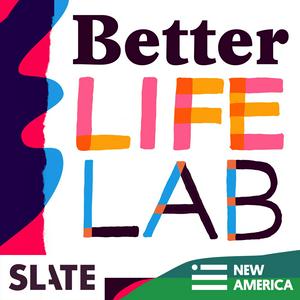
About Better Life Lab
Economists say the way we work has become so stressful it’s now the fifth leading cause of death. Our mission is to find a better way. Explore the art and science of living a full and healthy life with behavioral and social science researchers who can help us better understand what drives our human experiences, and how to change. Better Life Lab is a co-production from New America and Slate. Hosted on Acast. See acast.com/privacy for more information.
Podcast websiteListen to Better Life Lab, The Shawn Ryan Show and many other podcasts from around the world with the radio.net app
Get the free radio.net app
- Stations and podcasts to bookmark
- Stream via Wi-Fi or Bluetooth
- Supports Carplay & Android Auto
- Many other app features
Get the free radio.net app
- Stations and podcasts to bookmark
- Stream via Wi-Fi or Bluetooth
- Supports Carplay & Android Auto
- Many other app features
Better Life Lab
Scan code,
download the app,
start listening.
download the app,
start listening.
Better Life Lab: Podcasts in Family
 USA
USA