
Listen to this podcast in the app for free: Download for free in the App Store
radio.net
Sleep timer
Save favorites
77 episodes
Joshua Tan (Current AI): The Honda Civic Model of AI
10/22/2026 | 36 mins.Kevin Werbach speaks with Joshua Tan, CTO of Current AI, about the case for public AI: The idea that AI can and should be public infrastructure, like highways, libraries, or the internet. Tan traces his path from theoretical machine learning at Oxford to starting the reseaerch group Metagov. He explains what work on decentralized and collective organizations can offer AI governance. He also discusses autonomous organizations run by AI agents, the safety questions that arise when agents hold bank accounts and manage human employees, and why incentives shift once these experiments reach real scale.
Tan positions public AI as a third way between closed proprietary AI and open-weight models, which are struggling to keep pace with frontier-scale capital costs. Current AI focuses on everything beyond the model, aiming to build a fully open source stack on top of fully open models, a Linux for AI. He describes this as a Honda Civic strategy: not at the frontier, but close enough, cheaper, and reliable. The conversation also covers the role of government funding, a new Swiss cooperative, a community-owned data center effort in Maine, and what it would take for Europe and other middle powers to compete.
Joshua Tan is CTO at Current AI. He also leads product and strategy for the public AI movement and leads Stanford AO, an incubator and lab for autonomous organizations at Stanford OpenLab. He previously co-founded Metagov, a lab for engineering institutions, completed his PhD and postdoc in computer science at Oxford, and held fellowships at Stanford, Princeton, and MIT. He founded and led DAOstar.
Transcript
Joshua Tan research page
Current AI
Not just the model (Artifacts Interview)Brett Levenson (Moonbounce): The Best AI Security System is the One People Will Use
10/15/2026 | 39 mins.Kevin Werbach speaks with Brett Levenson, co-founder and CEO of Moonbounce, about building real-time controls that make AI systems follow the policies companies write for them. Drawing on his years leading integrity work at Meta after the Cambridge Analytica scandal, Levenson explains why content moderation policies there could not be enforced consistently. His team shifted from a decision-first approach to what he calls info-first enforcement, breaking complex policies into simple yes-or-no questions organized in a decision tree. Reviewer consistency jumped dramatically. That atomized approach now underlies Moonbounce, which acts as a semantic firewall that evaluates every input, output, and action an AI takes.
Levenson argues that AI made the application layer non-deterministic, breaking security models that assume predictable software. He describes the challenge of making decisions within a few hundred milliseconds, and a decision memory system that keeps policies adaptive by incorporating customer corrections without hidden state. He also explains Moonbounce's move beyond simple allow-or-block choices to escalating to humans and rewriting outputs. Werbach and Levenson discuss the legal tension around audit trails, payment providers acting as de facto regulators, and why Levenson believes the industry needs measurable, falsifiable standards.
Brett Levenson is co-founder and CEO of Moonbounce. He left Apple in 2019 to lead business integrity at Facebook during the Cambridge Analytica fallout, and later headed Meta's Integrity unit. He co-founded Moonbounce with CTO Ash Bhardwaj, a former Apple engineering leader who built large-scale cloud and AI infrastructure. Moonbounce has raised $12 million in funding co-led by Amplify Partners and StepStone Group.
Transcript
The Facebook insider building content moderation for the AI eraSharon Goldman (Ground Level AI): AI as It Meets the Real World
10/08/2026 | 33 mins.Kevin Werbach speaks with AI journalist Sharon Goldman about her new venture, Ground Level AI. Goldman describes taking on the AI beat at VentureBeat in 2022, months before ChatGPT launched, and then learning to translate technical developments for Fortune's broad business audience. She explains why she left to launch her own newsletter and podcast, focused on infrastructure, security, governance, policy, and the communities absorbing AI's effects.
Goldman shares her reporting from data center sites, and weighs how much of the data center backlash reflects local impacts versus broader anxieties about AI. The conversation turns to cybersecurity, where the speed and scale of AI-enabled attacks may outpace defenders. Goldman argues that the AI safety and cybersecurity communities, long divided by culture, must now work together. She closes on what she thinks is underappreciated: how quickly things are changing.
Sharon Goldman is the founder of Ground Level AI. She spent four years covering the AI boom, most recently at Fortune and before that at VentureBeat, and has more than 15 years of experience covering technology and business for publications including Business Insider, Forbes, and CIO. She launched Ground Level AI in June 2026 as a newsletter and podcast on Substack.
Transcript
Ground Level AI
Who gets a seat at the table to decide if frontier AI is safe?
AI safety and cybersecurity have long been two different worlds. In the age of AI agents, they're collidingRobert Levitan (Ethical Tech Project): Unlimited Intelligence, But Where's the Wisdom?
10/01/2026 | 36 mins.Kevin Werbach speaks with Robert Levitan, Chair of the Ethical Tech Project, about what the early internet can teach companies deploying AI today. Levitan, who helped build iVillage and Flooz.com in the dot-com era, argues that the central lesson of those years is that new technologies always carry unintended consequences. Moving fast and breaking things is untenable, he says, now that AI sits on top of the internet and mobile. Levitan explains his essay comparing a coming AI disaster to the 1911 Triangle Shirtwaist Factory fire, which spurred workplace safety laws and helped shape the New Deal. He expects a comparable AI catastrophe to trigger regulation, and urges executives not to wait for it. Trust is a competitive advantage, he argues, and litigation will arrive much faster than it did for the internet. The conversation closes with why Levitan remains an optimist despite the risks, pointing to healthcare's ethical framework and guardrails as a model for other industries.
Disclosure: Kevin Werbach is an advisor to the Ethical Tech Project.
Over thirty years, Robert Levitan has founded, scaled, and advised companies including iVillage, Flooz.com, and Pando Networks, and his recent work focuses on the societal impacts of AI. He studied history and public policy in college and describes himself as a serial entrepreneur whose ventures have ranged from a high-profile IPO to a high-profile bankruptcy to a private sale to Microsoft.
Transcript
Our AI Triangle Shirtwaist Moment Is Coming. Don't Be the Factory Owner (LinkedIn)
Pulse 2.0 interview with LevitanHarish Peri (Okta): When the Thing Accessing Your Systems Has a Brain
06/25/2026 | 33 mins.In the final episode of our series on governing AI agents, Kevin Werbach speaks with Harish Peri, SVP and General Manager for AI Security at Okta. Peri frames agent governance as the natural next chapter of what Okta has done for two decades: standing in the middle of people accessing technology. The twist is that the new "software" is a non-deterministic agent with a brain, which imposes a much higher security bar. He argues that agents live at the application layer, where the real question is one of authorization: is this agent allowed to take this action or access this data, at this moment, on behalf of this user, given all available signals? Much of the conversation explores why a neutral, independent control plane separate from the frontier models and agent runtimes matters from a cybersecurity standpoint, spreading risk across multiple layers rather than concentrating it in one place.
Peri notes that while awareness of rogue AI is universal, roughly 20% of agents carry about 80% of the risk. He distinguishes security threats like prompt injection and poisoned skill files from "intent mismatch," where an under-specified instruction such as "clean this up" gets read as "delete," and explains how coarse-grained limits, fine-grained context-based authorization, and selectively applied human-in-the-loop checks each play a role in agent governance.
Harish Peri is the SVP and General Manager for AI Security at Okta, where he leads product, go-to-market, and commercial strategy for securing agentic AI. He has more than 20 years of experience across engineering, product management, marketing, and general management, spanning financial services, technology, and human capital management, with prior roles at Salesforce, ADP, and Proxyclick. He holds an MBA from the Haas School of Business at UC Berkeley.
Transcript
The Future of AI Security: The Right Architecture for Agents
Secure Your Business Against AI Agents
More Business podcasts







Trending Business podcasts

























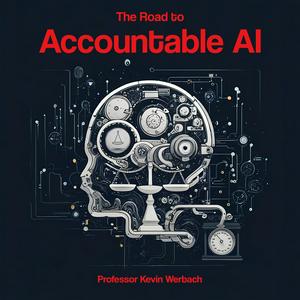
About The Road to Accountable AI
Artificial intelligence is changing business, and the world. How can you navigate through the hype to understand AI's true potential, and the ways it can be implemented effectively, responsibly, and safely? Wharton Professor and Chair of Legal Studies and Business Ethics Kevin Werbach has analyzed emerging technologies for thirty years, and created one of the first business school course on legal and ethical considerations of AI in 2016. He interviews the experts and executives building accountable AI systems in the real world, today.
Podcast websiteListen to The Road to Accountable AI, Unblinded with Sean Callagy and many other podcasts from around the world with the radio.net app
Get the free radio.net app
- Stations and podcasts to bookmark
- Stream via Wi-Fi or Bluetooth
- Supports Carplay & Android Auto
- Many other app features
Get the free radio.net app
- Stations and podcasts to bookmark
- Stream via Wi-Fi or Bluetooth
- Supports Carplay & Android Auto
- Many other app features

The Road to Accountable AI
Scan code,
download the app,
start listening.
download the app,
start listening.
 USA
USA