
Listen to this podcast in the app for free: Download for free in the App Store
radio.net
Sleep timer
Save favorites
436 episodes
5 Things That Keep Us Whole: Staying Grounded in an Unraveling World | Frankly 163
10/23/2026 | 16 mins.In the face of increasing chaos in our world, Nate turns inward in this week's Frankly to examine a more personal question: what allows an individual to remain grounded, authentic, and capable of contributing meaningfully in turbulent times? He draws on his own experience to identify five things that help him build personal resilience, taking care to not treat them as any sort of universal formula. Rather, Nate offers a systems-oriented perspective that recognizes that our capacity to engage with a complex world depends partly on the conditions that sustain us as human beings.
For Nate, those conditions begin with self-care and the knowledge that burning oneself out in service of an urgent – although perhaps just – cause undermines the work itself. He explores the need for both structured routines and slack that allows the mind and body to process experiences, rather than remain trapped in a constant state of simulation. He also discusses how time in nature and friendship help reconnect him to a deeper sense of belonging and self, and the importance of meaningful work that directs our time and energy toward the possibility of creating a better future than the default. Nate's five priorities form a sort of personal compass that allows him to navigate uncertainty without losing sight of what makes life worth living – he invites listeners to examine their own experiences in order to discover the conditions that help them show up more fully for themselves, their communities, and the future they hope to build.
What are five things from your own life that help you feel like your whole self? How might you redesign your daily life to create more space for the relationships, environments, and practices that sustain you? And if you had more of what genuinely grounds you, what meaningful work might you become capable of doing?
(Recorded October 21st, 2026)
Show Notes and More
Watch this video episode on YouTube
Want to learn the broad overview of The Great Simplification in 30 minutes? Watch our Animated Movie.
---
Support The Institute for the Study of Energy and Our Future
Join our Substack newsletter
Join our Hylo channel and connect with other listenersEarth's Oldest Teachers: How to Live Well on Earth with Robin Wall Kimmerer
10/21/2026 | 1h 25 mins.Many of us question the core principles of individualism, competition, and transaction our current civilization is founded on. But with an entire culture steeped in these ideals, we don't know where to look for a different way forward. Thankfully, against all odds, there are pockets of cultures who have preserved their knowledge and are able to share both what they know and who their greatest teachers are.
In this episode, Nate is joined by Robin Wall Kimmerer to explore what we can learn from some of Earth's oldest and smallest beings: plants. Robin weaves together her experience as a botanist and a Citizen Potawatomi Nation member to offer what she's learned about living well within nature's limits, including practices such as the Honorable Harvest and the importance of restraint and reciprocity. She also shares the Potawatomi prophecy of the Seventh Fire, in which humanity stands at a fork between a scorched path and a green one, and can only move forward by walking back to recover what was lost along the way. Robin frames this moment as the age of remembering – an invitation to restore the land and our relationship with it.
What can we learn from the long-term persistence of mosses, and how might it change our own definition of success? How might our relationship with the living world shift if our language treated plants and animals as fellow beings and kin rather than "it"? Lastly, if we reframed our ideas of abundance to be more focused on 'enoughness,' how would it change our choices and expectations for generations to come?
(Conversation recorded on September 24th, 2026)
About Robin Wall Kimmerer:
Robin Wall Kimmerer is a plant ecologist, bryologist, writer, and enrolled member of the Citizen Potawatomi Nation. She is a SUNY Distinguished Teaching Professor of Environmental Biology and the founder and director emeritus of the Center for Native Peoples and the Environment at SUNY College of Environmental Science and Forestry. Her research examines moss ecology, ecological restoration, Traditional Ecological Knowledge, and the restoration of culturally significant plants in partnership with Indigenous communities.
Kimmerer holds a BS in botany from SUNY ESF and an MS and PhD in botany from the University of Wisconsin. Her honors include a 2022 MacArthur Fellowship and the 2023 National Humanities Medal. Across her scientific and literary work, she seeks to braid Indigenous knowledge with Western science and to restore not only ecosystems, but the human relationships with land that determine how those ecosystems are treated.
Show Notes and More
Watch this video episode on YouTube
Want to learn the broad overview of The Great Simplification in 30 minutes? Watch our Animated Movie.
---
Support The Institute for the Study of Energy and Our Future
Join our Substack newsletter
Join our Hylo channel and connect with other listeners
---7 Rungs of a Runaway System: How Civilization Descended Into Crisis | Frankly 162
10/16/2026 | 29 mins.In this week's Frankly Nate unfurls a metaphorical "ladder" that traces the systems-oriented forces shaping the economic Superorganism. He outlines seven rungs that trickle down to affect the behaviors and events we witness in our daily lives, as well as reinforce humanity's dependence on energy and material growth. These rungs – such as worldview, status symbols, and incentives – help to illustrate that destructive outcomes need not emerge from malicious intent. They can arise from ordinary people responding rationally to the pressures of a system that produces globally irrational results.
Nate also confronts a deeper constraint – that the biological drives shaping human behavior cannot simply be redesigned. Our appetite for status, novelty, and relative advantage is deeply rooted, and yet history shows that the cultural scoreboards governing those drives can change. This shifts the focus from reacting to daily events toward reshaping the values and social signals that influence collective behavior. While the most visible problems occupy the surface of the system, Nate argues that the greatest leverage lies in the slower-moving structures and cultural assumptions beneath them. Understanding that distinction may offer a more useful map for deciding at which points to intervene.
How do values and status symbols affect the behavior of individuals living under the Superorganism? When you think of the responses to the metacrisis present in your own life, which rung of the ladder are they seeking to address? And what are the implications of the idea that the most slow-changing aspects of our society also hold the most leverage?
(Recorded October 13th, 2026)
Show Notes and More
Watch this video episode on YouTube
Want to learn the broad overview of The Great Simplification in 30 minutes? Watch our Animated Movie.
---
Support The Institute for the Study of Energy and Our Future
Join our Substack newsletter
Join our Hylo channel and connect with other listenersOptionality Collapse: We're Investing in a Future That Won't Exist with Indy Johar
10/14/2026 | 1h 28 mins.Traditional financial management tells us that, if we invest right, we'll be able to retire and sink into a future of comfort and stability – and even pass on your wealth to your children and grandchildren. But this vision is built on an anomalous period of stability in which climate, energy resources, and labor markets were all predictable. As ecological breakdown, resource conflict, and AI-driven labor disruption begin to feed into one another, that predictability is slipping away. How can we better position hundreds of trillions of dollars in claims on the future to withstand uncertainty in the increasingly volatile world ahead?
In this episode, Nate welcomes back Indy Johar, co-founder of Dark Matter Labs, for an exploration of how coupled systemic risks are reshaping capital, institutions, and what it means to invest for the future. Indy explains why most financial forecasting – built on linear, siloed models – misses the compounding, coupled crises we will have to face, and argues that "civilizational optionality" is diminishing, threatening the value of our claims on the future (money). Indy presents Expanding Civilizational Optionality (xCO), the initiative he is building at Dark Matter Labs, as a way to protect these claims, while also increasing the ability of societies to adapt, mitigate, and respond to crises from various directions. xCO combines a capital platform that lets money protect the futures it depends on, an option foundry that helps the people exposed to those risks build the demand and capability to act on them, and a learning and organizing infrastructure. Indy and Nate also discuss their deeper philosophies about humanity, emphasizing doubt and humility as critical mentalities for anyone attempting to navigate a future that will look very different from the past.
How much money is currently being saved for a future that isn't even available to buy? How might a "civilizational Sharpe ratio" – one that weighs returns against systemic volatility – change the way wealth is allocated, and broaden how we measure the capital returns? And if moments of crisis are when cultural narratives shift, what can each of us do now to cultivate the ideas, relationships, and courage needed to meet them?
(Conversation recorded on September 23rd, 2026)
About Indy Johar:
Indy Johar is the co-founder of Dark Matter Labs, where he is currently building Expanding Civilizational Optionality (xCO). He is a professor at RMIT University, and the Executive Director of Project 00. An architect by training, he is also Non-Executive Director of the WikiHouse Foundation and Bloxhub, as well as a Vision Keeper at The Collaborative for Systemic Climate action. He writes frequently on his Substack.
Show Notes and More
Watch this video episode on YouTube
Want to learn the broad overview of The Great Simplification in 30 minutes? Watch our Animated Movie.
---
Support The Institute for the Study of Energy and Our Future
Join our Substack newsletter
Join our Hylo channel and connect with other listenersHumanity's Icarus Moment: The Wings, the Sea, and the Sun of AI | Frankly 161
10/09/2026 | 59 mins.This week Nate examines artificial intelligence through the metaphor of Icarus, asking what risks arise when a civilization injects trillions of cognitive workers into a civilization that's already in resource overshoot. Emphasizing that our society already largely ignores the depleting fossil energy that powers our lives, Nate traces how AI could amplify our economic growth imperative rather than help us escape it. He also touches on optimization – how solving solely for efficiency erodes the robustness and slack that allow our human systems to adapt to energy and material descent.
The latter part of Nate's analysis turns toward risks related to power concentration and the downstream effects of increased societal integration of AI. He considers the long-term implications of trends like shrinking entry-level opportunities, mounting cognitive debt, and prose averaging out across research, media, and even everyday life. He also dives into potential nearer-term risks like the emergence of technofeudalism and decreasing costs of surveillance. Nate ends the episode by leaving the last risk unnamed, arguing that the most important consequence of transformative technology may be the one nobody can foresee.
How do AI "cognitive workers" interact with the logic of the economic Superorganism? What happens when a civilization optimized for growth without accounting for resilience introduces a technology such as AI? And can humanity choose a middle path when the systems driving AI are rewarded for extremes?
(Recorded September 27th, 2026)
Show Notes and More
Watch this video episode on YouTube
Want to learn the broad overview of The Great Simplification in 30 minutes? Watch our Animated Movie.
---
Support The Institute for the Study of Energy and Our Future
Join our Substack newsletter
Join our Hylo channel and connect with other listeners
More Earth Sciences podcasts
Trending Earth Sciences podcasts
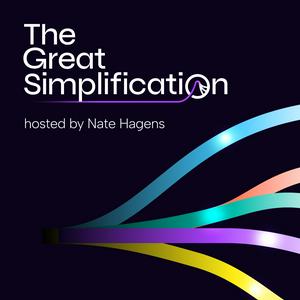
About The Great Simplification with Nate Hagens
The Great Simplification is a podcast that explores the systems science underpinning the human predicament. Through conversations with experts and leaders hosted by Dr. Nate Hagens, we explore topics spanning ecology, economics, energy, geopolitics, human behavior, and monetary/financial systems. Our goal is to provide a simple educational resource for the complex energetic, physical, and social constraints ahead, and to inspire people to play a role in our collective future. Ultimately, we aim to normalize these conversations and, in doing so, change the initial conditions of future events.
Podcast websiteListen to The Great Simplification with Nate Hagens, Care More Be Better: A Podcast For Sustainable Social Impact and Regeneration and many other podcasts from around the world with the radio.net app
Get the free radio.net app
- Stations and podcasts to bookmark
- Stream via Wi-Fi or Bluetooth
- Supports Carplay & Android Auto
- Many other app features
Get the free radio.net app
- Stations and podcasts to bookmark
- Stream via Wi-Fi or Bluetooth
- Supports Carplay & Android Auto
- Many other app features

The Great Simplification with Nate Hagens
Scan code,
download the app,
start listening.
download the app,
start listening.
 USA
USA