

Listen to this podcast in the app for free: Download for free in the App Store
radio.net
Sleep timer
Save favorites
51 episodes
When Caring Starts Wearing You Down
10/09/2026 | 25 mins.What happens when you still care about someone, but you are simply exhausted from caring? Compassion fatigue can leave caregivers, healthcare professionals, therapists, first responders, and family members feeling emotionally drained, irritable, detached, and guilty about feelings they may not understand.
In this episode of Off the Couch Psychology Podcast, you'll learn what compassion fatigue is, how it differs from burnout and secondary traumatic stress, and why constantly caring for others without enough recovery or support can begin affecting your own life. You'll also meet Rachel, a 40-year-old woman caring for a grandmother with dementia while receiving almost no help from the rest of her family. Her story shows how love, responsibility, exhaustion, resentment, and guilt can exist at the same time.
Most importantly, you'll learn practical ways to recognize compassion fatigue, protect your own well-being, ask for specific help, create healthier boundaries, and make caring for someone else more sustainable.
Key Takeaways
Recognize the warning signs of compassion fatigue before you reach complete exhaustion.
Understand the differences between compassion fatigue, burnout, and secondary traumatic stress.
Stop confusing exhaustion with a lack of love or compassion.
Ask others for specific, concrete help rather than waiting until you are overwhelmed.
Protect recovery time and maintain parts of your life outside caregiving.
Remember that sustainable caregiving includes caring for the caregiver.
Learn more and explore additional episodes at Quest-Success.com.
Suggested Reading & Research
Professional Quality of Life (ProQOL): Compassion Fatigue and Secondary Traumatic Stress — Resources explaining compassion fatigue, compassion satisfaction, burnout, and secondary traumatic stress.
What Do Family Caregivers of People With Dementia Need? — A systematic review examining support, information, education, and balance among dementia caregivers.
Becoming a Family Caregiver to a Person With Dementia — A literature review examining changing family roles, caregiver burden, respite, and the need for support.
Effects of Peer Support Interventions for Family Caregivers of Persons With Dementia — A 2026 systematic review and meta-analysis examining peer support and caregiver outcomes.
Themes Describing Social Isolation in Family Caregivers of People Living With Dementia — A review exploring isolation, psychological strain, social networks, and support among dementia caregivers.
Mentioned in This Episode
#SuperheroMovies #Caregiving #Dementia49 adjustment disorder
10/06/2026 | 26 mins.One week your life feels predictable. The next, a job loss, divorce, medical diagnosis, financial problem, or another major change leaves you wondering why you suddenly cannot handle things the way you normally do.
In this episode of Off the Couch Psychology Podcast, you'll learn what an adjustment disorder is, how it differs from the normal stress that follows a difficult life event, and what the symptoms can look like in everyday life. Through the story of Karen—a woman facing the loss of her 23-year career and her marriage at nearly the same time—you'll see how quickly major change can affect sleep, concentration, mood, anxiety, relationships, and daily functioning.
More importantly, you'll hear practical ways to begin moving forward when life changes faster than you can adjust.
Key Takeaways
How adjustment disorders can develop after an identifiable stressor
The major symptoms and different ways they can appear
Why struggling with change is not a measure of personal strength
How CBT and solution-focused brief therapy may help
Practical ways to rebuild routine and regain a sense of control
Why focusing on the next reasonable step can make a difference
Learn more and explore additional episodes at Quest-Success.com.
Suggested Reading & References
American Psychiatric Association. Diagnostic and Statistical Manual of Mental Disorders, Fifth Edition, Text Revision (DSM-5-TR). American Psychiatric Association Publishing.
Clear, James. Atomic Habits: An Easy & Proven Way to Build Good Habits & Break Bad Ones. Avery, 2018.
Salinger, J. D. The Catcher in the Rye. Little, Brown and Company, 1951.
O'Donnell, M. L., et al. "Adjustment Disorder: Current Developments and Future Directions." International Journal of Environmental Research and Public Health.
Mentioned in This Episode
#TheCatcherInTheRye #JDSalinger #AtomicHabits #JamesClearYour Body Can Calm Your Mind
10/02/2026 | 25 mins.What if calming your mind sometimes starts with your body?
In this crossover episode of Quest for Success Podcast and Off the Couch Psychology Podcast, Dr. Jerry Cunningham explores practical ways to use your body to change the intensity of what you're feeling. You'll learn why breathing, facial tension, movement, your senses, and even temperature can influence your emotional state—and what you can do when stress, anxiety, anger, or feeling overwhelmed starts taking control.
You'll discover the physiological sigh, the 5-4-3-2-1 grounding technique, facial feedback, temperature shifts, and simple movement strategies you can use in everyday life. More importantly, you'll learn how to recognize your body's warning signs before your emotions reach the point where your mouth starts making decisions your brain may have to apologize for later.
Key Takeaways
Use breathing to reduce physical arousal and regain control.
Recognize tension in your jaw, face, shoulders, and muscles as early warning signs.
Use your senses to interrupt emotional spirals and reconnect with the present.
Move your body when stress has created physical activation.
Create space between what you feel and what you do.
Practice these strategies before you desperately need them.
For more episodes and resources, visit Quest-Success.com.
Suggested Reading & Research
Yilmaz Balban, M., et al. (2023). "Brief Structured Respiration Practices Enhance Mood and Reduce Physiological Arousal." Cell Reports Medicine. This randomized controlled study examined several breathing practices and found that five minutes of daily breathwork, particularly exhale-focused cyclic sighing, was associated with improved mood and reduced respiratory rate.
Coles, N. A., Larsen, J. T., & Lench, H. C. (2019). "A Meta-Analysis of the Facial Feedback Literature: Effects of Facial Feedback on Emotional Experience Are Small and Variable." Psychological Bulletin. A useful scientific look at the facial-feedback hypothesis; importantly, the researchers found that the effects exist but tend to be small and vary across circumstances.
Levine, Peter A. — Waking the Tiger: Healing Trauma. Levine explores the relationship between trauma, bodily sensations, nervous-system responses, and body-based approaches to regulation.
Dialectical Behavior Therapy (DBT) Distress-Tolerance Skills. For listeners interested in going deeper, DBT provides a broader framework for managing periods of intense emotional arousal through practical distress-tolerance and regulation strategies.
People & Books Mentioned
#AndrewHuberman
#PeterLevine
#WakingTheTigerWhen a Child Cannot Trust
09/29/2026 | 32 mins.What happens when a child learns early in life that the people they need most cannot always be trusted?
In this episode of Off the Couch Psychology Podcast, you'll get a clearer understanding of Reactive Attachment Disorder (RAD), a condition associated with severe disruptions in early caregiving and a child's ability to form healthy attachments. You'll learn what RAD can look like beyond the labels of "defiant," "cold," or "unloving," and why some children may reject the very comfort they desperately need.
We'll look at what may be happening in the developing brain, how early neglect and unstable caregiving can shape a child's expectations of relationships, and why simply placing a child in a loving home may not immediately erase those lessons.
You'll also hear the disturbing story of Theodore, a troubled little boy who eventually became known to the world as Ted Bundy. His story raises an important question about childhood trauma and intervention while also reminding us that there is no documented RAD diagnosis for Bundy and that RAD does not predict serial violence.
Most importantly, you'll learn how consistent caregiving, professional treatment, family involvement, and repeated experiences of safety can help a child begin building something they may never have learned to expect: trust.
Key Takeaways
RAD involves much more than difficult or defiant behavior.
Severe neglect and disrupted caregiving can interfere with a child's ability to seek and accept comfort.
A safe home is important, but rebuilding trust can take time and repeated experiences of dependable care.
Treatment should involve qualified professionals and often includes caregivers as part of the process.
Coercive or frightening "attachment therapies" can be dangerous and should be avoided.
A child's difficult beginning does not determine the ending of their story.
For more episodes, resources, and information from Dr. Jerry Cunningham, visit Quest-Success.com.
Suggested Reading & Resources
American Academy of Child & Adolescent Psychiatry — Attachment Disorders
A family-focused resource for understanding attachment disorders and the importance of proper assessment.
AACAP Facts for Families: Attachment Disorders
Ellis, Yilanli & Saadabadi — "Reactive Attachment Disorder," StatPearls
A clinical overview covering symptoms, diagnostic criteria, evaluation, and management of RAD.
Read Reactive Attachment Disorder — StatPearls
American Academy of Child & Adolescent Psychiatry — Policy Statement on Coercive Interventions for Attachment Disorders
Important guidance concerning appropriate treatment and the dangers associated with coercive attachment interventions.
Read the AACAP Policy Statement
Boris & Zeanah — Practice Parameter for the Assessment and Treatment of Children and Adolescents With Reactive Attachment Disorder
A detailed professional resource on assessment, caregiver relationships, treatment, and attachment-focused care.
Read the AACAP Practice Parameter
People & Movies Mentioned
#TedBundy
#TheBoarder
#TroubledChildTherapy or Coaching: Which Do You Need?
09/25/2026 | 27 mins.Do you need help healing something from your past—or help figuring out what to do next?
Therapy and life coaching can both help people make meaningful changes, but they are not interchangeable. In this crossover episode of Quest for Success Podcast and Off the Couch Psychology Podcast, you'll discover where therapy and coaching differ, where they overlap, and why choosing the right kind of help matters.
Through real-world examples, humor, and a little Good Will Hunting, we'll look at how therapy can address emotional distress and unresolved issues while coaching can focus on goals, habits, performance, accountability, and forward movement. You'll also hear what can happen when a coaching conversation uncovers something deeper that may need the attention of a mental health professional.
Key Takeaways
How therapy and coaching serve different purposes
Why looking backward can sometimes help you move forward
When goal setting and accountability may be useful
When a coaching issue may actually require therapy
How therapy and coaching can sometimes complement each other
Questions to consider when deciding what kind of help you need
For more episodes and resources, visit Quest-Success.com.
Suggested Reading & Resources
American Psychological Association — Understanding Psychotherapy and How It Works — A practical overview of psychotherapy, what it addresses, and how the process works.
International Coaching Federation — Guide to Experiencing Coaching — Explains coaching, its focus on growth and goals, and important distinctions between coaching and therapy.
International Coaching Federation — Coaching vs. Therapy — A resource specifically addressing the differences and areas of overlap between the two approaches.
Atomic Habits — James Clear — The book discussed in this episode explores how small, consistent changes and better systems can produce meaningful behavior change. Learn more about Atomic Habits
American Psychological Association — How to Choose a Psychologist — Includes signs that professional psychological help may be appropriate and guidance on finding a psychologist.
Mentioned in This Episode
#GoodWillHunting #MichaelPhelps #SerenaWilliams #JamesClear #AtomicHabits #MattDamon #RobinWilliams
More Education podcasts
 The Table with Anthony ONealBusiness, Christianity, Education, Entrepreneurship, Investing, Religion & Spirituality, Self-Improvement
 Becoming UnDone® with Dr. Toby BrooksDocumentary, Education, Health & Wellness, Self-Improvement, Society & Culture
 The Mel Robbins PodcastEducation, Health & Wellness, Mental Health, Relationships, Self-Improvement, Society & Culture
 The Jamie Kern Lima ShowBusiness, Education, Entrepreneurship, Health & Wellness, Mental Health, Self-Improvement
 How to Be a Better HumanEducation, Self-Improvement
 Life KitBusiness, Education, Health & Wellness, Kids & Family, Self-Improvement
 IMO with Michelle Obama and Craig RobinsonEducation, Self-Improvement, Society & Culture
 Finding Peak with Ryan HanleyBusiness, Education, Entrepreneurship, Management, Self-Improvement
 Motivation Daily by MotiversityEducation, Health & Wellness, Self-Improvement
Trending Education podcasts
 This Is PurdueBusiness, Education, Marketing, Technology
 HerLearn Legacy PodcastEducation, Tutorials
 Grounded Wellness by Primally PureAlternative Health, Education, Health & Wellness, Self-Improvement
 Who Am I? PodcastEducation, Health & Wellness, Mental Health, Religion & Spirituality, Self-Improvement, Spirituality
 Maxwell Leadership PodcastBusiness, Education
 Silver Disobedience® Perception Dynamics with Dian Griesel: How People Think, Lead and SucceedEducation, Personal Journals, Self-Improvement, Society & Culture
 Science of Reading: The PodcastEducation, Science, Social Sciences, Tutorials
 No Dumb QuestionsEducation, Society & Culture
 Kill ComplacencyEducation, Self-Improvement
 Learning Easy EnglishEducation, Language Learning
 Spanish for BeginnersEducation, Language Learning
 Luke's ENGLISH Podcast - Learn British English with Luke ThompsonComedy, Education, Language Learning
 MARGARET ROACH A WAY TO GARDENEducation, Hobbies, Leisure, Natural Sciences, Science, Society & Culture, Sports
 The Rachel Hollis PodcastEducation, Relationships, Religion & Spirituality, Self-Improvement, Society & Culture, Spirituality, Tutorials
About Off the Couch Psychology
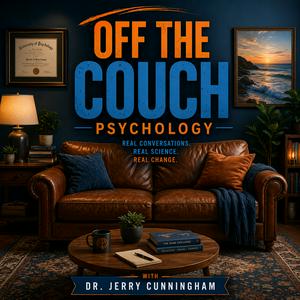
Off the Couch Psychology Podcast is your go-to source for understanding mental health, breaking the stigma around mental illness, and learning how to take control of your mind and your life.
Hosted by Dr. Jerry Cunningham, psychologist, author, and podcast host, this show breaks down complex psychological topics into real, practical conversations you can actually use in your everyday life.
Each episode explores mental health in a way that is clear, relatable, and grounded in real science. From anxiety, depression, ADHD, trauma, and burnout to cutting-edge psychological research and treatment approaches, you'll gain a deeper understanding of what's really going on in your mind—and what you can do about it.
This isn't therapy—but it might be the closest thing you can get in your car, at the gym, or sitting on your couch.
If you've ever struggled with stress, overthinking, emotional exhaustion, or just found yourself wondering, "What is going on in my mind?"—this podcast is for you.
You'll learn:
• How anxiety, depression, and other mental health disorders actually work
• Evidence-based therapy approaches that professional use and coping strategies you can use
• How to manage stress, overthinking, and emotional overwhelm
• Information about mental health medications and treatment options
• Practical tools to improve your mental health and daily life
This podcast is designed to educate, motivate, and empower you to take action—because understanding your mind is the first step to changing your life.
Podcast websiteListen to Off the Couch Psychology, The Table with Anthony ONeal and many other podcasts from around the world with the radio.net app
Get the free radio.net app
- Stations and podcasts to bookmark
- Stream via Wi-Fi or Bluetooth
- Supports Carplay & Android Auto
- Many other app features
Get the free radio.net app
- Stations and podcasts to bookmark
- Stream via Wi-Fi or Bluetooth
- Supports Carplay & Android Auto
- Many other app features

Off the Couch Psychology
Scan code,
download the app,
start listening.
download the app,
start listening.
 USA
USA