

Listen to this podcast in the app for free: Download for free in the App Store
radio.net
Sleep timer
Save favorites
120 episodes
Rethinking Purpose
09/20/2026 | 41 mins.These days, it seems like advice for how to “find your purpose” is everywhere. But what if purpose isn’t some hidden answer waiting to be found? And what if anxiously searching for our one true calling actually makes it harder to live with purpose?
On this episode, we explore some other approaches to the problem. Clinical psychologist Ross White tells us about how psychological flexibility can help us form purpose over time, and stay connected to it, even as our lives change. And we talk to philosopher Edward Slingerland about what early Chinese thinkers like Confucius and Zhuangzi would have made of our modern obsession with inventing a meaningful path from scratch.
Ross White is an Honorary Professor of Clinical Psychology at Queen’s University, Belfast and the Founding Director of Strive2Thrive. He is the author of the book The Tree That Bends: How a flexible mind can help you thrive, as well as the article “Your purpose isn’t something you find, it’s something you form.”
Edward Slingerland is a Professor of Philosophy at the University of British Columbia and a Visiting Professor in the Department of Religion at Dartmouth. He is the author of many books, including Trying Not to Try and the forthcoming title, Learning to See: Literature, Moral Perception and Early Confucian Virtue Ethics. Find out more about his work on his website.Season 11 Trailer
09/13/2026 | 3 mins.Join us for Season 11 of How God Works, starting next week!HGW Presents: Oh God Now What
08/23/2026 | 45 mins.How God Works will be back with all new episodes in September. In the meantime, we're excited to feature an episode from our friends at Oh God Now What, hosted by Niala Boodhoo.
*
In the debut episode, "Voting Your Morals," host Niala Boodhoo welcomes public theologian Curtis Chang and Rabbi Jill Jacobs. Using their expertise as religious thought leaders, they help us navigate aligning beliefs with how we vote. And they offer perspective and tools for strengthening democracy outside of high-stakes elections.
Chang is the Executive Director of Good Faith, which helps politically ‘homeless’ Christians navigate a deeply divided world. Rabbi Jacobs is the CEO of T’ruah, which empowers rabbis and cantors to lead Jewish communities in advancing democracy and human rights.Bonus Episode: God, Code, and Consciousness (Aspen Ideas)
08/02/2026 | 45 mins.As humans increasingly turn to AI for moral guidance and answers to life’s biggest questions, the lines between technology and religion are blurring—even leading some in Silicon Valley to wonder if AI might have a spiritual life of its own or be destined to change the world’s religious landscape. What does the impulse to see a god in the machine reveal about our enduring hunger for meaning, belonging, and spiritual growth?
Dave explores these questions and more with psychologist Paul Bloom, author Elizabeth Oldfield, and theologian Paolo Benanti in a discussion recorded live at the 2026 Aspen Ideas Festival.
Paul Bloom is a professor of psychology at the University of Toronto and the Brooks and Suzanne Ragen Professor Emeritus of Psychology at Yale University. He's also the author of seven books, including his latest “Psych: The Story of the Human Mind.”
Elizabeth Oldfield hosts “The Sacred” podcast, dedicated to conversations about being human, finding wisdom, building a more tolerant society, and what spirituality and religion might offer in answer to those questions. She is also the author of Fully Alive: Tending to the Soul in Turbulent Times.
Paolo Benanti is a professor of moral philosophy at Luiss Guido Carli University in Rome and a professor of technology ethics at Seattle University. A Franciscan priest and leading global voice on AI ethics, he advises the Vatican on emerging technologies and the rise of generative AI and chatbots.Aliens and Spirituality (Encore Presentation)
07/12/2026 | 34 mins.Religion is often about powerful beings coming down from the skies and humans yearning to go up to join them. Does that mean we can swap aliens in for God? More and more people seem to think so. In fact, many spiritually-minded people are looking to UFOs as opportunities to commune with enlightened alien teachers. Some believe they’re even aliens themselves, sent here to prepare us for a new age. But when religion gets mixed with conspiracy theory, things can sometimes take a darker turn.
Join Dave as he speaks with religious studies professor Diana Walsh Pasulka, about what belief in UFOs might share with other religions, and with anthropologist Susannah Crockford about how and why conspiracy theories are giving rise to a new spiritual movement.
Diana Walsh Pasulka is the author of Encounters: Experiences with Nonhuman Intelligence and American Cosmic: UFOs, Religion, Technology. Find out more about her work on her website.
Susannah Crockford is the author of Ripples of the Universe: Spirituality in Sedona, Arizona, and the host of the show Miss Information, a podcast about the ways online misinformation and conspiracy theories infiltrate wellness communities and conservative Christian spaces.
More Philosophy podcasts
 The Art of ManlinessEducation, Philosophy, Society & Culture
 The Gray Area with Sean IllingNews, Philosophy, Politics, Society & Culture
 Dear Hank & JohnComedy, Education, Improv, Philosophy, Self-Improvement, Society & Culture
 ConspiritualityPhilosophy, Religion & Spirituality, Science, Social Sciences, Society & Culture, Spirituality
 Alan Watts Being in the WayEducation, Philosophy, Religion & Spirituality, Self-Improvement, Society & Culture, Spirituality
 Within ReasonPhilosophy, Religion & Spirituality, Society & Culture
 Philosophize This!Education, Philosophy, Society & Culture
 Conversations with ColemanPhilosophy, Society & Culture
 Macrodosing: Arian Foster and PFT CommenterPhilosophy, Society & Culture
 Theories of the Third KindDocumentary, History, Philosophy, Society & Culture, True Crime
Trending Philosophy podcasts
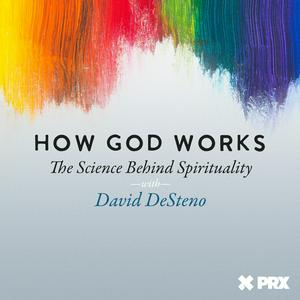
About How God Works: The Science Behind Spirituality
While religion and science often seem at odds, there’s one thing they can agree on: people who take part in spiritual practices tend to live longer, healthier, and happier lives. The big question is: Why? In How God Works, professor Dave DeSteno takes us on a journey to find out how spirituality impacts our minds and bodies, as well as the world in which we live.He speaks to leading scientists and philosophers, religious thinkers, and thought leaders to explore what we can learn from the world’s faith traditions to help us meet some of life’s biggest challenges. Along the way, he’ll look at how we can adapt and use spiritual practices in our own lives, whatever our beliefs, including none at all.It’s by working across the boundaries that usually divide us – science versus religion, one faith versus another – that we’ll find new ways to make life better for everyone.
Podcast websiteListen to How God Works: The Science Behind Spirituality, The Art of Manliness and many other podcasts from around the world with the radio.net app
Get the free radio.net app
- Stations and podcasts to bookmark
- Stream via Wi-Fi or Bluetooth
- Supports Carplay & Android Auto
- Many other app features
Get the free radio.net app
- Stations and podcasts to bookmark
- Stream via Wi-Fi or Bluetooth
- Supports Carplay & Android Auto
- Many other app features
How God Works: The Science Behind Spirituality
Scan code,
download the app,
start listening.
download the app,
start listening.
How God Works: The Science Behind Spirituality: Podcasts in Family
 USA
USA