

Listen to this podcast in the app for free: Download for free in the App Store
radio.net
Sleep timer
Save favorites
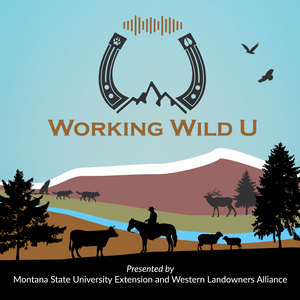
Working Wild U
Western Landowners Alliance and Montana State University Extension
Latest episode
38 episodes
Can a Town Really Be Bear-Proof?
09/01/2026 | 28 mins.After a visit to an elementary school in Wyoming that practices "bear drills," we head to Gardiner, Montana, where living alongside grizzlies is part of daily life.
There, Evan Stout with Bear Awareness Gardiner shows us what it takes for a community to become bear-aware—and find surprising parallels between living with grizzlies in town and on working lands.
Show notes
—
Topics discussed: Bear Awareness Gardiner, Bear Smart Communities, community-led conflict reduction, bear-resistant trash and attractant management, electric fencing, fruit trees and gleaning, community education and buy-in, tourism and wildlife, funding for conflict reduction
Featuring: Elise Cole (teacher at Wapiti Elementary, where bear drills are a daily routine, also a rancher), Evan Stout (Bear Awareness Gardiner and owner of Yellowstone Wildlife Guide Company)
—
Cover image: View of the Wapiti Elementary playground through a 6ft tall fence, where students regularly practice "bear drills" after a grizzly wandered by the school's front door in 2024. Credit: Zach Altman
Working Wild University is a production of Western Landowners Alliance and Dr. Jared Beaver of Montana State University Extension, and a proud part of Natural Resources University podcast network.
Hosted by Hallie Mahowald and Jared Beaver; Produced by Matt Collins and Zach Altman; Editing by Kathleen Shannon and Zach Altman; Executive producers: Louis Wertz, Jared Beaver, Hallie Mahowald and Erik Kalsta.Where are the Grizzly Bears Headed?
08/25/2026 | 51 mins.Grizzly management update: What's really going on with the USFWS new proposed grizzly rule
As grizzlies expand across the Northern Rockies, we're revisiting a story from last season that helps connect the dots.
We head to southwest Montana, where ranchers Jami Murdoch and Erik Kalsta are monitoring grizzlies and other wildlife moving through their working lands. Along with Blackfeet rancher Kristen Kipp and federal and state wildlife experts, we explore what grizzly recovery really entails - and what it takes for bears and people to share the landscape.
Note: This episode was first released in January 2024 as part of our second season about community and landowner-led endangered species recovery.
Show Notes
__
Working Wild University is a production of Western Landowners Alliance and Dr. Jared Beaver of Montana State University Extension, and a proud part of Natural Resources University podcast network.
Hosted by Hallie Mahowald and Jared Beaver; Produced and edited by Zach Altman; Executive producers: Louis Wertz, Jared Beaver, Hallie Mahowald and Erik Kalsta.Why Did the Grizzly Bear Cross the Road?
08/20/2026 | 25 mins.Working lands help give expanding grizzly populations room to roam - but highways can turn those connected landscapes into isolated islands.
In this episode, we follow the movement of grizzlies across the Northern Rockies and explore how roads can become barriers to bears and other wildlife. From a bear that approached I-90 47 times before finally crossing, to a stretch of Highway 93 in Montana where vehicle collisions are a major source of grizzly mortality, we dig into the science of what grizzlies need to cross a road.
Environmental journalist and author Ben Goldfarb takes us into the emerging field of road ecology, while wildlife managers with the Confederated Salish and Kootenai Tribes and the US Fish & Wildlife Service show us how wildlife crossings can reconnect habitat and make highways safer for people and animals.
But a crossing is only as useful as the land it connects. What will it take to keep those landscapes intact, too?
Show notes
—
Topics discussed: grizzly bear habitat connectivity, wildlife-vehicle collisions, road ecology, wildlife crossings and overpasses, Banff National Park wildlife crossings, private working lands and habitat connectivity, conservation easements and land stewardship, the economics of wildlife crossings, funding for wildlife crossing infrastructure
Featuring: Hilary Cooley (Grizzly Bear Recovery Coordinator, USFWS), Ben Goldfarb (author of Crossings: How Road Ecology Is Shaping the Future of Our Planet), Payton Adams (Wildlife Biologist, Confederated Salish and Kootenai Tribes), Kari Kingery (Wildlife Program Manager, Confederated Salish and Kootenai Tribes).
—
Cover image: The Peter Lougheed Wildlife Overpass in Alberta has led to an 80% reduction in animal-vehicle collisions. Courtesy DIALOG.
Working Wild University is a production of Western Landowners Alliance and Dr. Jared Beaver of Montana State University Extension, and a proud part of Natural Resources University podcast network. Hosted by Hallie Mahowald and Jared Beaver; Produced by Zach Altman; Editing by Kathleen Shannon and Zach Altman; Executive producers: Louis Wertz, Jared Beaver, Hallie Mahowald and Erik Kalsta.Ranching with Grizzlies in Wyoming's Upper Green
08/11/2026 | 32 mins.What if keeping cattle on public lands is also helping keep critical wildlife habitat intact?
In Wyoming's Upper Green, ranchers move cattle along the historic Green River Drift through one of the epicenters of livestock-grizzly conflict in the Northern Rockies. Public grazing helps sustain private ranchlands—including critical river bottoms and winter range that keep this landscape connected for wildlife.
As grizzlies recover, the challenge of keeping ranches viable while maintaining habitat for wildlife is growing. We ride with a range rider and hear from ranchers and wildlife managers about what it takes to keep working lands, rural livelihoods, and grizzlies on the same landscape.
Show notes
—
Topics discussed: Green River Drift, Upper Green River Cattle Association, public lands grazing, private ranchlands and wildlife habitat, Greater Yellowstone Ecosystem, grizzly bear recovery and livestock conflict, calf depredation and livestock losses, range riding, wildlife migration corridors, ranch economics and land development, compensation for livestock losses, conflict reduction tools, grizzly bear management, the Four Cs of conflict reduction
Featuring: Brittany Hesseltine (foreman and range rider for the Upper Green River Cattle Association), Albert Sommers (fourth-generation Upper Green rancher, former president of the Upper Green River Cattle Association, Wyoming legislator and former Speaker of the Wyoming House), Coke Landers (president of the Upper Green River Cattle Association and rancher), Dan Thompson (large carnivore supervisor with Wyoming Game and Fish), Matt Collins (Working Wild Challenge Manager, Western Landowners Alliance)
—
Cover image by Matt Collins
Working Wild University is a production of Western Landowners Alliance and Dr. Jared Beaver of Montana State University Extension, and a proud part of Natural Resources University podcast network.
Hosted by Hallie Mahowald and Jared Beaver; Produced by Matt Collins and Zach Altman; Editing by Kathleen Shannon and Zach Altman; Executive producers: Louis Wertz, Jared Beaver, Hallie Mahowald and Erik Kalsta.Beyond Yellowstone: Grizzlies, the Craighead Brothers, and the Rise of Modern Wildlife Ecology
08/04/2026 | 29 mins.The Greater Yellowstone Ecosystem is one of the defining concepts in wildlife conservation. But where did it come from?
In the 1950s, Frank and John Craighead pioneered modern grizzly bear research, using radio telemetry to follow bears far beyond the boundaries of Yellowstone National Park. Their work revealed that grizzlies depended on a much larger, connected landscape (including working lands) and helped introduce the concept of the Greater Yellowstone Ecosystem - an idea that continues to guide wildlife conservation and grizzly bear management today.
Show notes
—
Topics discussed: Frank and John Craighead, Aldo Leopold's 'Sand County Almanac', the birth of the Greater Yellowstone Ecosystem as a concept, pioneering grizzly bear research and "cowboy biology," Yellowstone's garbage dumps, the rise of ecosystem-based conservation, radio telemetry and grizzly bear research, Craighead Institute, the conflict between the Craigheads and the National Park Service, the legacy of the Craigheads' work, Endangered Species Act, Yellowstone's role in wildlife conservation
Featuring: Dan Flores (Western historian, author of Wild New World, host of Meateater's The American West, Dan Tyres ( Greater Yellowstone Ecosystem grizzly bear habitat coordinator for the U.S. Forest Service, adjunct professor at Montana State University), Kerry Gunther (Bear Management Biologist for Yellowstone National Park).
—
Cover art: courtesy of the Craighead Institute
Working Wild University is a production of Western Landowners Alliance and Dr. Jared Beaver of Montana State University Extension, and a proud part of Natural Resources University podcast network.
Hosted by Hallie Mahowald and Jared Beaver; Produced by Zach Altman; Editing by Kathleen Shannon and Zach Altman; Executive producers: Louis Wertz, Jared Beaver, Hallie Mahowald and Erik Kalsta. Special thanks to the Archives and Special Collections at Montana State University Library for granting access to the Frank Craighead Collection.
More Natural Sciences podcasts
 DarkHorse PodcastNatural Sciences, News, Politics, Science, Society & Culture
 The Common Descent PodcastEducation, Natural Sciences, Science
 Daniel and Kelly’s Extraordinary UniverseNatural Sciences, Science
 Sasquatch ChroniclesNatural Sciences, Science, Society & Culture
 BrainStuffNatural Sciences, Science, Technology
 Weather GeeksNatural Sciences, News, Science
 RadiolabDocumentary, History, Natural Sciences, Science, Society & Culture
 BirdNote DailyEducation, Natural Sciences, Nature, Science, Tutorials
 In Defense of Plants PodcastNatural Sciences, Science
 Outside/InDocumentary, Natural Sciences, Nature, Science, Society & Culture
Trending Natural Sciences podcasts
About Working Wild U
Working Wild U takes you out into the field, forest and range with the people and wildlife of the American West to tell you the big stories at the heart of the struggle to sustain resilient and connected landscapes and communities. We share immersive stories at the crossroads of culture and science focused on the challenges and successes of sharing and managing farms and ranches with wildlife.
If you are passionate about open spaces, wild places and healthy communities that sustain people and wildlife, listen in.
Podcast websiteListen to Working Wild U, DarkHorse Podcast and many other podcasts from around the world with the radio.net app
Get the free radio.net app
- Stations and podcasts to bookmark
- Stream via Wi-Fi or Bluetooth
- Supports Carplay & Android Auto
- Many other app features
Get the free radio.net app
- Stations and podcasts to bookmark
- Stream via Wi-Fi or Bluetooth
- Supports Carplay & Android Auto
- Many other app features
Working Wild U
Scan code,
download the app,
start listening.
download the app,
start listening.
 USA
USA