

Listen to this podcast in the app for free: Download for free in the App Store
radio.net
Sleep timer
Save favorites
23 episodes
Alfred Hitchcock, Part 1: Becoming the Master of Suspense — Fear, Power, and the Fight for Control
10/13/2026 | 1h 26 mins.Before he became the Master of Suspense, Alfred Hitchcock had to start somewhere. He started in a British film industry struggling to survive — and in a fight for control that would carry him all the way to Hollywood.
Continuing our October Halloween series, this is Part 1 of our three-part look at the life of Alfred Hitchcock.
Over half a century, Alfred Hitchcock perfected the art of suspense, becoming one of the most celebrated filmmakers who ever lived and earning a title that still belongs to him and him alone: the Master of Suspense.
But before he got there, before Rear Window, Vertigo, North by Northwest, and Psycho, he had to break free of a small, strictly ordered world, find his way into pictures, and turn his own fears into something he could use.
This episode follows Hitchcock from his 1899 birth in Leytonstone to his first job in pictures, designing title cards for silent films at a London studio, where he met Alma Reville — the editor who would become his wife and lifelong collaborator. From there, he became one of Britain's leading filmmakers through The Lodger, Blackmail, The 39 Steps, and The Lady Vanishes.
In 1939, David O. Selznick brought Hitchcock to Hollywood. His first American film, Rebecca, became an Oscar-winning hit — but its making also introduced him to a producer determined to control every detail. Over the next decade, as Selznick loaned him to other studios, Hitchcock directed Foreign Correspondent, Mr. & Mrs. Smith, Suspicion, Shadow of a Doubt, Lifeboat, Spellbound, and Notorious, working with Cary Grant, Ingrid Bergman, Joan Fontaine, Carole Lombard, and more of Hollywood's biggest stars.
By the end of the 1940s, Hitchcock had made himself one of Hollywood's most successful directors. But he still did not have the control he wanted. Free of Selznick at last, he was about to begin chasing it.
Part 2 of our Alfred Hitchcock series — following Hitchcock's first attempt at Hollywood independence and the extraordinary run that made his name synonymous with suspense — releases next Tuesday, October 20.
—
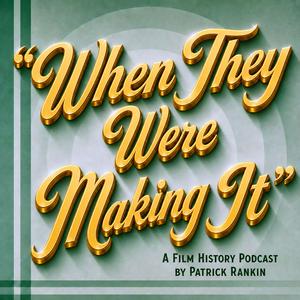
When They Were Making It is written, produced, and hosted by Patrick Rankin. Original artwork by Simone Beech and original music by Lionel Ziblat.
Join WTWMI: The Backlot — our Patreon — for exclusive extras including mini and full-length bonus episodes, episode companion pieces, and behind-the-scenes materials at https://www.patreon.com/WhenTheyWereMakingIt.
For episode information, show notes, upcoming episodes, and more, visit whentheyweremakingit.com.
Follow WTWMI on Instagram and TikTok: @whentheyweremakingit. On Instagram, we share visual companion pieces for every episode, bringing the images, people, places, and atmosphere behind the story to life.
New episodes of When They Were Making It drop every Tuesday. Follow now wherever you get your podcasts.
★ Support this podcast on Patreon ★Fay Wray & King Kong (1933): The Making of the Original Scream Queen — RKO, Damsels in Distress, and Hollywood's Impossible Spectacle
10/06/2026 | 1h 36 mins.The first in our October Halloween series: four weeks of classic Hollywood's darker, stranger, and more monstrous stories.
Fay Wray was already one of Hollywood's busiest young leading ladies when RKO cast her in King Kong. She had risen from Hal Roach shorts and the WAMPAS Baby Stars to Erich von Stroheim's The Wedding March, then made a name in the fast, precarious world of early-1930s pictures.
This episode follows Wray from her poverty-stricken childhood in Canada and early years in Hollywood through the silent era, Paramount, multiple leading lady roles, The Most Dangerous Game, and the extraordinary production that put her in the hand of a giant ape.
Alongside Wray's story is the making of that production, King Kong: Merian C. Cooper and Ernest B. Schoedsack's grand RKO gamble, Willis O'Brien's stop-motion effects, Ruth Rose's screenplay, Max Steiner's score, the Empire State Building, and the film's event-scale 1933 release.
King Kong made Fay Wray famous in a way no other role did — but not immediately in the way Hollywood stardom is supposed to work. Over the decades, through reissues, television, and the film's growing reputation, one job among many came to define her public life — whether she wanted it to or not.
From the original film's influence on Godzilla to the 1976 remake with Jessica Lange and Peter Jackson’s 2005 version with Naomi Watts, this is the story of Fay Wray, King Kong, and the image that made them both immortal.
—
When They Were Making It is written, produced, and hosted by Patrick Rankin. Original artwork by Simone Beech and original music by Lionel Ziblat.
Join WTWMI: The Backlot — our Patreon — for exclusive extras including mini and full-length bonus episodes, episode companion pieces, and behind-the-scenes materials at https://www.patreon.com/WhenTheyWereMakingIt.
For episode information, show notes, upcoming episodes, and more, visit whentheyweremakingit.com.
Follow WTWMI on Instagram and TikTok: @whentheyweremakingit. On Instagram, we share visual companion pieces for every episode, bringing the images, people, places, and atmosphere behind the story to life.
New episodes of When They Were Making It drop every Tuesday. Follow now wherever you get your podcasts.
★ Support this podcast on Patreon ★Edward G. Robinson: Hollywood's Literal OG — Little Caesar, the Blacklist Era, and the Man Behind the Movie Gangster
09/29/2026 | 1h 26 mins.Edward G. Robinson helped invent the modern movie gangster. As Rico Bandello in Little Caesar, he made the short, sharp-eyed criminal not only the centre of a Hollywood picture, but a defining figure in American pop culture. And in doing so, he became a star almost overnight.
This episode follows Robinson from his early years as Emanuel Goldenberg, a Romanian Jewish immigrant and serious Broadway actor, through Little Caesar, the Warner Bros. gangster cycle, and his long fight to prove he could be more than Rico. Along the way came The Whole Town's Talking, Confessions of a Nazi Spy, Double Indemnity, The Woman in the Window, Scarlet Street, and Key Largo.
Also along the way came the House Un-American Activities Committee — HUAC — and the threat of the Hollywood blacklist.
Robinson was never a Communist, but his public support for liberal and anti-fascist causes made him a target. He was not formally blacklisted, but "graylisted" — pushed from major pictures into smaller films and television.
What began as a fight to be seen as more than the gangster became a fight to remain in Hollywood at all.
This is the story of Edward G. Robinson — one of Hollywood's greatest screen actors, far more than the role that made him famous — and of his fight not only to build a career beyond the gangster, but eventually to save it when Hollywood decided he was through.
—
When They Were Making It is written, produced, and hosted by Patrick Rankin. Original artwork by Simone Beech and original music by Lionel Ziblat.
Join WTWMI: The Backlot — our Patreon — for exclusive extras including mini and full-length bonus episodes, episode companion pieces, and behind-the-scenes materials at https://www.patreon.com/WhenTheyWereMakingIt.
For episode information, show notes, upcoming episodes, and more, visit whentheyweremakingit.com.
Follow WTWMI on Instagram and TikTok: @whentheyweremakingit. On Instagram, we share visual companion pieces for every episode, bringing the images, people, places, and atmosphere behind the story to life.
New episodes of When They Were Making It drop every Tuesday. Follow now wherever you get your podcasts.
★ Support this podcast on Patreon ★Judy Garland's A Star Is Born (1954): Hollywood's Most Complicated Comeback — A Fragile Icon, Studio Butchering, and an Infamous Oscar Upset
09/22/2026 | 1h 33 mins.By 1950, MGM was done with Judy Garland — and so, it seemed, was Hollywood. A Star Is Born was the film that was supposed to change all of that.
After a devastating breakdown, the end of her studio contract, and an industry convinced she was finished, Garland spent the next two years rebuilding herself — on concert stages in London, Dublin, and New York. By 1952, she and her husband-manager, Sid Luft, were betting everything on one extraordinary project.
This episode follows the making of the 1954 musical remake of A Star Is Born — the second of four A Star Is Born films, later remade with Barbra Streisand and Kris Kristofferson in 1976, and with Lady Gaga and Bradley Cooper in 2018.
The picture was designed to bring Garland back to Hollywood. It traces the unlikely partnership behind it: Luft, an ambitious outsider with little producing experience; George Cukor, one of Hollywood's most respected directors; Warner Bros.; and a cast led by Garland and James Mason as the rising Esther Blodgett and the fading star Norman Maine.
From the search for a leading man — including George Cukor's pursuit of Cary Grant — to the arrival of Mason, Harold Arlen and Ira Gershwin's songs, and the creation of 'The Man That Got Away,' A Star Is Born became far more ambitious than a simple remake: a lavish CinemaScope musical, a personal comeback vehicle, and one of the most closely watched productions in Hollywood.
But the production was troubled almost from the beginning. Eight days into filming, Warner Bros. abandoned its new widescreen process and ordered the film restarted. The shoot stretched across nine months, the budget more than doubled, and Garland's ongoing struggles with exhaustion and prescription medication collided with the immense pressure of carrying a major studio picture.
And yet, the work on screen was remarkable.
When A Star Is Born premiered in September 1954, critics hailed Garland's performance as the triumph everyone had hoped for. The film was a major event, drawing rapturous reviews and positioning Garland as the frontrunner for the Academy Award for Best Actress.
But the triumph wouldn't last.
This is the story of Judy Garland's great screen comeback: the film that proved exactly what she could do, the studio decisions that changed its fate, and the decades-long effort to recover the lost version audiences had fallen in love with.
—
When They Were Making It is written, produced, and hosted by Patrick Rankin. Original artwork by Simone Beech and original music by Lionel Ziblat.
Join WTWMI: The Backlot — our Patreon — for exclusive extras including mini and full-length bonus episodes, episode companion pieces, and behind-the-scenes materials at https://www.patreon.com/WhenTheyWereMakingIt.
For episode information, show notes, upcoming episodes, and more, visit whentheyweremakingit.com.
Follow WTWMI on Instagram and TikTok: @whentheyweremakingit. On Instagram, we share visual companion pieces for every episode, bringing the images, people, places, and atmosphere behind the story to life.
New episodes of When They Were Making It drop every Tuesday. Follow now wherever you get your podcasts.
★ Support this podcast on Patreon ★Veronica Lake: The Making and Unmaking of a Movie Star — Film Noir Stardom, a Fallen-Star Story, and the Woman Behind It All
09/15/2026 | 1h 15 mins.Veronica Lake was one of the most unforgettable faces of 1940s Hollywood: blonde, beautiful, elusive, with a curtain of hair falling across one eye. Paramount turned that image into a sensation. But behind the "Peek-a-Boo Girl" was Constance Ockelman — a young actress whose life was far more complicated than either the glamour or the later downfall headlines allowed.
From Brooklyn, Saranac Lake, Miami, and, finally, Beverly Hills, Lake arrived in Hollywood as a teenager and drifted through a handful of small parts before Paramount saw something different in her. For I Wanted Wings, the studio gave Constance Keane a new name, a new look, and a nightclub role that made audiences take notice. Veronica Lake was born.
This episode follows Lake through her remarkable early rise: Sullivan's Travels with Preston Sturges and Joel McCrea; the creation of the Peek-a-Boo Girl phenomenon; and the dark, charged crime pictures that paired her with Alan Ladd, including This Gun for Hire, The Glass Key, and The Blue Dahlia. It explores how Lake became one of the defining women of the emerging film-noir cycle — cool, funny, watchful, and never quite as easy to read as Paramount's publicity suggested.
It also looks behind the image: a difficult first marriage, the loss of her infant son, her growing reputation as a difficult star, wartime stardom, and the series of professional and personal blows that slowly changed Lake's place at Paramount. By the end of the 1940s, the studio that had built her into a star had chosen not to renew her contract.
What followed was not one simple collapse, however much the newspapers later preferred that version. Lake kept working — in live television, regional theatre, touring productions, and low-budget films — while navigating financial hardship, troubled marriages, alcoholism, and long periods of uncertainty.
Then, in 1962, an Associated Press reporter recognized Veronica Lake working as a cocktail waitress at Manhattan's Martha Washington Hotel. The resulting headlines turned her into a national fallen-star spectacle. Lake herself saw it differently.
This is the story of the actress behind one of Hollywood's most enduring images: the woman Paramount made famous, the performer audiences too often underestimated, and the person who kept finding a way forward long after the cameras had moved on.
—
When They Were Making It is written, produced, and hosted by Patrick Rankin. Original artwork by Simone Beech and original music by Lionel Ziblat.
Join WTWMI: The Backlot — our Patreon — for exclusive extras including mini and full-length bonus episodes, episode companion pieces, and behind-the-scenes materials at https://www.patreon.com/WhenTheyWereMakingIt.
For episode information, show notes, upcoming episodes, and more, visit whentheyweremakingit.com.
Follow WTWMI on Instagram and TikTok: @whentheyweremakingit. On Instagram, we share visual companion pieces for every episode, bringing the images, people, places, and atmosphere behind the story to life.
New episodes of When They Were Making It drop every Tuesday. Follow now wherever you get your podcasts.
★ Support this podcast on Patreon ★
More Film History podcasts
Trending Film History podcasts
About When They Were Making It
The real human stories behind classic Hollywood's greatest films and legends.
Marilyn Monroe. Casablanca. Audrey Hepburn. The Wizard of Oz. Charlie Chaplin. Breakfast at Tiffany's. Alfred Hitchcock. Sunset Boulevard.
What do they all have in common?
They had to make it first.
Each week, we go beyond the legend to explore classic Hollywood's biggest icons and most beloved films.
Not the myths. Not the takedowns. The whole human story.
From the silent era to the early 1960s — the people, the films, and the impossible work of becoming a legend.
WTWMI is written, produced, and hosted by Patrick Rankin. Original artwork by Simone Beech and original music by Lionel Ziblat.
A new chapter every Tuesday. Follow wherever you get your podcasts.
Podcast websiteListen to When They Were Making It, The Plot Thickens and many other podcasts from around the world with the radio.net app
Get the free radio.net app
- Stations and podcasts to bookmark
- Stream via Wi-Fi or Bluetooth
- Supports Carplay & Android Auto
- Many other app features
Get the free radio.net app
- Stations and podcasts to bookmark
- Stream via Wi-Fi or Bluetooth
- Supports Carplay & Android Auto
- Many other app features
When They Were Making It
Scan code,
download the app,
start listening.
download the app,
start listening.
When They Were Making It: Podcasts in Family
 USA
USA